靡
| ||||||||
Translingual
Han character
靡 (Kangxi radical 175, 非+11, 19 strokes, cangjie input 戈金中一卜 (ICLMY) or 戈木中一卜 (IDLMY), four-corner 00211, composition ⿸麻非)
References
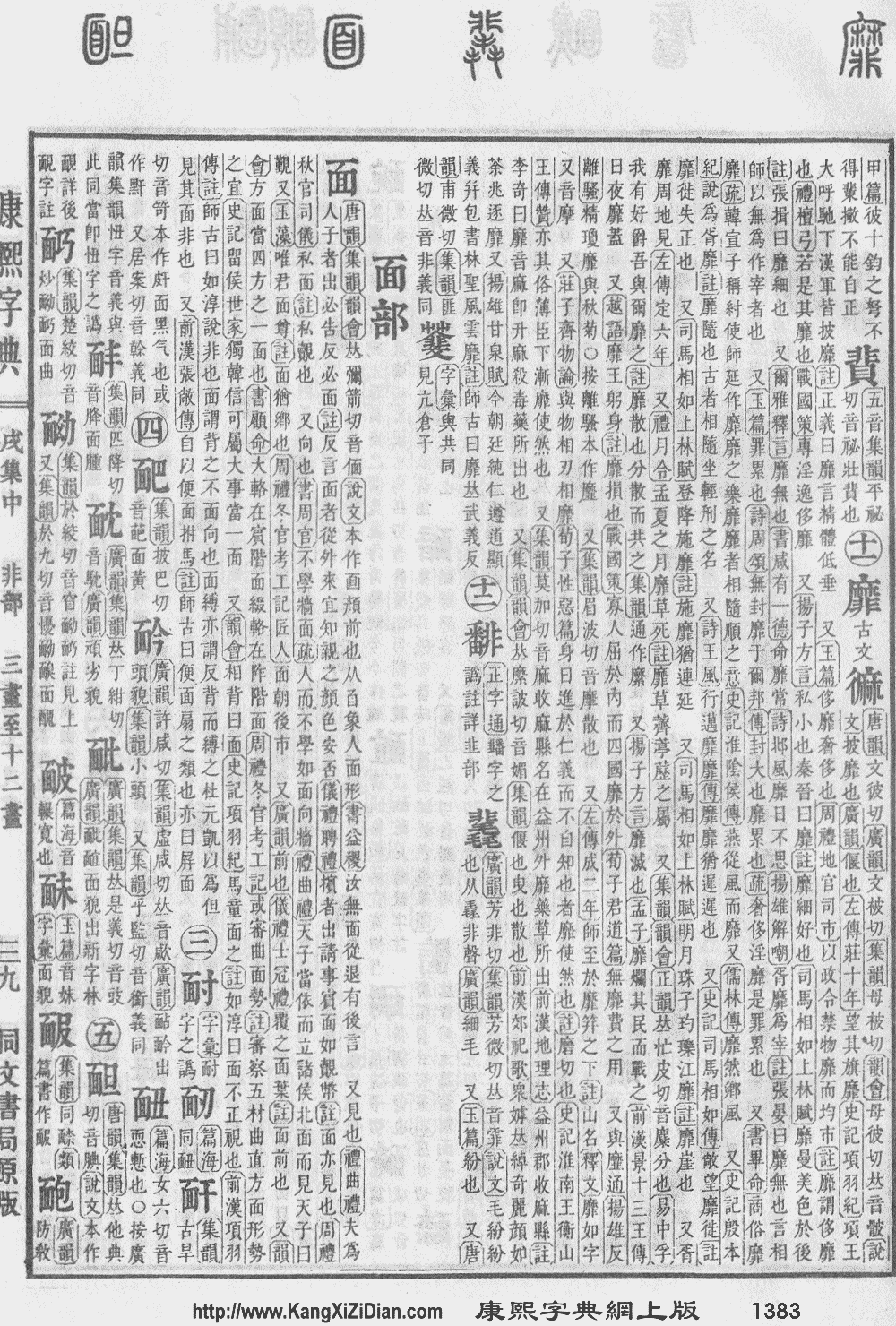
- Kangxi Dictionary: page 1383, character 2
- Dai Kanwa Jiten: character 42612
- Dae Jaweon: page 1896, character 14
- Hanyu Da Zidian (first edition): volume 6, page 4088, character 5
- Unihan data for U+9761
Chinese
| trad. | 靡 | |
|---|---|---|
| simp. # | 靡 | |
Glyph origin
Characters in the same phonetic series (麻) (Zhengzhang, 2003)
Phono-semantic compound (形聲/形声, OC *mralʔ) : phonetic 麻 (OC *mraːl) + semantic 非 - to scatter.
Pronunciation 1
Definitions
靡
- (literary) to fall down; to collapse; to be swept away
- 吾視其轍亂,望其旗靡,故逐之。 [Classical Chinese, trad.]
- From: Commentary of Zuo, c. 4th century BCE
- Wú shì qí zhé luàn, wàng qí qí mǐ, gù zhú zhī. [Pinyin]
- But when I examined the enemy's wheel-tracks and found them cries-crossing and looked afar and saw his banners drooping, I advised pursuit.
吾视其辙乱,望其旗靡,故逐之。 [Classical Chinese, simp.]
- (literary) extravagant; beautiful; splendid
- (literary) delicate; minute
- (literary) no; not
- 侯服於周、天命靡常。 [Classical Chinese, trad.]
- From: The Classic of Poetry, c. 11th – 7th centuries BCE, translated based on James Legge's version
- Hóu fú yú Zhōu, tiānmìng mǐ cháng. [Pinyin]
- They became subject to Zhou; the appointment of Heaven is not constant.
侯服于周、天命靡常。 [Classical Chinese, simp.]
- (literary) to not have; to be without
Pronunciation 2
Definitions
靡
Compounds
- 之死靡他
- 之死靡它
- 低靡
- 侈靡
- 夷靡
- 奓靡
- 奢靡
- 妖靡
- 委靡
- 委靡不振
- 從風而靡/从风而靡
- 所向披靡
- 披靡 (pīmǐ)
- 旗靡
- 曼靡
- 望風披靡/望风披靡
- 望風而靡/望风而靡 (wàngfēng'érmǐ)
- 江靡
- 浮靡
- 淫靡 (yínmǐ)
- 猗猗靡靡
- 猗靡
- 當者披靡/当者披靡
- 禍福靡常/祸福靡常
- 綺靡/绮靡
- 胥靡 (xūmí)
- 與世靡爭/与世靡争
- 草靡風行/草靡风行
- 萍蹤靡定/萍踪靡定
- 萎靡
- 華靡/华靡 (huámǐ)
- 萎靡不振
- 誇多鬥靡/夸多斗靡
- 轍亂旗靡/辙乱旗靡 (zhéluànqímǐ)
- 迆靡
- 迤靡
- 鉅細靡遺/巨细靡遗 (jùxìmǐyí)
- 阤靡
- 靃靡
- 靡密
- 靡愬
- 靡敝
- 靡散
- 靡曼 (mǐmàn)
- 靡有孑遺/靡有孑遗
- 靡然
- 靡然向風/靡然向风
- 靡然從風/靡然从风
- 靡然鄉風/靡然乡风
- 靡爛/靡烂
- 靡知所措
- 靡衣偷食
- 靡衣玉食
- 靡費/靡费 (mífèi)
- 靡追
- 靡靡 (mǐmǐ)
- 靡靡之樂/靡靡之乐 (mǐmǐzhīyuè)
- 靡靡之音 (mǐmǐzhīyīn)
- 靡顏膩理/靡颜腻理
- 靡麗/靡丽 (mǐlì)
- 頹靡/颓靡 (tuímǐ)
- 頹靡不振/颓靡不振
- 風行草靡/风行草靡
- 風靡/风靡 (fēngmǐ)
- 風靡一時/风靡一时 (fēngmǐyīshí)
- 風靡雲湧/风靡云涌
- 風靡雲蒸/风靡云蒸
- 飛靡/飞靡
- 鳳靡鸞吪/凤靡鸾吪
- 麗靡/丽靡
References
- “靡”, in 漢語多功能字庫 (Multi-function Chinese Character Database), 香港中文大學 (the Chinese University of Hong Kong), 2014–
Japanese
Kanji
靡
Readings
(Can we verify(+) this pronunciation?)
Compounds
- 靡迤 (bī)
- 靡貨 (bika)
- 靡顔 (bigan)
- 靡傾 (bikei)
- 靡盬 (biko)
- 靡砕 (bisai)
- 靡財 (bizai)
- 靡散 (bisan)
- 靡然 (bizen)
- 靡薄 (bihaku)
- 靡披 (bihi)
- 靡費 (bihi)
- 靡靡 (bibi)
- 靡敝, 靡弊 (bihei)
- 靡幣 (bihei)
- 靡曼, 靡嫚 (biman)
- 靡濫 (biran)
- 靡爛 (biran)
- 靡麗 (birei)
- 夷靡 (ibi)
- 委靡 (ibi)
- 猗靡 (ibi)
- 萎靡 (ibi)
- 陁靡 (ibi)
- 阤靡 (ibi)
- 淫靡 (inbi)
- 華靡 (kabi)
- 綺靡 (kibi)
- 旗靡 (kibi)
- 軽靡 (keibi)
- 傾靡
- 妍靡
- 侈靡 (shibi)
- 奢靡 (shabi)
- 従靡
- 胥靡 (shobi)
- 靃靡 (suibi)
- 繊靡 (senbi)
- 頽靡
- 披靡 (hibi)
- 微靡
- 浮靡 (fubi)
- 風靡 (fūbi)
- 沸靡 (futsubi)
- 曼靡
- 離靡
- 麗靡 (reibi)
Korean
Hanja
靡 (eum 미 (mi))
- This term needs a translation to English. Please help out and add a translation, then remove the text
{{rfdef}}.
Vietnamese
This article is issued from Wiktionary. The text is licensed under Creative Commons - Attribution - Sharealike. Additional terms may apply for the media files.