亂
| ||||||||
| ||||||||
Translingual
| Japanese | 乱 |
|---|---|
| Simplified | 乱 |
| Traditional | 亂 |
| Stroke order | |||
 | |||
Han character
亂 (Kangxi radical 5, 乙+12, 13 strokes, cangjie input 月月山 (BBU), four-corner 22210, composition ⿰𤔔乚)
Derived characters
- 𠏢, 薍, 𥂽
Descendants
- 乱 (Japanese shinjitai and simplified Chinese)
References
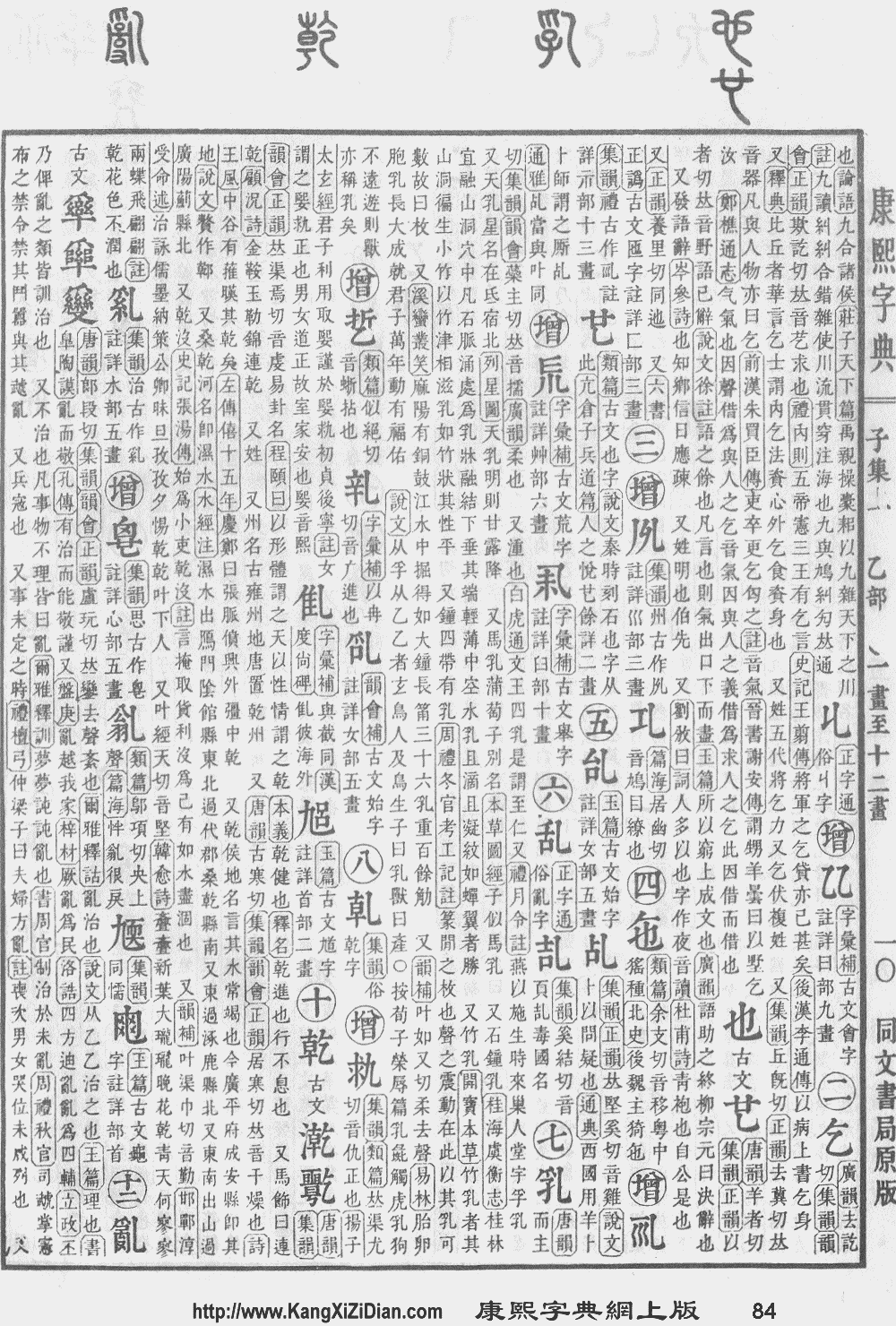
- Kangxi Dictionary: page 84, character 33
- Dai Kanwa Jiten: character 214
- Dae Jaweon: page 173, character 8
- Hanyu Da Zidian (first edition): volume 1, page 57, character 10
- Unihan data for U+4E82
- Unihan data for U+F91B
Chinese
| trad. | 亂 | |
|---|---|---|
| simp. | 乱 | |
| alternative forms | ||
Glyph origin
| Historical forms of the character 亂 | ||
|---|---|---|
| ||
|
References: Mostly from Richard Sears' Chinese Etymology site (authorisation),
|


Phono-semantic compound (形聲/形声, OC *roːns) : phonetic 𤔔 (*[r]ˁo[n]-s) + semantic 乚. The left-side component 𤔔 is itself ideogrammatic, depicting the effort to comb a tangle of threads, hence the semantic link to order and disorder.
Etymology
Area word of Austroasiatic origin. Compare Khmer ប្រួល (pruəl, “changing; unstable”) < Khmer រួល (ruəl, “to cook; to grill”), and also Khmer កំរោល (kɑmraol, “to go berserk; to become excited”) < Khmer រោល (rool, “to burn; to roast”) (Schuessler, 2007). Burmese ရုန်း (run:, “to struggle, to warp, to cause chaos”) and Tibetan ཁྲལ་ཁྲུལ (khral khrul, “fragments; scattered”) are Austroasiatic loans. Compare also Vietnamese lộn (“to turn the inside out, upside down, to reverse, to return, etc.”) and trộn (“to mix; to blend; to turn upside down”).
Pronunciation 1
Definitions
亂
- disorderly; chaotic
- unstable; volatile; turbulent
- unrest; uprising; revolt; rebellion
- 內亂/内乱 ― nèiluàn ― domestic turmoil
- 安史之亂/安史之乱 ― ānshǐzhīluàn ― An Lushan Rebellion
- 自云先世避秦時亂,率妻子邑人來此絕境,不復出焉,遂與外人間隔。 [Classical Chinese, trad.]
- From: 421, Tao Yuanming, 桃花源記 (The Peach Blossom Spring)
- Zì yún xiānshì bì Qín shí luàn, lǜ qīzǐ yìrén lái cǐ juéjìng, bù fù chū yān, suì yǔ wàirén jiāngé. [Pinyin]
- They told the fisherman that their ancestors had fled the chaos of the Qin Dynasty, and had led their wives and fellow villagers to this isolated area. No one had left since. As a result, they had become completely cut off from the outside world.
自云先世避秦时乱,率妻子邑人来此绝境,不复出焉,遂与外人间隔。 [Classical Chinese, simp.]
- confused; befuddled
- distraught; upset
- promiscuous
- wildly; in an uncontrolled way; without order or reason; at random; haphazardly; having no direction or coherence; recklessly; arbitrarily
- to obscure; to blur; to mix up
- 以假亂真/以假乱真 ― yǐjiǎluànzhēn ― to pass off fake items as genuine or mix the fake with the genuine
- to destroy; to ruin; to throw into disorder; to upset
- 子曰:「巧言亂德,小不忍則亂大謀。」 [Classical Chinese, trad.]
- From: The Analects of Confucius, c. 475 – 221 BCE, translated based on James Legge's version
- Zǐyuē: “Qiǎoyán luàn dé, xiǎo bù rěn zé luàn dà móu.” [Pinyin]
- The Master said, "Specious words confound virtue. Want of forbearance in small matters confounds great plans."
子曰:「巧言乱德,小不忍则乱大谋。」 [Classical Chinese, simp.]
- (obsolete, literary, music or poetry) coda; finale; conclusion of a piece
- 子曰:「師摯之始,《關雎》之亂,洋洋乎盈耳哉!」 [Classical Chinese, trad.]
- From: The Analects of Confucius, c. 475 – 221 BCE, translated based on James Legge's version
- Zǐyuē: “Shī Zhì zhī shǐ, “Guānjū” zhī luàn, yángyáng hū yíng ěr zāi!” [Pinyin]
- The Master said, "When the music master Zhi first entered on his office, the finish of the Guan Ju was magnificent — how it filled the ears!"
子曰:「师挚之始,《关雎》之乱,洋洋乎盈耳哉!」 [Classical Chinese, simp.]
- (Classical) to administer; to govern; to manage
- 眇眇予末小子,其能而亂四方以敬忌天威。 [Classical Chinese, trad.]
- From: The Book of Documents, circa 4th – 3rd century BCE
- Miǎomiǎo yǔmòxiǎozǐ, qí néng ér luàn sìfāng yǐ jìngjì tiānwēi. [Pinyin]
- I am utterly insignificant and but a child, how should I be able to govern the four quarters (of the kingdom) with a corresponding reverent awe of the dread majesty of Heaven!
眇眇予末小子,其能而乱四方以敬忌天威。 [Classical Chinese, simp.]
- (rare and obsolete) to cross a body of water
- 西傾因桓是來,浮于潛,逾于沔,入于渭,亂于河。 [Classical Chinese, trad.]
- From: The Book of Documents, circa 4th – 3rd century BCE, translated based on James Legge's version
- Xīqīng yīn Huán shì lái, fú yú Qián, yú yú Miǎn, rù yú Wèi, luàn yú hé. [Pinyin]
- From Xi-qing they came by the course of the Huan; floated along the Qian, and then crossed the country to the Mian; passed to the Wei, and finally ferried across the He.
西倾因桓是来,浮于潜,逾于沔,入于渭,乱于河。 [Classical Chinese, simp.]
Synonyms
- (disorderly):
- 一塌糊塗/一塌糊涂
- 亂七八糟/乱七八糟 (luànqībāzāo)
- 亂雜/乱杂 (luànzá) (literary)
- 凌亂 (língluàn)
- 嘈亂/嘈乱 (cáoluàn) (literary, of sound)
- 大鼎炒狗蟻/大鼎炒狗蚁 (Hokkien)
- 挐亂/挐乱 (Hokkien)
- 擾擾/扰扰 (rǎorǎo)
- 散亂/散乱 (sǎnluàn)
- 有七無八/有七无八 (Hokkien)
- 殽亂/淆乱 (xiáoluàn) (literary)
- 混亂/混乱 (hùnluàn)
- 烏七八糟/乌七八糟 (wūqībāzāo)
- 烏哩單刀/乌哩单刀 (Cantonese)
- 無序/无序 (wúxù)
- 狼戾 (Hakka, literary)
- 狼狼戾戾 (Hakka)
- 狼藉 (lángjí)
- 立立亂/立立乱 (lap6 lap6-2 lyun6) (Cantonese)
- 糊塗/糊涂
- 糾紛/纠纷 (jiūfēn) (literary)
- 紊 (wěn) (literary, or in compounds)
- 紛亂/纷乱 (fēnluàn)
- 紊亂/紊乱 (wěnluàn)
- 紛雜/纷杂 (fēnzá) (literary)
- 繚亂/缭乱 (liáoluàn) (formal)
- 肆亂/肆乱 (sìluàn) (literary)
- 荊棘/荆棘 (jīngjí) (literary, figurative)
- 蕪雜/芜杂 (wúzá)
- 雜亂/杂乱 (záluàn)
- 鬼打樣/鬼打样 (Hakka)
- (unstable):
- (to obscure):
- (to damage):
- 僝僽 (chánzhòu) (literary)
- 圮毀/圮毁 (pǐhuǐ) (literary)
- 壞/坏 (huài)
- 打掉 (dǎdiào)
- 損壞/损坏 (sǔnhuài)
- 損毀/损毁 (sǔnhuǐ)
- 搗砸/捣砸 (dau2 zah5) (Jin)
- 摧殘/摧残 (cuīcán)
- 摧毀/摧毁 (cuīhuǐ)
- 毀/毁 (huǐ)
- 毀壞/毁坏 (huǐhuài)
- 毀損/毁损 (huǐsǔn)
- 決裂/决裂 (juéliè) (archaic)
- 破 (pò) (literary, or in compounds)
- 破壞/破坏 (pòhuài)
- 糟 (zāo) (literary, or in compounds)
- 糟蹋 (zāotà)
- 隳 (huī) (literary, or in compounds)
Compounds
- 七國之亂/七国之乱
- 三藩之亂/三藩之乱 (Sānfānzhīluàn)
- 不亂/不乱
- 乘亂/乘乱
- 乘亂坐大/乘乱坐大
- 乾霍亂/干霍乱 (gānhuòluàn)
- 亂七八糟/乱七八糟 (luànqībāzāo)
- 亂三攪四/乱三搅四
- 亂世/乱世 (luànshì)
- 亂世佳人/乱世佳人
- 亂世凶年
- 亂中有序/乱中有序 (luànzhōngyǒuxù)
- 亂亂騰騰/乱乱腾腾
- 亂事/乱事
- 亂交/乱交 (luànjiāo)
- 亂作蕭牆/乱作萧墙
- 亂來/乱来 (luànlái)
- 亂俗/乱俗
- 亂俗傷風/乱俗伤风
- 亂倫/乱伦 (luànlún)
- 亂兒/乱儿 (luànr)
- 亂兒媽/乱儿妈
- 亂兵/乱兵 (luànbīng)
- 亂刀/乱刀
- 亂反射/乱反射 (luànfǎnshè)
- 亂叫/乱叫
- 亂哄哄/乱哄哄
- 亂啼/乱啼
- 亂嘈嘈/乱嘈嘈
- 亂嚼舌頭/乱嚼舌头
- 亂國/乱国 (luànguó)
- 亂塚/乱冢
- 亂墜天花/乱坠天花
- 亂墳崗/乱坟岗 (luànfèngǎng)
- 亂天常/乱天常
- 亂婚/乱婚
- 亂子/乱子 (luànzi)
- 亂家子/乱家子
- 亂局/乱局 (luànjú)
- 亂岔岔/乱岔岔
- 亂廝/乱厮
- 亂彈/乱弹 (luàntán)
- 亂得慌/乱得慌
- 亂性/乱性 (luànxìng)
- 亂成一團/乱成一团
- 亂戰/乱战
- 亂抖/乱抖
- 亂撞/乱撞
- 亂擾擾/乱扰扰
- 亂攛/乱撺
- 亂攛攛/乱撺撺
- 亂放炮/乱放炮
- 亂旋/乱旋
- 亂棒胡敲/乱棒胡敲
- 亂極則平/乱极则平
- 亂機/乱机
- 亂民/乱民
- 亂氣流/乱气流
- 亂流/乱流 (luànliú)
- 亂源/乱源
- 亂烘烘/乱烘烘
- 亂用/乱用 (luànyòng)
- 亂真/乱真 (luànzhēn)
- 亂石/乱石 (luànshí)
- 亂碼/乱码 (luànmǎ)
- 亂視/乱视 (luànshì)
- 亂穿靴/乱穿靴
- 亂竄/乱窜 (luàncuàn)
- 亂箭/乱箭
- 亂箭攢心/乱箭攒心
- 亂箭穿心/乱箭穿心
- 亂糟糟/乱糟糟 (luànzāozāo)
- 亂紀/乱纪
- 亂紛紛/乱纷纷
- 亂罵/乱骂 (luànmà)
- 亂聲/乱声
- 亂臣/乱臣 (luànchén)
- 亂臣賊子/乱臣贼子 (luànchénzéizǐ)
- 亂臣逆子/乱臣逆子
- 亂舞/乱舞
- 亂花/乱花
- 亂葬埂/乱葬埂 (luànzànggěng)
- 亂葬崗/乱葬岗 (luànzànggǎng)
- 亂葬崗子/乱葬岗子 (luànzànggǎngzi)
- 亂蓋/乱盖
- 亂蓬蓬/乱蓬蓬
- 亂言/乱言 (luànyán)
- 亂言片楮/乱言片楮
- 亂說/乱说 (luànshuō)
- 亂講/乱讲 (luànjiǎng)
- 亂跑/乱跑 (luànpǎo)
- 亂跳/乱跳
- 亂軍/乱军 (luànjūn)
- 亂逆/乱逆 (luànnì)
- 亂道/乱道
- 亂邦/乱邦 (luànbāng)
- 亂針繡/乱针绣
- 亂闖/乱闯
- 亂階/乱阶
- 亂集團/乱集团
- 亂雜/乱杂 (luànzá)
- 亂離/乱离 (luànlí)
- 亂頭/乱头
- 亂頭粗服/乱头粗服
- 亂顫/乱颤
- 亂首/乱首
- 亂首垢面/乱首垢面
- 亂騰騰/乱腾腾
- 亂鬆鬆/乱松松
- 亂鬧/乱闹 (luànnào)
- 亂麻/乱麻 (luànmá)
- 亂點鴛鴦/乱点鸳鸯
- 亂黨/乱党
- 五胡亂華/五胡乱华 (Wǔhúluànhuá)
- 五色亂目/五色乱目
- 人多手亂/人多手乱
- 以暴易亂/以暴易乱
- 作亂/作乱 (zuòluàn)
- 侯景之亂/侯景之乱
- 倒亂/倒乱
- 兆亂/兆乱
- 內亂/内乱 (nèiluàn)
- 內亂罪/内乱罪
- 八王之亂/八王之乱 (Bā Wáng Zhī Luàn)
- 兵亂/兵乱 (bīngluàn)
- 兵荒將亂/兵荒将乱
- 兵荒馬亂/兵荒马乱 (bīnghuāngmǎluàn)
- 凌亂 (língluàn)
- 凌亂不堪
- 出亂子/出乱子 (chūluànzi)
- 動亂/动乱 (dòngluàn)
- 動員戡亂/动员戡乱
- 反亂/反乱 (fǎnluàn)
- 叛亂/叛乱 (pànluàn)
- 叛亂罪/叛乱罪
- 唯恐天下不亂/唯恐天下不乱 (wéi kǒng tiānxià bù luàn)
- 喪亂/丧乱 (sāngluàn)
- 喪亂帖/丧乱帖
- 嘈亂/嘈乱 (cáoluàn)
- 坐懷不亂/坐怀不乱
- 大亂/大乱 (dàluàn)
- 大亂子/大乱子
- 大動亂/大动乱
- 天下大亂/天下大乱 (tiānxiàdàluàn)
- 天寶之亂/天宝之乱
- 天花亂墜/天花乱坠 (tiānhuāluànzhuì)
- 始亂終棄/始乱终弃 (shǐluànzhōngqì)
- 安史之亂/安史之乱 (Ān Shǐ Zhī Luàn)
- 家亂/家乱 (jiāluàn)
- 家反宅亂/家反宅乱
- 家翻宅亂/家翻宅乱
- 寇亂/寇乱 (kòuluàn)
- 幫亂/帮乱
- 平亂/平乱 (píngluàn)
- 庚子拳亂/庚子拳乱
- 弭亂/弭乱
- 徒亂人意/徒乱人意
- 徼亂/徼乱
- 心亂/心乱 (xīnluàn)
- 心亂如麻/心乱如麻 (xīnluànrúmá)
- 心慌意亂/心慌意乱 (xīnhuāngyìluàn)
- 心煩意亂/心烦意乱 (xīnfányìluàn)
- 心煩慮亂/心烦虑乱
- 忙亂/忙乱 (mángluàn)
- 怙亂/怙乱
- 怪力亂神/怪力乱神 (guàilìluànshén)
- 悖亂/悖乱 (bèiluàn)
- 悶亂/闷乱
- 惑亂/惑乱 (huòluàn)
- 惱亂/恼乱
- 意亂心慌/意乱心慌
- 慌亂/慌乱 (huāngluàn)
- 憒亂/愦乱
- 戡亂/戡乱 (kānluàn)
- 戰亂/战乱 (zhànluàn)
- 手忙腳亂/手忙脚乱 (shǒumángjiǎoluàn)
- 扶危定亂/扶危定乱
- 捻亂/捻乱
- 掠亂/掠乱
- 搞亂/搞乱 (gǎoluàn)
- 搗亂/捣乱 (dǎoluàn)
- 播亂/播乱 (bōluàn)
- 撩亂/撩乱 (liáoluàn)
- 撥亂/拨乱
- 撥亂之才/拨乱之才
- 撥亂反正/拨乱反正 (bōluànfǎnzhèng)
- 撥亂反治/拨乱反治
- 撥亂濟危/拨乱济危
- 撥亂濟時/拨乱济时
- 撥亂興治/拨乱兴治
- 撥亂誅暴/拨乱诛暴
- 擾亂/扰乱 (rǎoluàn)
- 攛哄鳥亂/撺哄鸟乱
- 攪亂/搅乱 (jiǎoluàn)
- 敗常亂俗/败常乱俗
- 敗法亂紀/败法乱纪
- 散亂/散乱 (sǎnluàn)
- 方寸亂矣/方寸乱矣
- 方寸大亂/方寸大乱 (fāngcùndàluàn)
- 方寸已亂/方寸已乱
- 昏亂/昏乱 (hūnluàn)
- 晴空亂流/晴空乱流
- 暴亂/暴乱 (bàoluàn)
- 朝天搗亂/朝天捣乱
- 梟亂/枭乱 (xiāoluàn)
- 欺世亂俗/欺世乱俗
- 歡蹦亂跳/欢蹦乱跳 (huānbèng luàntiào)
- 歡迸亂跳/欢迸乱跳
- 止亂/止乱 (zhǐluàn)
- 歪談亂講/歪谈乱讲
- 歪談亂道/歪谈乱道
- 歷亂/历乱
- 殽亂/淆乱 (xiáoluàn)
- 永嘉之亂/永嘉之乱 (Yǒngjiā Zhī Luàn)
- 沒亂/没乱
- 汩亂/汩乱
- 沒亂死/没乱死
- 沒亂殺/没乱杀
- 沒亂煞/没乱煞
- 沒亂裡/没乱里
- 沒撩沒亂/没撩没乱
- 沒留沒亂/没留没乱
- 治亂/治乱 (zhìluàn)
- 治亂存亡/治乱存亡
- 治亂興亡/治乱兴亡
- 波涌雲亂/波涌云乱 (bōyǒngyúnluàn)
- 活蹦亂跳/活蹦乱跳 (huóbèngluàntiào)
- 淆亂/淆乱
- 混亂/混乱 (hùnluàn)
- 淫亂/淫乱 (yínluàn)
- 潰亂/溃乱 (kuìluàn)
- 潦亂/潦乱
- 煩亂/烦乱 (fánluàn)
- 熱亂/热乱
- 燐亂/磷乱
- 犯上作亂/犯上作乱
- 狂亂/狂乱 (kuángluàn)
- 猖亂/猖乱
- 理不忘亂/理不忘乱
- 理亂/理乱
- 百般忙亂/百般忙乱
- 眼花撩亂/眼花撩乱 (yǎnhuāliáoluàn)
- 眼花瞭亂/眼花了乱
- 眼花繚亂/眼花缭乱 (yǎnhuāliáoluàn)
- 瞀亂/瞀乱
- 破亂/破乱
- 破零三亂/破零三乱
- 碎瓊亂玉/碎琼乱玉
- 神昏意亂/神昏意乱
- 神經錯亂/神经错乱
- 神魂撩亂/神魂撩乱
- 禁暴誅亂/禁暴诛乱
- 禁暴靜亂/禁暴静乱
- 禍亂/祸乱 (huòluàn)
- 禍亂交興/祸乱交兴
- 禍亂滔天/祸乱滔天
- 稔亂/稔乱
- 稱亂/称乱
- 穢亂/秽乱 (huìluàn)
- 粗服亂頭/粗服乱头
- 精神錯亂/精神错乱 (jīngshén cuòluàn)
- 紅紫亂朱/红紫乱朱
- 紊亂/紊乱 (wěnluàn)
- 紛亂/纷乱 (fēnluàn)
- 紛亂無序/纷乱无序
- 繚亂/缭乱 (liáoluàn)
- 群魔亂舞/群魔乱舞 (qúnmóluànwǔ)
- 聽讒惑亂/听谗惑乱
- 胡亂/胡乱 (húluàn)
- 胡吹亂滂/胡吹乱滂
- 胡吹亂謅/胡吹乱诌
- 胡思亂想/胡思乱想 (húsīluànxiǎng)
- 胡思亂量/胡思乱量
- 胡擄忙亂/胡掳忙乱
- 胡行亂作/胡行乱作
- 胡言亂語/胡言乱语 (húyánluànyǔ)
- 胡說亂語/胡说乱语
- 胡說亂道/胡说乱道
- 腳忙手亂/脚忙手乱
- 腳頭亂/脚头乱
- 臨危不亂/临危不乱 (línwēibùluàn)
- 自亂/自乱 (zìluàn)
- 致亂/致乱 (zhìluàn)
- 花亂雙眼/花乱双眼
- 荒亂/荒乱 (huāngluàn)
- 蓬亂/蓬乱
- 藩鎮之亂/藩镇之乱
- 蝦荒蟹亂/虾荒蟹乱
- 裹亂/裹乱
- 訌亂/讧乱
- 變亂/变乱 (biànluàn)
- 變亂四起/变乱四起
- 變亂紛乘/变乱纷乘
- 變古亂常/变古乱常
- 賊子亂臣/贼子乱臣
- 賊臣亂子/贼臣乱子
- 轍亂旗靡/辙乱旗靡 (zhéluànqímǐ)
- 返正撥亂/返正拨乱
- 逆亂/逆乱 (nìluàn)
- 迷亂/迷乱 (míluàn)
- 迷溜沒亂/迷溜没乱
- 迷留悶亂/迷留闷乱
- 迷留摸亂/迷留摸乱
- 迷留沒亂/迷留没乱
- 逆道亂常/逆道乱常
- 造亂/造乱
- 違法亂紀/违法乱纪 (wéifǎluànjì)
- 避亂/避乱 (bìluàn)
- 錯亂/错乱 (cuòluàn)
- 閒言亂語/闲言乱语
- 闇亂/暗乱
- 闖亂子/闯乱子
- 陣腳大亂/阵脚大乱
- 雜亂/杂乱 (záluàn)
- 雜亂無章/杂乱无章 (záluàn wú zhāng)
- 離亂/离乱
- 零亂/零乱 (língluàn)
- 霍亂/霍乱 (huòluàn)
- 霍亂弧菌/霍乱弧菌 (huòluàn hújūn)
- 霍亂疫區/霍乱疫区
- 靖亂/靖乱
- 顛倒錯亂/颠倒错乱
- 騷亂/骚乱 (sāoluàn)
- 髒亂/脏乱 (zāngluàn)
- 鬢亂釵橫/鬓乱钗横
- 鬧亂子/闹乱子
- 鬼亂/鬼乱
- 鴉飛鵲亂/鸦飞鹊乱
- 麤服亂頭/粗服乱头
- 黃巢之亂/黄巢之乱
- 黃巾之亂/黄巾之乱
Pronunciation 2
Synonyms
Korean
Vietnamese
Han character
亂: Hán Nôm readings: loạn, trộn, lộn
- This term needs a translation to English. Please help out and add a translation, then remove the text
{{rfdef}}.