討
See also: 讨
| ||||||||
Translingual
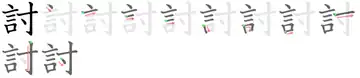
| Stroke order | |||
|---|---|---|---|
 | |||
Han character
討 (Kangxi radical 149, 言+3, 10 strokes, cangjie input 卜口木戈 (YRDI), four-corner 04600, composition ⿰訁寸)
Derived characters
References
- Kangxi Dictionary: page 1147, character 16
- Dai Kanwa Jiten: character 35231
- Dae Jaweon: page 1614, character 11
- Hanyu Da Zidian (first edition): volume 6, page 3940, character 6
- Unihan data for U+8A0E

Chinese
| trad. | 討 | |
|---|---|---|
| simp. | 讨 | |
Glyph origin
| Historical forms of the character 討 |
|---|
| Liushutong (compiled in Ming) |
| Transcribed ancient scripts |
 |
Phono-semantic compound (形聲/形声, OC *tʰuːʔ) : abbreviated phonetic 肘 (OC *tkuʔ) + semantic 言. Shuowen Jiezi interprets it as an ideogrammic compound (會意/会意) : 言 (“speech”) + 寸 (“hand”) – rectify.
Pronunciation
Definitions
討
- to send armed forces to suppress
- to denounce; to condemn
- to examine; to discuss
- to ask for; to beg
- to invite
- to marry
- (Zhao'an Hakka) to want
- 𠊎討坐高鐵去高雄 坐火車去台中 [Zhao'an Hakka, trad.]
- From: 2022, 曾仲瑋, lyrics by 曾仲瑋 and 李幸妃, 好天氣
- ngaiˋ too^ cooˇ gooˇ teedˊ kui^ gooˇ hiungˋ, cooˇ foo^ chaˇ kui^ taiˋ zhungˇ [Taiwanese Hakka Romanization System]
- I want to take the high-speed rail to Kaohsiung, take the train to Taichung
𠊎讨坐高铁去高雄 坐火车去台中 [Zhao'an Hakka, simp.]
- (Zhao'an Hakka) to be about to
Synonyms
Dialectal synonyms of 找 (“to look for, to seek, to search for”) [map]
Dialectal synonyms of 要 (“to want (to do something)”) [map]
Compounds
- 不討采
- 乞討/乞讨 (qǐtǎo)
- 催討/催讨 (cuītǎo)
- 北討/北讨
- 南征北討
- 取討/取讨 (qǔtǎo)
- 商討/商讨 (shāngtǎo)
- 尋討/寻讨
- 尋頭討腦/寻头讨脑
- 征討 (zhēngtǎo)
- 按討/按讨
- 探討/探讨 (tàntǎo)
- 搜討/搜讨
- 擒姦討暴/擒奸讨暴
- 東征西討/东征西讨
- 東討西伐/东讨西伐
- 東討西征/东讨西征
- 檢討/检讨 (jiǎntǎo)
- 檢討會/检讨会
- 沿波討源/沿波讨源
- 沿流討源/沿流讨源
- 漫天討價/漫天讨价
- 申討/申讨 (shēntǎo)
- 研討/研讨 (yántǎo)
- 索討/索讨
- 聲討/声讨 (shēngtǎo)
- 自討沒趣/自讨没趣
- 自討苦吃/自讨苦吃 (zìtǎokǔchī)
- 討乖/讨乖
- 討乞/讨乞 (tǎoqǐ)
- 討交情/讨交情
- 討人/讨人 (tǎorén)
- 討人情/讨人情
- 討令/讨令
- 討伐/讨伐 (tǎofá)
- 討休/讨休
- 討俏/讨俏 (tǎoqiào)
- 討信/讨信
- 討保/讨保
- 討便宜/讨便宜
- 討個分曉/讨个分晓
- 討債/讨债 (tǎozhài)
- 討債鬼/讨债鬼
- 討價/讨价 (tǎojià)
- 討價還價/讨价还价 (tǎojiàhuánjià)
- 討公道/讨公道
- 討分上/讨分上
- 討分曉/讨分晓
- 討厭/讨厌 (tǎoyàn)
- 討厭鬼/讨厌鬼
- 討取/讨取
- 討口/讨口
- 討口牙/讨口牙
- 討吃/讨吃
- 討命/讨命
- 討喜/讨喜 (tǎoxǐ)
- 討嘴/讨嘴
- 討好/讨好 (tǎohǎo)
- 討好賣乖/讨好卖乖
- 討嫌/讨嫌 (tǎoxián)
- 討安歇/讨安歇
- 討巧/讨巧 (tǎoqiǎo)
- 討帳/讨帐 (tǎozhàng)
- 討平/讨平
- 討店/讨店
- 討彩/讨彩
- 討情/讨情
- 討惡剪暴/讨恶剪暴
- 討愧/讨愧
- 討探/讨探
- 討擾/讨扰
- 討收管/讨收管
- 討教/讨教 (tǎojiào)
- 討救/讨救
- 討救兵/讨救兵
- 討死/讨死 (tǎosǐ)
- 討氣/讨气
- 討沒意思/讨没意思
- 討沒臉面/讨没脸面
- 討決裂/讨决裂
- 討沒趣/讨没趣
- 討油水/讨油水
- 討海/讨海 (tǎohǎi)
- 討海人/讨海人 (tǎohǎirén)
- 討源/讨源
- 討生活/讨生活 (tǎoshēnghuó)
- 討皮疾/讨皮疾
- 討皮疼/讨皮疼
- 討究/讨究
- 討笤/讨笤
- 討老腳/讨老脚
- 討虜/讨虏
- 討親/讨亲
- 討論/讨论 (tǎolùn)
- 討論區/讨论区 (tǎolùnqū)
- 討賊/讨贼 (tǎozéi)
- 討賞/讨赏
- 討賤/讨贱
- 討逆除暴/讨逆除暴
- 討野火/讨野火
- 討針線/讨针线
- 討錢/讨钱
- 討面皮/讨面皮
- 討順風/讨顺风
- 討頭/讨头
- 討食/讨食
- 討飯/讨饭 (tǎofàn)
- 討饒/讨饶 (tǎoráo)
- 討饒頭/讨饶头
- 誅凶討逆/诛凶讨逆
- 誅暴討逆/诛暴讨逆
- 誅討/诛讨
- 追討/追讨
Japanese
Korean
Etymology
From Middle Chinese 討 (MC thawX).
| Historical readings |
|---|
|
Pronunciation
- (to attack; to subjugate; etc.):
- (SK Standard/Seoul) IPA(key): [tʰo̞]
- Phonetic hangul: [토]
- (to discuss; to debate; etc.):
- (SK Standard/Seoul) IPA(key): [tʰo̞(ː)]
- Phonetic hangul: [토(ː)]
- Though still prescribed in Standard Korean, most speakers in both Koreas no longer distinguish vowel length.
Compounds
Vietnamese
This article is issued from Wiktionary. The text is licensed under Creative Commons - Attribution - Sharealike. Additional terms may apply for the media files.