糟
See also: 蹧
| ||||||||
Translingual
Han character
糟 (Kangxi radical 119, 米+11, 17 strokes, cangjie input 火木廿田日 (FDTWA), four-corner 95966, composition ⿰米曹)
References
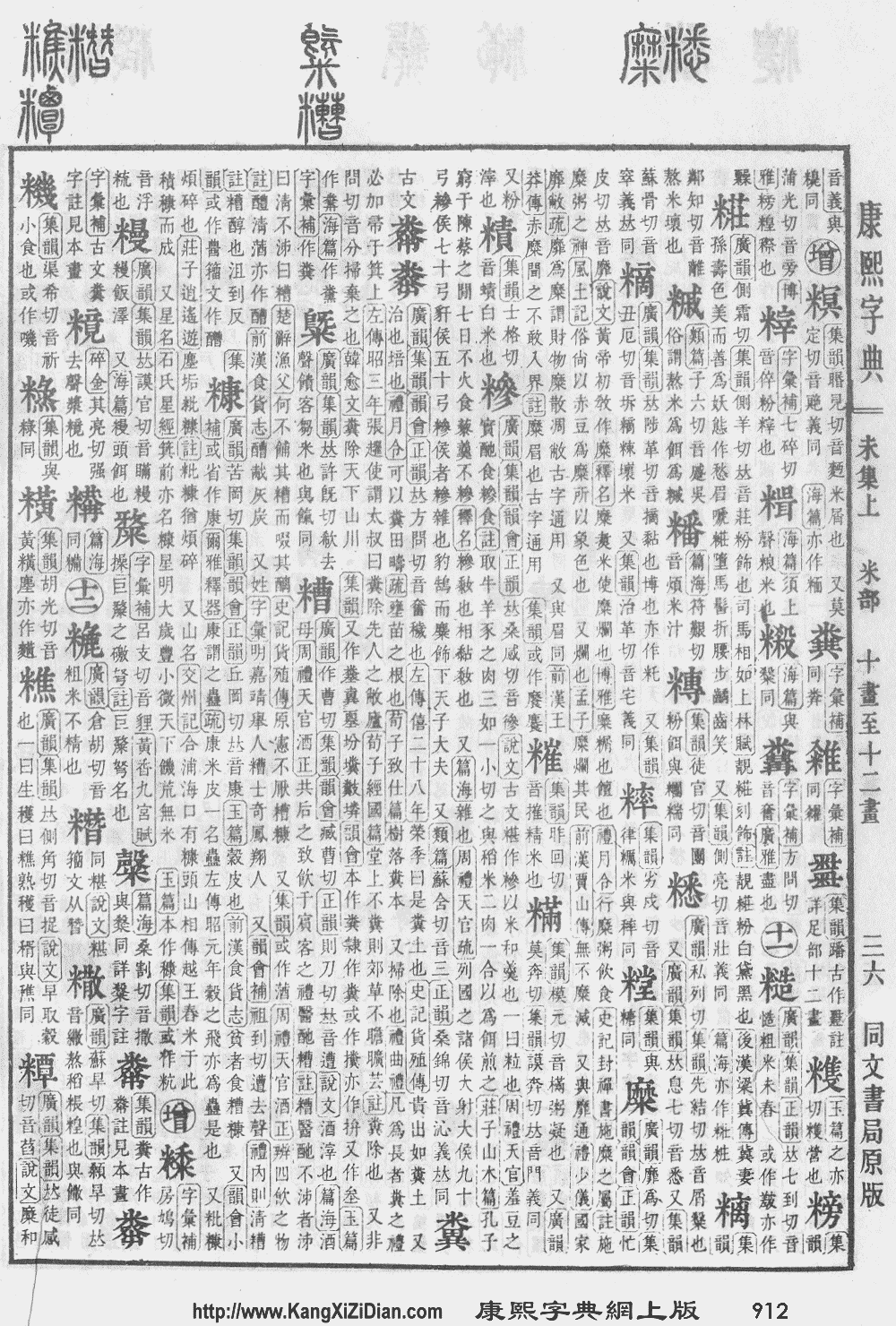
- Kangxi Dictionary: page 912, character 30
- Dai Kanwa Jiten: character 27104
- Dae Jaweon: page 1339, character 21
- Hanyu Da Zidian (first edition): volume 5, page 3158, character 2
- Unihan data for U+7CDF
Chinese
| trad. | 糟 | |
|---|---|---|
| simp. # | 糟 | |
| 2nd round simp. | 𮇘 | |
Glyph origin
| Historical forms of the character 糟 |
|---|
| Shuowen Jiezi (compiled in Han) |
| Small seal script |
 |
Characters in the same phonetic series (曹) (Zhengzhang, 2003)
Phono-semantic compound (形聲/形声, OC *ʔsluː) : semantic 米 + phonetic 曹 (OC *zluː).
Pronunciation
Definitions
糟
Synonyms
- (awful):
Dialectal synonyms of 壞 (“bad; not good”) [map]
| Variety | Location | Words |
|---|---|---|
| Classical Chinese | 惡 | |
| Formal (Written Standard Chinese) | 壞 | |
| Mandarin | Beijing | 壞, 賴 |
| Taiwan | 壞 | |
| Jinan | 壞, 孬, 賴 | |
| Xi'an | 瞎, 壞 | |
| Wuhan | 壞, 拐 | |
| Chengdu | 壞 | |
| Yangzhou | 壞 | |
| Hefei | 壞 | |
| Malaysia | 壞 | |
| Singapore | 壞 | |
| Cantonese | Guangzhou | 壞, 弊, 衰 |
| Hong Kong | 壞, 衰 | |
| Zhongshan (Shiqi) | 衰 | |
| Yangjiang | 壞 | |
| Kuala Lumpur (Guangfu) | 衰 | |
| Singapore (Guangfu) | 衰 | |
| Gan | Nanchang | 壞 |
| Hakka | Meixian | 壞 |
| Wuhua (Meilin) | 衰 | |
| Jin | Taiyuan | 賴, 壞 |
| Northern Min | Jian'ou | 壞, 獰 |
| Eastern Min | Fuzhou | 呆, 否 |
| Southern Min | Xiamen | 歹, 䆀 |
| Xiamen (Tong'an) | 歹 | |
| Quanzhou | 歹 | |
| Jinjiang | 歹 | |
| Nan'an | 歹 | |
| Shishi | 歹 | |
| Zhangzhou | 䆀 | |
| Zhao'an | 䆀, 孬 | |
| Tainan | 歹 | |
| Penang (Hokkien) | 䆀, 歹 | |
| Singapore (Hokkien) | 歹 | |
| Manila (Hokkien) | 歹 | |
| Datian | 歹 | |
| Chaozhou | 孬 | |
| Shantou | 孬 | |
| Jieyang | 孬, 歹 | |
| Singapore (Teochew) | 歹, 孬 | |
| Leizhou | 㾀 | |
| Wenchang | 㾀 | |
| Haikou | 㾀 | |
| Singapore (Hainanese) | 㾀 | |
| Wu | Shanghai | 壞, 恘 |
| Suzhou | 壞, 恘 | |
| Ningbo | 歪, 推扳, 嘸做 | |
| Wenzhou | 毛 | |
| Xiang | Changsha | 壞, 拐 |
| Shuangfeng | 壞, 拐 | |
- (to decay):
- (to damage):
- 亂/乱 (luàn) (literary, or in compounds)
- 僝僽 (chánzhòu) (literary)
- 圮毀/圮毁 (pǐhuǐ) (literary)
- 壞/坏 (huài)
- 打掉 (dǎdiào)
- 損壞/损坏 (sǔnhuài)
- 損毀/损毁 (sǔnhuǐ)
- 搗砸/捣砸 (dau2 zah5) (Jin)
- 摧殘/摧残 (cuīcán)
- 摧毀/摧毁 (cuīhuǐ)
- 毀/毁 (huǐ)
- 毀壞/毁坏 (huǐhuài)
- 毀損/毁损 (huǐsǔn)
- 決裂/决裂 (juéliè) (archaic)
- 破 (pò) (literary, or in compounds)
- 破壞/破坏 (pòhuài)
- 糟蹋 (zāotà)
- 隳 (huī) (literary, or in compounds)
Compounds
- 一團糟/一团糟 (yītuánzāo)
- 不棄糟糠/不弃糟糠 (bùqìzāokāng)
- 亂七八糟/乱七八糟 (luànqībāzāo)
- 亂糟糟/乱糟糟 (luànzāozāo)
- 污糟 (wūzāo)
- 烏七八糟/乌七八糟 (wūqībāzāo)
- 破米糟糖
- 糟丘
- 糟坊 (zāofáng)
- 糟心
- 糟擾/糟扰
- 糟粕 (zāopò)
- 糟糕 (zāogāo)
- 糟糠 (zāokāng)
- 糠糟
- 糟糠不厭/糟糠不厌
- 糟糠之妻 (zāokāngzhīqī)
- 糟糠妻
- 糟老頭兒/糟老头儿
- 糟豆腐
- 糟蹋 (zāotà)
- 糟錢兒/糟钱儿
- 糟頭/糟头
- 貧賤糟糠/贫贱糟糠
- 酒糟 (jiǔzāo)
- 酒糟頭/酒糟头
- 酒糟鼻 (jiǔzāobí)
- 醪糟 (láozāo)
- 鏖糟
- 餔糟啜醨/𫗦糟啜醨
- 餔糟歠醨/𫗦糟歠醨
Japanese
Readings
Korean
Hanja
糟 • (jo) (hangeul 조, revised jo, McCune–Reischauer cho, Yale co)
- This term needs a translation to English. Please help out and add a translation, then remove the text
{{rfdef}}.
Vietnamese
Han character
References
- Nguyễn et al. (2009).
This article is issued from Wiktionary. The text is licensed under Creative Commons - Attribution - Sharealike. Additional terms may apply for the media files.