儕
| ||||||||
Translingual
| Traditional | 儕 |
|---|---|
| Shinjitai (extended) |
㑪 |
| Simplified | 侪 |
Han character
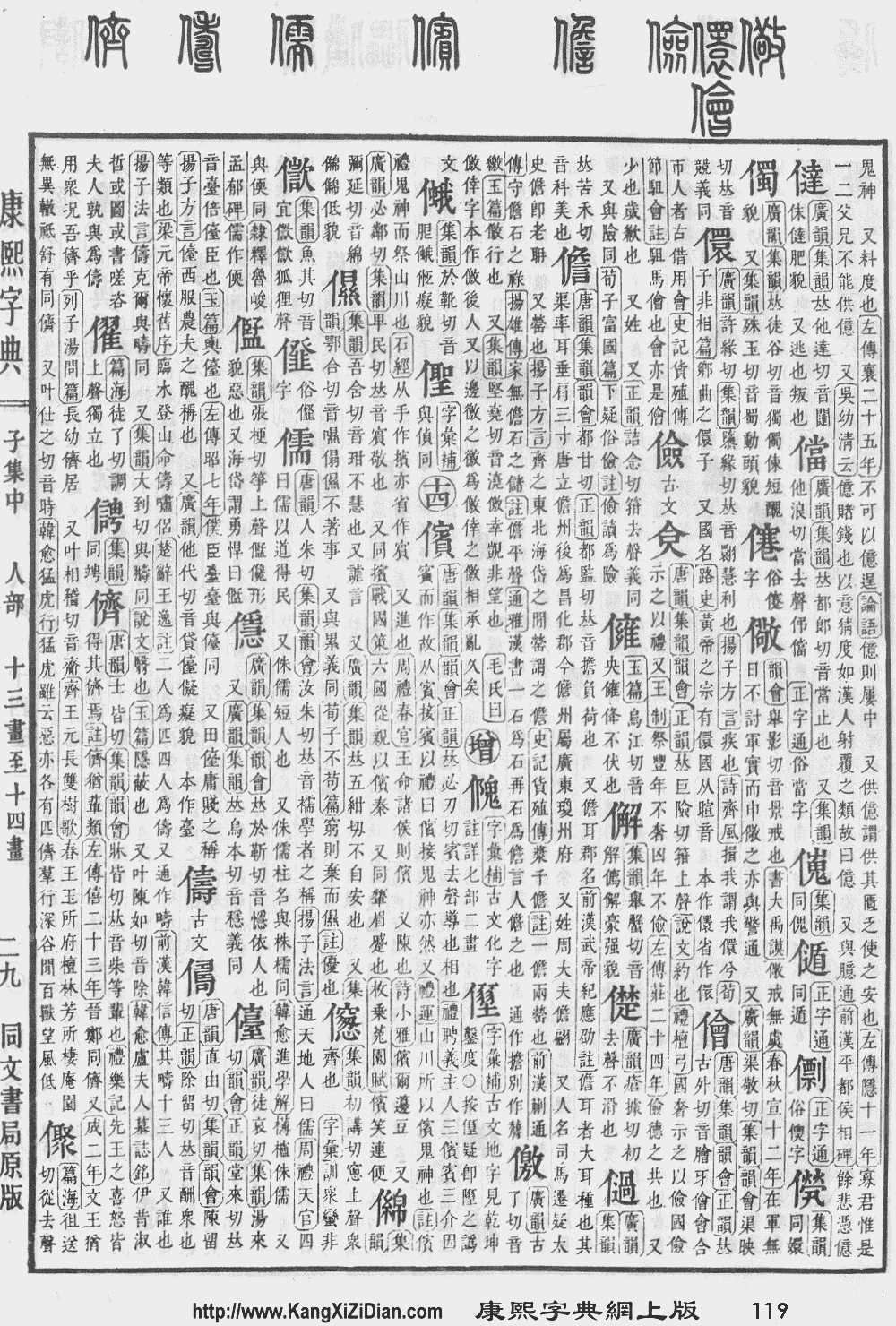
儕 (Kangxi radical 9, 人+14, 16 strokes, cangjie input 人卜難 (OYX), four-corner 20223, composition ⿰亻齊)
References
- Kangxi Dictionary: page 119, character 38
- Dai Kanwa Jiten: character 1227
- Dae Jaweon: page 253, character 14
- Hanyu Da Zidian (first edition): volume 1, page 231, character 14
- Unihan data for U+5115
Chinese
Glyph origin
| Historical forms of the character 儕 | |||
|---|---|---|---|
| |||
|
References: Mostly from Richard Sears' Chinese Etymology site (authorisation),
|


Characters in the same phonetic series (齊) (Zhengzhang, 2003)
| Old Chinese | |
|---|---|
| 儕 | *zriːl |
| 麡 | *zriːl, *ʔsliːl, *zliːl |
| 齋 | *ʔsriːl |
| 穧 | *ʔsleds, *ʔsliːls, *zliːls |
| 擠 | *ʔsliːl, *ʔsliːls |
| 躋 | *ʔsliːl, *ʔsliːls |
| 齏 | *ʔsliːl |
| 齎 | *ʔsliːl, *ʔslil |
| 櫅 | *ʔsliːl |
| 齌 | *ʔsliːl, *sʰliːl, *zliːls |
| 隮 | *ʔsliːl, *ʔsliːls |
| 賷 | *ʔsliːl |
| 虀 | *ʔsliːl |
| 濟 | *ʔsliːlʔ, *ʔsliːls |
| 癠 | *ʔsliːlʔ, *zliːl, *zliːlʔ, *zliːls |
| 霽 | *ʔsliːls |
| 齊 | *zliːl, *zliːls |
| 臍 | *zliːl |
| 蠐 | *zliːl, *zlil |
| 懠 | *zliːl, *zliːls |
| 薺 | *zliːlʔ, *zlil |
| 鱭 | *zliːlʔ |
| 嚌 | *zliːls |
| 劑 | *zliːls, *ʔslel |
| 齍 | *ʔslil |
Phono-semantic compound (形聲/形声, OC *zriːl) : semantic 人 + phonetic 齊 (OC *zliːl, *zliːls).
Pronunciation
Definitions
儕
- † fellows; associates; company; companion
- † to make (two people) become a pair; to make people marry
- † together; with each other
Etymology 2
| trad. | 儕 | |
|---|---|---|
| simp. | 侪 | |
| alternative forms | 倽 畲 | |
Possibly related to Proto-Tai *ʑaːjᴬ (“man; male”) (Luo and Deng, 1995; Li, 1997).
Pronunciation
Definitions
儕
- (Hakka, Central Min, in compounds) person
- (Hakka) Classifier for people.
- 食个人,婦人家㧯細人仔以外,約有五千儕。 [Sixian Hakka, trad.]
- From: 現代臺灣客語譯本 (Today's Taiwan Hakka Version), 馬太福音 (Matthew) 14:21
- Sṳ̍t ke ngìn, fu-ngìn-kâ lâu se-ngìn-è yî-ngoi, yok yû ńg-chhiên sà. [Pha̍k-fa-sṳ]
- And they that had eaten were about five thousand men, beside women and children.
食个人,妇人家㧯细人仔以外,约有五千侪。 [Sixian Hakka, simp.]
Synonyms
Dialectal synonyms of 個 (“(classifier for people)”) [map]
Compounds
Etymology 3
| For pronunciation and definitions of 儕 – see 濟 (“(Min) many”). (This character is a variant form of 濟). |
Etymology 4
| trad. | 儕 | |
|---|---|---|
| simp. | 侪 | |
| alternative forms | 纔/才 裁 全 | |
Origins unclear, possibly a development from 全.
First attested in writing in the Ming Dynasty, in The Mountain Songs (山歌) by Feng Menglong, either as a sound-borrowing or through grammaticalisation of Etymology 1. (Shen, 2017)
Pronunciation
Adverb
儕
- (Northern Wu) all; completely; each and every one out of a determinate quantity; always; under all circumstances
- 天浪太陽月亮,年年才是一樣。 [Suzhounese, trad.]
- From: 1949, 倪海曙 [Ni Haishu], 《蘇州話詩經》——〈天浪太陽月亮〉 [The Sun and The Moon In the Sky, from The Suzhounese Book of Songs]
- 1thie-laon6 1tha5-yan2 8ngeq-3lian6 2gnie-gnie2 2ze 6zy 7iq-3yan6 [Wugniu]
- The sun and the moon in the sky, always are the same year after year.
天浪太阳月亮,年年才是一样。 [Suzhounese, simp.]
Synonyms
Dialectal synonyms of 都 (“all; both”) [map]
Korean
Hanja
儕 (eum 제 (je))
- This term needs a translation to English. Please help out and add a translation, then remove the text
{{rfdef}}.
Vietnamese
This article is issued from Wiktionary. The text is licensed under Creative Commons - Attribution - Sharealike. Additional terms may apply for the media files.