固
See also: 周
| ||||||||
Translingual
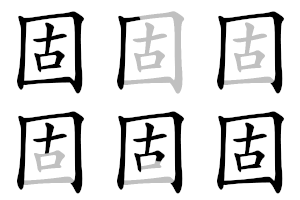
| Stroke order | |||
|---|---|---|---|
 | |||
Han character
固 (Kangxi radical 31, 囗+5, 8 strokes, cangjie input 田十口 (WJR), four-corner 60604, composition ⿴囗古)
References
- Kangxi Dictionary: page 218, character 3
- Dai Kanwa Jiten: character 4745
- Dae Jaweon: page 445, character 23
- Hanyu Da Zidian (first edition): volume 1, page 716, character 9
- Unihan data for U+56FA

Chinese
| simp. and trad. |
固 | |
|---|---|---|
Glyph origin
| Historical forms of the character 固 | |||
|---|---|---|---|
| Western Zhou | Warring States | Shuowen Jiezi (compiled in Han) | Liushutong (compiled in Ming) |
| Bronze inscriptions | Chu slip and silk script | Small seal script | Transcribed ancient scripts |
 |
 |
 |
 |
Characters in the same phonetic series (古) (Zhengzhang, 2003)
| Old Chinese | |
|---|---|
| 箇 | *kaːls |
| 個 | *kaːls |
| 居 | *kɯ, *kas |
| 橭 | *kaː, *kʰaː |
| 嫴 | *kaː |
| 姑 | *kaː |
| 辜 | *kaː |
| 酤 | *kaː, *kaːs, *ɡaːʔ |
| 蛄 | *kaː |
| 鴣 | *kaː |
| 沽 | *kaː, *kaːʔ, *kaːs |
| 盬 | *kaː, *kaːʔ |
| 古 | *kaːʔ |
| 罟 | *kaːʔ |
| 估 | *kaːʔ |
| 鈷 | *kaːʔ |
| 詁 | *kaːʔ |
| 牯 | *kaːʔ |
| 故 | *kaːs |
| 固 | *kaːs |
| 稒 | *kaːɡs |
| 痼 | *kaːɡs |
| 錮 | *kaːɡs |
| 鯝 | *kaːɡs |
| 棝 | *kaːɡs |
| 凅 | *kaːɡs |
| 枯 | *kʰaː |
| 軲 | *kʰaː |
| 跍 | *kʰaː |
| 骷 | *kʰaː |
| 苦 | *kʰaːʔ, *kʰaːs |
| 葫 | *qʰaː, *ɡaː |
| 餬 | *ɡaː |
| 瑚 | *ɡaː |
| 湖 | *ɡaː |
| 鶘 | *ɡaː |
| 猢 | *ɡaː |
| 醐 | *ɡaː |
| 糊 | *ɡaː |
| 箶 | *ɡaː |
| 蝴 | *ɡaː |
| 胡 | *ɡaː |
| 瓳 | *ɡaː |
| 怙 | *ɡaːʔ |
| 祜 | *ɡaːʔ |
| 岵 | *ɡaːʔ |
| 婟 | *ɡaːʔ, *ɡaːɡs |
| 楛 | *ɡaːʔ |
| 据 | *ka |
| 裾 | *ka |
| 琚 | *ka |
| 椐 | *ka, *kas, *kʰa |
| 鶋 | *ka |
| 蜛 | *ka |
| 崌 | *ka |
| 涺 | *ka |
| 腒 | *ka, *ɡa |
| 鋸 | *kas |
| 倨 | *kas |
| 踞 | *kas |
| 涸 | *ɡaːɡ |
Phono-semantic compound (形聲/形声, OC *kaːs) : semantic 囗 + phonetic 古 (OC *kaːʔ).
Etymology
STEDT compares it to Proto-Sino-Tibetan *r-ka (“earth; ground; soil”). Compare Jingpho ga (“earth”), Garo ha (“earth”).
Pronunciation
Definitions
固
- firm; solid; strong
- solid
- to solidify; to strengthen
- 固本 ― gùběn ― to strengthen the foundation
- stubborn
- firmly
- (literary) in the first place; all along
- (literary) no doubt
- 然則小固不可以敵大,寡固不可以敵眾,弱固不可以敵彊。 [Classical Chinese, trad.]
- From: Mencius, c. 4th century BCE
- Ránzé xiǎo gù bù kěyǐ dí dà, guǎ gù bù kěyǐ dí zhòng, ruò gù bù kěyǐ dí qiáng. [Pinyin]
- A small country certainly cannot contend with a great, few certainly cannot contend with many, and the weak certainly cannot contend with the strong.
然则小固不可以敌大,寡固不可以敌众,弱固不可以敌强。 [Classical Chinese, simp.]
Compounds
- 丁固生松
- 不固
- 保固 (bǎogù)
- 保固期
- 僵固
- 凝固 (nínggù)
- 凝固劑/凝固剂
- 凝固點/凝固点
- 北固山
- 北固樓/北固楼
- 固執/固执
- 固執己見/固执己见 (gùzhíjǐjiàn)
- 固壽/固寿
- 固姑
- 固守 (gùshǒu)
- 固宜
- 固定 (gùdìng)
- 固定作用
- 固定價格/固定价格
- 固定匯率/固定汇率
- 固定成本
- 固定格式
- 固定液
- 固定詞組/固定词组
- 固定資本/固定资本
- 固定資產/固定资产 (gùdìng zīchǎn)
- 固定重音
- 固徵/固征
- 固態/固态 (gùtài)
- 固拉合瑪/固拉合玛 (Gùlāhémǎ)
- 固接
- 固時俗/固时俗
- 固有 (gùyǒu)
- 固有國籍/固有国籍
- 固有文化
- 固有道德
- 固本 (gùběn)
- 固步自封 (gùbùzìfēng)
- 固氮 (gùdàn)
- 固氮作用 (gùdàn zuòyòng)
- 固氮菌 (gùdànjūn)
- 固沙林 (gùshālín)
- 固然 (gùrán)
- 固無/固无
- 固瑪/固玛 (Gùmǎ)
- 固疾 (gùjí)
- 固相 (gùxiàng)
- 固知
- 固窮/固穷
- 固節/固节
- 固結/固结
- 固習/固习
- 固若金湯/固若金汤 (gùruòjīntāng)
- 固著/固着
- 固蒂
- 固請/固请
- 固讓/固让
- 固辭/固辞 (gùcí)
- 固遜/固逊
- 固金甌/固金瓯
- 固陋 (gùlòu)
- 固非
- 固體/固体 (gùtǐ)
- 固體潮/固体潮
- 固體電路/固体电路
- 堅固/坚固 (jiāngù)
- 埴固
- 安固
- 巧固球 (qiǎogùqiú)
- 強固/强固 (qiánggù)
- 恪固
- 持祿固寵/持禄固宠
- 推亡固存
- 擁兵自固/拥兵自固
- 擇善固執/择善固执 (zéshàngùzhí)
- 本固枝榮/本固枝荣 (běngùzhīróng)
- 根深固本
- 根深柢固
- 根深蒂固 (gēnshēndìgù)
- 欲取固與/欲取固与
- 深根固本 (shēngēngùběn)
- 深根固柢
- 深根固蒂
- 深閉固距/深闭固距
- 滯固/滞固
- 牢固 (láogù)
- 理固當然/理固当然
- 盤固草/盘固草
- 盤石之固/盘石之固
- 磐石之固
- 稽固
- 穩固/稳固 (wěngù)
- 老頑固/老顽固 (lǎowángù)
- 膠固/胶固
- 膽固醇/胆固醇 (dǎngùchún)
- 藏舟難固/藏舟难固
- 血液凝固
- 裕固族 (Yùgùzú)
- 補氣固表/补气固表
- 覆盂之固
- 負固/负固 (fùgù)
- 貞固/贞固 (zhēngù)
- 負固不悛/负固不悛
- 負固不服/负固不服
- 超固態/超固态 (chāogùtài)
- 鄙固
- 防固
- 險固/险固 (xiǎngù)
- 靳固
- 鞏固/巩固 (gǒnggù)
- 頑固/顽固 (wángù)
- 類固醇/类固醇 (lèigùchún)
Japanese
Readings
Korean
Vietnamese
This article is issued from Wiktionary. The text is licensed under Creative Commons - Attribution - Sharealike. Additional terms may apply for the media files.