懂
See also: 𢤦
| ||||||||
Translingual
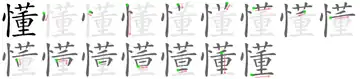
| Stroke order | |||
|---|---|---|---|
 | |||
Han character
懂 (Kangxi radical 61, 心+13, 16 strokes, cangjie input 心廿竹土 (PTHG), four-corner 94014, composition ⿰忄董)
References
- Kangxi Dictionary: page 405, character 12
- Dai Kanwa Jiten: character 11320
- Dae Jaweon: page 745, character 22
- Hanyu Da Zidian (first edition): volume 4, page 2353, character 6
- Unihan data for U+61C2

Chinese
| trad. | 懂 | |
|---|---|---|
| simp. # | 懂 | |
| 2nd round simp. | 㤏 | |
| alternative forms | 𢤦 | |
Glyph origin
Characters in the same phonetic series (重) (Zhengzhang, 2003)
| Old Chinese | |
|---|---|
| 撞 | *rdoːŋ, *rdoːŋs |
| 幢 | *rdoːŋ, *rdoːŋs |
| 橦 | *rdoːŋ, *doːŋ, *tjoŋ |
| 噇 | *rdoːŋ |
| 𩪘 | *rdoːŋ |
| 艟 | *rdoːŋs, *tʰjoŋ |
| 憧 | *rdoːŋs, *tʰjoŋ |
| 畽 | *tʰoːnʔ, *tʰuːnʔ |
| 董 | *toːŋʔ |
| 蕫 | *toːŋʔ, *doːŋ |
| 箽 | *toːŋʔ |
| 懂 | *toːŋʔ |
| 湩 | *toːŋs, *tuːŋʔ, *toŋs |
| 曈 | *tʰoːŋ, *tʰoːŋʔ, *doːŋ |
| 童 | *doːŋ |
| 僮 | *doːŋ |
| 瞳 | *doːŋ |
| 罿 | *doːŋ, *tʰjoŋ |
| 犝 | *doːŋ |
| 潼 | *doːŋ, *tʰjoŋ |
| 穜 | *doːŋ, *doŋ |
| 動 | *doːŋʔ |
| 慟 | *doːŋs |
| 堹 | *toŋs |
| 諥 | *toŋs |
| 蹱 | *tʰoŋ, *tʰoŋs, *tjoŋ |
| 重 | *doŋ, *doŋʔ, *doŋs |
| 緟 | *doŋ, *doŋs |
| 蝩 | *doŋ |
| 褈 | *doŋ, *tʰjoŋ |
| 鐘 | *tjoŋ, *tjoŋ |
| 鍾 | *tjoŋ |
| 籦 | *tjoŋ |
| 種 | *tjoŋʔ, *tjoŋs |
| 腫 | *tjoŋʔ |
| 踵 | *tjoŋʔ |
| 歱 | *tjoŋʔ |
| 喠 | *tjoŋʔ, *tʰjoŋʔ |
| 偅 | *tjoŋs |
| 衝 | *tʰjoŋ |
| 揰 | *tʰjoŋs |
| 尰 | *djoŋʔ |
Phono-semantic compound (形聲/形声, OC *toːŋʔ) : semantic 心 (“heart”) + phonetic 董 (OC *toːŋʔ).
Etymology
Perhaps cognate with 黨 (OC *taːŋʔ, “to know”), an ancient Chu dialect word (Schuessler, 2007).
Pronunciation
Definitions
懂
- to understand; to comprehend
- (Singapore, Hong Kong) to know
- Used in 懵懂 (měngdǒng, “confused”).
- a surname: Dong
Synonyms
- (to understand):
- 了解 (liǎojiě)
- 佔有/占有 (zhànyǒu)
- 分曉/分晓 (fēnxiǎo)
- 參悟/参悟 (cānwù)
- 悟 (wù) (literary, or in compounds)
- 懂得 (dǒngde)
- 打生 (Wenzhounese)
- 把握 (bǎwò)
- 掌握 (zhǎngwò)
- 明 (ming4) (Cantonese)
- 明白
- 明瞭/明了 (míngliǎo)
- 曉得/晓得 (xiǎode)
- 會悟/会悟 (huìwù) (literary)
- 洞悉 (dòngxī)
- 清亮 (mainland China)
- 清楚
- 熟似 (Hokkien)
- 熟悉 (shúxī)
- 熟稔 (shúrěn) (literary)
- 熟識/熟识 (shúshí)
- 理會/理会 (lǐhuì)
- 理解 (lǐjiě)
- 瞭悟/了悟 (liǎowù) (literary)
- 知影 (Hokkien, Teochew)
- 知悉 (zhīxī) (literary)
- 知曉/知晓 (zhīxiǎo)
- 知識/知识 (zhīshí) (literary)
- 知道
- 覺/觉
- 覺悟/觉悟 (juéwù)
- 覺醒/觉醒 (juéxǐng)
- 認識/认识
- 諳曉/谙晓 (ānxiǎo) (literary)
- 諳達/谙达 (āndá) (literary)
- 貫通/贯通 (guàntōng)
- 通曉/通晓 (tōngxiǎo)
- 通解 (tōngjiě) (literary)
- 通達/通达 (tōngdá)
- 達/达 (literary, or in compounds)
- 醒悟 (xǐngwù)
- 開悟/开悟 (kāiwù) (literary)
- 領悟/领悟 (lǐngwù)
- 領會/领会 (lǐnghuì)
- 領略/领略 (lǐnglüè)
Antonyms
- (antonym(s) of “to understand”):
Japanese
Kanji
懂
- This term needs a translation to English. Please help out and add a translation, then remove the text
{{rfdef}}.
Korean
Vietnamese
Han character
懂: Hán Nôm readings: đổng, đỏng
- This term needs a translation to English. Please help out and add a translation, then remove the text
{{rfdef}}.
This article is issued from Wiktionary. The text is licensed under Creative Commons - Attribution - Sharealike. Additional terms may apply for the media files.