哉
See also: 或
| ||||||||
Translingual
Han character
哉 (Kangxi radical 30, 口+6, 9 strokes, cangjie input 十戈口 (JIR), four-corner 43650, composition ⿹𢦏口)
References
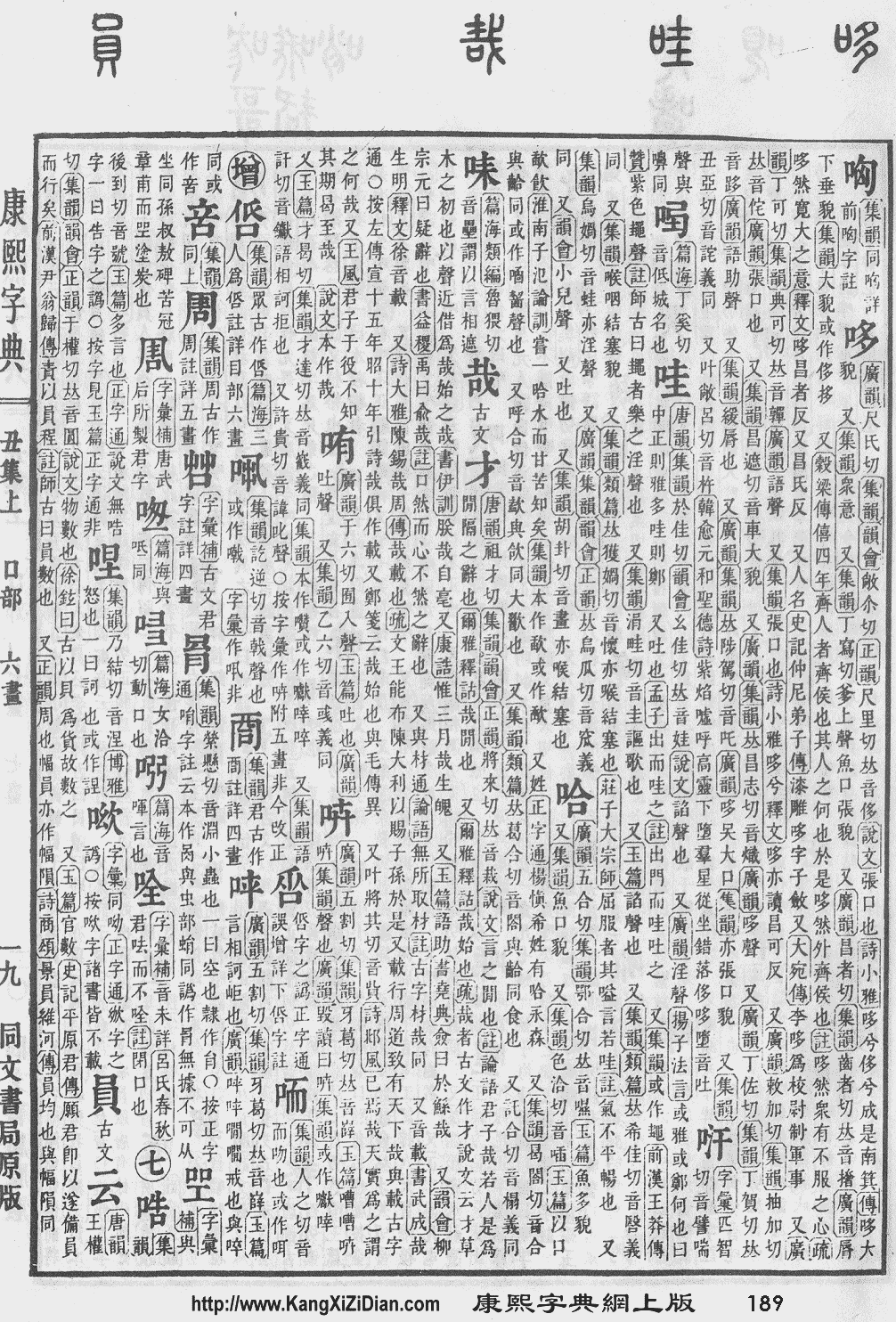
- Kangxi Dictionary: page 189, character 8
- Dai Kanwa Jiten: character 3596
- Dae Jaweon: page 408, character 14
- Hanyu Da Zidian (first edition): volume 1, page 611, character 7
- Unihan data for U+54C9
Chinese
Glyph origin
| Historical forms of the character 哉 |
|---|
| Spring and Autumn |
| Bronze inscriptions |
 |
Characters in the same phonetic series (𢦏) (Zhengzhang, 2003)
Phono-semantic compound (形聲/形声, OC *ʔslɯː) : semantic 口 + phonetic 𢦏 (OC *ʔslɯː).
Pronunciation
Definitions
哉
- † grammatical particle indicating emphasis
- sentence-medial particle indicating inverted construction for the emphasis of the predicate
- 大哉斯言! [Classical Chinese] ― Dà zāi sī yán! [Pinyin] ― How great, these words!
- 子路曰:「有是哉,子之迂也!奚其正?」子曰:「野哉由也!君子於其所不知,蓋闕如也。」 [Classical Chinese, trad.]
- From: The Analects of Confucius, c. 475 – 221 BCE, translated based on James Legge's version
- Zǐlù yuē: “Yǒu shì zāi, zǐ zhī yū yě! Xī qí zhèng?” Zǐyuē: “Yě zāi Yóu yě! Jūnzǐ yú qí suǒbùzhī, gài quèrú yě.” [Pinyin]
- "So! indeed!" said Zilu, "You are wide of the mark! Why must there be such rectification?" The Master said, "How uncultivated you are, Zhongyou! A superior man, in regard to what he does not know, shows a cautious reserve."
子路曰:「有是哉,子之迂也!奚其正?」子曰:「野哉由也!君子于其所不知,盖阙如也。」 [Classical Chinese, simp.]
- sentence-final particle indicating exclamation, emphasis, or strong intention
- 子曰:「默而識之,學而不厭,誨人不倦,何有於我哉?」 [Classical Chinese, trad.]
- From: The Analects of Confucius, c. 475 – 221 BCE, translated based on James Legge's version
- Zǐyuē: “Mò ér zhìzhī, xué ér bùyàn, huìrén bùjuàn, hé yǒuyúwǒ zāi?” [Pinyin]
- The Master said, "The silent treasuring up of knowledge; learning without satiety; and instructing others without being wearied - which one of these things belongs to me?"
子曰:「默而识之,学而不厌,诲人不倦,何有于我哉?」 [Classical Chinese, simp.]- 欽念哉!欽念哉! [Classical Chinese, trad.]
- From: The Records of the Grand Historian, by Sima Qian, c. 91 BCE
- Qīn niàn zāi! Qīn niàn zāi! [Pinyin]
- Be reverent and remember this!
钦念哉!钦念哉! [Classical Chinese, simp.]
- sentence-medial particle indicating inverted construction for the emphasis of the predicate
- † begin, commence
- 惟三月哉生魄,周公初基作新大邑于東國洛。 [Classical Chinese, trad.]
- From: The Book of Documents, circa 4th – 3rd century BCE
- Wéi sānyuè zāi shēngpò, Zhōugōng chū jī zuò xīndàyì yú dōngguó luò. [Pinyin]
- On the third month, when the moon began to wane, the duke of Zhou commenced the foundations, and proceeded to build the new great city of Lo, of the eastern states.
惟三月哉生魄,周公初基作新大邑于东国洛。 [Classical Chinese, simp.]
See also
- 兮 (xī)
Compounds
Etymology 2
| simp. and trad. |
哉 | |
|---|---|---|
| alternative forms | 者 | |
According to Qian (2010), in contemporary Urban Shanghainese, it has become 了 through lenition (/zəʔ/ > /ləʔ/). Full lenition chain 哉 (MC tsoj) > Suzhounese /t͡se/ > Suburban Shanghainese /tæʔ/, while Old urban Shanghainese/ze/ /zəʔ/ > Contemporary urban Shanghainese/ləʔ/(This etymology is missing or incomplete. Please add to it, or discuss it at the Etymology scriptorium.)
Pronunciation
Definitions
哉 (Wu)
- (Northern Wu) Sentence-final particle used to indicate the present tense
- 打勿得哉! [Shanghainese, trad. and simp.]
- From: 1892, 韓邦慶 (Han Bangqing), 《海上花列傳》
- 5tan veq-teq 0tse [Wugniu]
- Do not fight!
Usage notes
- Unlike Standard Chinese, Northern Wu languages can mark for some tenses, like many European languages. This term, therefore, cannot be accurately translated into Standard Chinese. In contemporary Shanghainese, 了 is more common.
Pronunciation
Japanese
Readings
Etymology 2
| Kanji in this term |
|---|
| 哉 |
| かな Jinmeiyō |
| kun’yomi |
| For pronunciation and definitions of 哉 – see the following entry. | ||
| ||
| (This term, 哉, is an alternative spelling of the above term.) |
Korean
Hanja
哉 (eum 재 (jae))
- This term needs a translation to English. Please help out and add a translation, then remove the text
{{rfdef}}.
Vietnamese
This article is issued from Wiktionary. The text is licensed under Creative Commons - Attribution - Sharealike. Additional terms may apply for the media files.