美
| ||||||||
Translingual
| Stroke order | |||
|---|---|---|---|
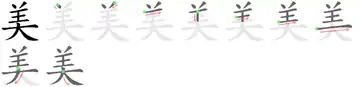 | |||
| Stroke order (Chinese) | |||
|---|---|---|---|
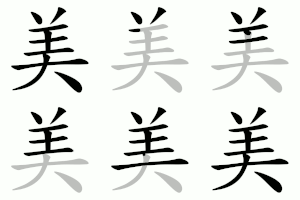 | |||
| Stroke order (Japan) | |||
|---|---|---|---|
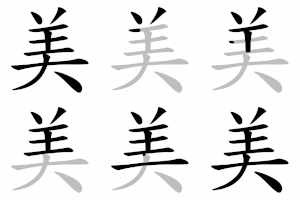 | |||
Han character
美 (Kangxi radical 123, 羊+3, 9 strokes, cangjie input 廿土大 (TGK), four-corner 80431, composition ⿱𦍌大)
Descendants
Derived characters
References
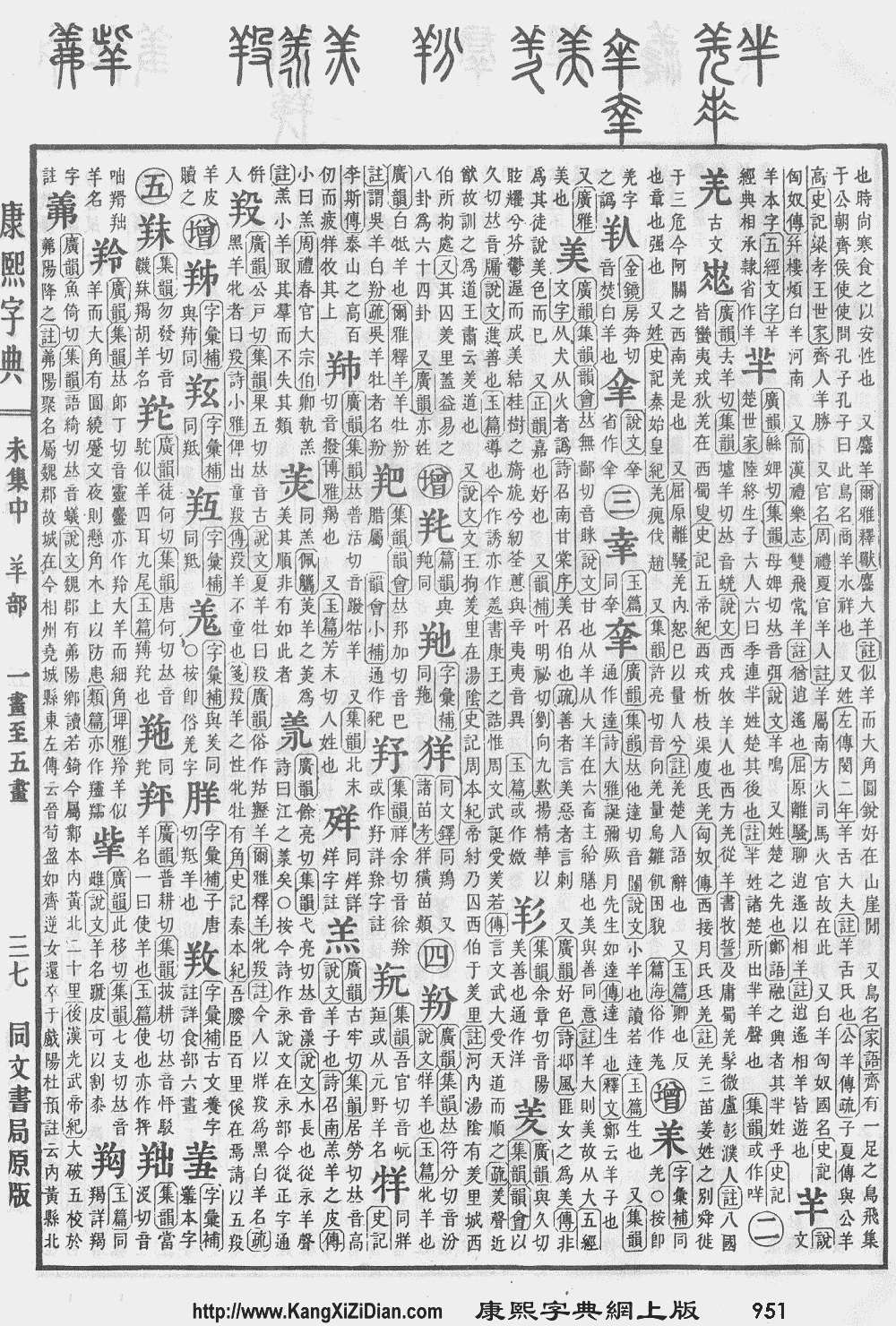
- Kangxi Dictionary: page 951, character 10
- Dai Kanwa Jiten: character 28435
- Dae Jaweon: page 1393, character 17
- Hanyu Da Zidian (first edition): volume 5, page 3126, character 5
- Unihan data for U+7F8E
Chinese
| trad. | 美 | |
|---|---|---|
| simp. # | 美 | |
| alternative forms | 媄 羙 媺 ancient 嬍 ancient 𫟈 | |
Glyph origin
| Historical forms of the character 美 | |
|---|---|
| Shang | Western Zhou |
| Oracle bone script | Bronze inscriptions |
 |
 |
Pictogram (象形) – a person (大) wearing a headdress (now written 羊) of feathers or ram's horn.
The modern form could be considered an ideogrammic compound (會意/会意) : 羊 (“ram or feathers”) + 大 (“person”).
Etymology
From Proto-Sino-Tibetan *mwaj (“beautiful, well, perfectly”) (STEDT).
According to Schuessler (2007), cognate with Mizo mawi (“beautiful, lovely”), Jingpho moi (“perfectly, beautifully”) as well as Karbi me- (“be good”) and Jingpho cha mai (“good”); the former two items from *moy "beautiful" and the latter from *may "good, well", which were two roots reconstructed separately by Benedict (1972).
Pronunciation
Definitions
美
- beautiful; pretty; attractive; good-looking
- delicious; tasty; flavoursome
- 美食 ― měishí ― culinary delicacy
- good; fine; satisfactory; happy
- to beautify; to prettify
- 美容 ― měiróng ― to improve one's appearance
- to praise; to commend
- (colloquial) to be pleased with oneself
- beautiful things; beauty
- Short for 美洲 (Měizhōu, “America (continent)”).
- 南美 ― Nánměi ― South America
- Short for 美國/美国 (Měiguó, “United States of America”).
- a surname. Mei
Synonyms
Compounds
- 七美 (Qīměi)
- 不作美
- 不美
- 丰神俊美
- 中美
- 中美地峽/中美地峡
- 中美洲 (Zhōngměizhōu)
- 五講四美/五讲四美
- 亞美利加/亚美利加 (yàměilìjiā)
- 亞美尼亞/亚美尼亚 (yàměiníyà)
- 作美 (zuòměi)
- 俊美 (jùnměi)
- 健美 (jiànměi)
- 價廉物美/价廉物美 (jiàliánwùměi)
- 優美/优美 (yōuměi)
- 內在美/内在美 (nèizàiměi)
- 內美/内美
- 全身美白
- 兩全其美/两全其美 (liǎngquánqíměi)
- 劇秦美新/剧秦美新
- 北美洲 (Běiměizhōu)
- 北美狼
- 十全十美 (shíquánshíměi)
- 南美 (Nán Měi)
- 南美洲 (Nánměizhōu)
- 和美 (héměi)
- 唯美 (wéiměi)
- 唯美主義/唯美主义 (wéiměi zhǔyì)
- 嘆美/叹美 (tànměi)
- 四美
- 壯美/壮美 (zhuàngměi)
- 外在美 (wàizàiměi)
- 姣美 (jiāoměi)
- 娟美
- 媲美 (pìměi)
- 嬌妻美妾/娇妻美妾
- 嬌美/娇美 (jiāoměi)
- 完美 (wánměi)
- 完美主義/完美主义 (wánměi zhǔyì)
- 完美無缺/完美无缺 (wánměiwúquē)
- 容美 (Róngměi)
- 審美/审美 (shěnměi)
- 專美/专美 (zhuānměi)
- 專美於前/专美于前
- 小針美容/小针美容
- 工藝美術/工艺美术 (gōngyì měishù)
- 巴美 (Bāměi)
- 帕耳美拉
- 年輕貌美/年轻貌美
- 幽美 (yōuměi)
- 形式美
- 想得美 (xiǎngdeměi)
- 愛美/爱美 (àiměi)
- 成人之美 (chéngrénzhīměi)
- 拉丁美洲 (Lādīng Měizhōu)
- 掠人之美
- 掩惡溢美/掩恶溢美
- 掠美
- 攘人之美
- 曲線美/曲线美 (qūxiànměi)
- 東南之美/东南之美
- 林美 (Línměi)
- 柔美 (róuměi)
- 歐洲美元/欧洲美元
- 歎美/叹美 (tànměi)
- 歐美/欧美 (Ōu-Měi)
- 歐風美雨/欧风美雨 (ōufēngměiyǔ)
- 比較美學/比较美学
- 汎美/泛美
- 汎美主義/泛美主义 (fànměizhǔyì)
- 汽車美容/汽车美容
- 泛美
- 洞窟美術/洞窟美术
- 淒美/凄美 (qīměi)
- 淑美
- 溢美 (yìměi)
- 潘岳貌美
- 潘美
- 濟美/济美
- 烏圖美仁/乌图美仁 (Wūtúměirén)
- 物美價廉/物美价廉 (wùměijiàlián)
- 特性美
- 玉成其美
- 珍羞美味
- 班美之戰/班美之战
- 甘美 (gānměi)
- 甘言美語/甘言美语
- 甜美 (tiánměi)
- 甜言美語/甜言美语 (tiányánměiyǔ)
- 男美
- 留美學人/留美学人
- 百美圖/百美图
- 盡善盡美/尽善尽美 (jìnshànjìnměi)
- 盡美盡善/尽美尽善
- 真善美 (zhēn-shàn-měi)
- 睡美人 (Shuìměirén)
- 秀美 (xiùměi)
- 稱美/称美 (chēngměi)
- 空間美/空间美
- 精美 (jīngměi)
- 精美絕倫/精美绝伦
- 精金美玉
- 網路美女/网路美女
- 網路選美/网路选美
- 美不勝收/美不胜收 (měibùshèngshōu)
- 美不滋
- 美中不足 (měizhōngbùzú)
- 美乃滋 (měinǎizī)
- 美事 (měishì)
- 美人 (měirén)
- 美人兒/美人儿 (měirénr)
- 美人命薄
- 美人尖 (měirénjiān)
- 美人局
- 美人拳
- 美人樹/美人树
- 美人燈兒/美人灯儿 (měiréndēngr)
- 美人癆/美人痨 (měirénláo)
- 美人胚子
- 美人胎子
- 美人蕉 (měirénjiāo)
- 美人計/美人计 (měirénjì)
- 美人記/美人记
- 美人遲暮/美人迟暮
- 美人香草
- 美人魚/美人鱼 (měirényú)
- 美仁 (Měirén)
- 美侖美奐/美仑美奂
- 美備/美备
- 美元 (měiyuán)
- 美其名曰 (měiqímíngyuē)
- 美冠一方
- 美利
- 美勁兒/美劲儿
- 美勞/美劳
- 美化 (měihuà)
- 美名 (měimíng)
- 美味 (měiwèi)
- 美味兒/美味儿
- 美味可口
- 美商 (měishāng)
- 美善 (měishàn)
- 美噸/美吨 (měidūn)
- 美國/美国 (Měiguó)
- 美國佬/美国佬 (Měiguólǎo)
- 美圓/美圆 (měiyuán)
- 美夢/美梦 (měimèng)
- 美夢成真/美梦成真 (měimèngchéngzhēn)
- 美夢難圓/美梦难圆
- 美大
- 美奐美輪/美奂美轮
- 美女 (měinǚ)
- 美女如雲/美女如云
- 美女破舌
- 美女篇
- 美女簪花
- 美好 (měihǎo)
- 美如冠玉
- 美妙 (měimiào)
- 美嬌娘/美娇娘
- 美孚油
- 美孚燈/美孚灯
- 美學/美学 (měixué)
- 美官
- 美容 (měiróng)
- 美容師/美容师 (měiróngshī)
- 美容術/美容术
- 美容院 (měiróngyuàn)
- 美容體操/美容体操 (měiróng tǐcāo)
- 美展
- 美工 (měigōng)
- 美工指導/美工指导
- 美差
- 美式 (měishì)
- 美式足球 (měishì zúqiú)
- 美得冒泡
- 美德 (měidé)
- 美惡/美恶
- 美感 (měigǎn)
- 美意 (měiyì)
- 美意延年
- 美才
- 美政
- 美景 (měijǐng)
- 美景良辰
- 美洲 (Měizhōu)
- 美洲組織/美洲组织
- 美洲虎
- 美洲豹 (měizhōubào)
- 美滋滋 (měizīzī)
- 美滿/美满 (měimǎn)
- 美滿收場/美满收场
- 美濃/美浓 (Měinóng)
- 美澤鑑人/美泽鉴人
- 美玉 (měiyù)
- 美玉無瑕/美玉无瑕
- 美甘甘
- 美田
- 美男子 (měinánzǐ)
- 美男破老
- 美目
- 美眄
- 美盼
- 美眷
- 美眷姻
- 美祥
- 美秀
- 美稱/美称 (měichēng)
- 美缺
- 美美
- 美耐板 (měinàibǎn)
- 美耐皿 (měinàimǐn)
- 美聲/美声 (měishēng)
- 美聲唱法/美声唱法 (měishēng chàngfǎ)
- 美聯社/美联社 (Měiliánshè)
- 美育 (měiyù)
- 美舉/美举
- 美色 (měisè)
- 美蒂雅
- 美處/美处
- 美術/美术 (měishù)
- 美術史/美术史 (měishùshǐ)
- 美術品/美术品 (měishùpǐn)
- 美術大師/美术大师
- 美術字/美术字 (měishùzì)
- 美術家/美术家 (měishùjiā)
- 美術燈/美术灯
- 美術片/美术片 (měishùpiàn)
- 美術節/美术节
- 美術設計/美术设计
- 美術電影/美术电影
- 美術館/美术馆 (měishùguǎn)
- 美衣玉食
- 美觀/美观 (měiguān)
- 美言 (měiyán)
- 美言不信
- 美計/美计
- 美談/美谈 (měitán)
- 美譽/美誉 (měiyù)
- 美豔/美艳 (měiyàn)
- 美貌 (měimào)
- 美貌無雙/美貌无双
- 美質/美质
- 美身
- 美輪美奐/美轮美奂 (měilúnměihuàn)
- 美遷/美迁
- 美選/美选
- 美酒 (měijiǔ)
- 美酒佳肴
- 美醜/美丑
- 美金 (měijīn)
- 美鈔/美钞 (měichāo)
- 美錦/美锦
- 美除
- 美食 (měishí)
- 美食家 (měishíjiā)
- 美食甘寢/美食甘寝
- 美餐 (měicān)
- 美饌/美馔 (měizhuàn)
- 美饌佳餚/美馔佳肴
- 美髮/美发 (měifà)
- 美髯公
- 美髮廳/美发厅
- 美麗/美丽 (měilì)
- 美麗奴羊/美丽奴羊
- 肥美 (féiměi)
- 自然美
- 臭美 (chòuměi)
- 至善至美
- 良宵美景
- 良時美景/良时美景
- 良田美地
- 良質美手/良质美手
- 良辰美景 (liángchénměijǐng)
- 良金美玉
- 艾美獎/艾美奖
- 莎樂美/莎乐美 (shālèměi)
- 華美/华美
- 葛萊美獎/葛莱美奖
- 蓀美/荪美
- 蘇美人/苏美人
- 虞美人 (yúměirén)
- 蛇蠍美人/蛇蝎美人 (shéxiē měirén)
- 褒美 (bāoměi)
- 觀美/观美
- 講美/讲美 (Jiǎngměi)
- 讚美/赞美 (zànměi)
- 讚美歌/赞美歌 (zànměigē)
- 讚美詩/赞美诗 (zànměishī)
- 豐美/丰美 (fēngměi)
- 豔美無敵/艳美无敌
- 豔美絕俗/艳美绝俗
- 貌美
- 貌美如花
- 遒美
- 達荷美/达荷美 (Dáhéměi)
- 選美/选美 (xuǎnměi)
- 邵美
- 配天之美
- 醇美
- 里仁為美
- 鍘美案/铡美案
- 阿美族 (Āměizú)
- 陳其美/陈其美
- 隆美爾/隆美尔
- 雅美族 (yǎměizú)
- 電影美術/电影美术
- 電腦美工/电脑美工
- 靜美/静美
- 面如美玉
- 頌美/颂美
- 風和日美/风和日美
- 香草美人
- 體內美容/体内美容
- 鮮美/鲜美 (xiānměi)
- 鮮衣美食/鲜衣美食
- 鳳毛濟美/凤毛济美
References
- “美”, in 漢語多功能字庫 (Multi-function Chinese Character Database), 香港中文大學 (the Chinese University of Hong Kong), 2014–
- “Entry #5385”, in 臺灣閩南語常用詞辭典 [Dictionary of Frequently-Used Taiwan Minnan] (overall work in Mandarin and Hokkien), Ministry of Education, R.O.C., 2023.
Japanese
Readings
Compounds
Etymology 1
| Kanji in this term |
|---|
| 美 |
| び Grade: 3 |
| kan’on |
Inflection
| Stem forms | |||
|---|---|---|---|
| Imperfective (未然形) | 美だろ | びだろ | bi daro |
| Continuative (連用形) | 美で | びで | bi de |
| Terminal (終止形) | 美だ | びだ | bi da |
| Attributive (連体形) | 美な | びな | bi na |
| Hypothetical (仮定形) | 美なら | びなら | bi nara |
| Imperative (命令形) | 美であれ | びであれ | bi de are |
| Key constructions | |||
| Informal negative | 美ではない 美じゃない |
びではない びじゃない |
bi de wa nai bi ja nai |
| Informal past | 美だった | びだった | bi datta |
| Informal negative past | 美ではなかった 美じゃなかった |
びではなかった びじゃなかった |
bi de wa nakatta bi ja nakatta |
| Formal | 美です | びです | bi desu |
| Formal negative | 美ではありません 美じゃありません |
びではありません びじゃありません |
bi de wa arimasen bi ja arimasen |
| Formal past | 美でした | びでした | bi deshita |
| Formal negative past | 美ではありませんでした 美じゃありませんでした |
びではありませんでした びじゃありませんでした |
bi de wa arimasen deshita bi ja arimasen deshita |
| Conjunctive | 美で | びで | bi de |
| Conditional | 美なら(ば) | びなら(ば) | bi nara (ba) |
| Provisional | 美だったら | びだったら | bi dattara |
| Volitional | 美だろう | びだろう | bi darō |
| Adverbial | 美に | びに | bi ni |
| Degree | 美さ | びさ | bisa |
| Stem forms | ||||
|---|---|---|---|---|
| Irrealis (未然形) | 美なら | びなら | binara | |
| Continuative (連用形) | 美に[1] 美なり[2] | びに びなり | bini binari | |
| Terminal (終止形) | 美なり | びなり | binari | |
| Attributive (連体形) | 美なる | びなる | binaru | |
| Realis (已然形) | 美なれ | びなれ | binare | |
| Imperative (命令形) | 美なれ | びなれ | binare | |
| Key constructions | ||||
| Negative | 美ならず | びならず | binarazu | |
| Contrasting conjunction | 美なれど | びなれど | binaredo | |
| Causal conjunction | 美なれば | びなれば | binareba | |
| Conditional conjunction | 美ならば | びならば | binaraba | |
| Past tense (firsthand knowledge) | 美なりき | びなりき | binariki | |
| Past tense (secondhand knowledge) | 美なりけり | びなりけり | binarikeri | |
| Adverbial | 美に | びに | bini | |
| [1]Without auxiliary verb. [2]With auxiliary verb. | ||||
Etymology 2
| Kanji in this term |
|---|
| 美 |
| み Grade: 3 |
| goon |
Pronunciation
- IPA(key): [mʲi]
Suffix
美 • (-mi)
- suffix used by female given names, such as 奈美 (なみ, Nami), 恵美 (えみ, Emi; めぐみ, Megumi), 宏美 (ひろみ, Hiromi)
- (rare) suffix used by male given names
References
- Matsumura, Akira, editor (2006), 大辞林 [Daijirin] (in Japanese), Third edition, Tōkyō: Sanseidō, →ISBN
Korean
Etymology
From Middle Chinese 美 (MC mijX).
| Historical Readings | ||
|---|---|---|
| Dongguk Jeongun Reading | ||
| Dongguk Jeongun, 1448 | 밍〯 (Yale: mǐ) | |
| Middle Korean | ||
| Text | Eumhun | |
| Gloss (hun) | Reading | |
| Gwangju Cheonjamun, 1575 | 아ᄅᆞᆷ다올 (Yale: alom-tawol) | 미 (Yale: mi) |
Pronunciation
- (USA (in compounds)):
- (SK Standard/Seoul) IPA(key): [mi]
- Phonetic hangul: [미]
- (beauty; good; etc.):
- (SK Standard/Seoul) IPA(key): [mi(ː)]
- Phonetic hangul: [미(ː)]
- Though still prescribed in Standard Korean, most speakers in both Koreas no longer distinguish vowel length.
Compounds
- 미속 (美俗, misok)
- 미덕 (美德, mideok)
- 미국 (美國, Miguk)
- 미학 (美學, mihak)
- 미술 (美術, misul)
- 미군 (美軍, migun)
- 미인 (美人, miin)
- 감미 (甘美, gammi)
- 한미 (韓美, hanmi)
- 미모 (美貌, mimo)
- 대미 (對美, daemi)
- 미화 (美化, mihwa)
- 반미 (反美, banmi)
- 주미 (駐美, jumi)
- 남미 (南美, Nammi)
- 구미 (歐美, Gumi)
- 북미 (北美, Bungmi)
- 미점 (美點, mijeom)
- 미남 (美男, minam)
- 도미 (渡美, domi)
- 미경 (美景, migyeong)
- 미관 (美觀, migwan)
- 미려 (美麗, miryeo)
- 미식 (美式, misik)
- 미풍 (美風, mipung)
- 찬미 (讚美, chanmi)
- 미명 (美名, mimyeong)
- 미용 (美容, miyong)
- 전미 (全美, jeonmi)
- 미녀 (美女, minyeo)
- 미적 (美的, mijeok)
- 미주 (美洲, miju)
- 극미 (極美, geungmi)
- 미감 (美感, migam)
- 미림 (美林, mirim)
- 미주 (美酒, miju)
- 재미 (在美, jaemi)
- 미경 (美境, migyeong)
- 미장 (美粧, mijang)
- 미칭 (美稱, miching)
- 찬미 (讚美, chanmi)
- 탐미 (耽美, tammi)
- 미과 (美果, migwa)
- 방미 (訪美, bangmi)
- 미소 (美蘇, miso)
- 미일 (美日, miil)
- 고미 (高美, gomi)
- 미대 (美大, midae)
- 미백 (美白, mibaek)
- 미사 (美事, misa)
- 미식 (美食, misik)
- 미안 (美顔, mian)
- 미언 (美言, mieon)
- 미호 (美好, miho)
- 화미 (華美, hwami)
- 미성 (美聲, miseong)
- 미묘 (美妙, mimyo)
- 미문 (美文, mimun)
- 미본 (美本, mibon)
- 미색 (美色, misaek)
- 미소년 (美少年, misonyeon)
- 미소녀 (美少女, misonyeo)
- 미국 영어 (美國英語, Miguk yeong'eo)
Vietnamese
Han character
美: Hán Việt readings: mỹ[1][2], mĩ[3]
美: Nôm readings: mẻ[2][3][4], mẹ[1][2], mỹ[1][2], mẽ[1][4], mỉa[1][4], mở[1], mỉ[3], mĩ[4]
References
- Nguyễn (2014).
- Nguyễn et al. (2009).
- Trần (2004).
- Taberd & Pigneau de Béhaine (1838).