筷
See also: 箸
| ||||||||
Translingual
| Stroke order | |||
|---|---|---|---|
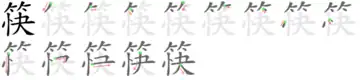 | |||
Han character
筷 (Kangxi radical 118, 竹+7, 13 strokes, cangjie input 竹心木大 (HPDK), four-corner 88934, composition ⿱𥫗快)
References
- Kangxi Dictionary: not present, would follow page 886, character 23
- Dai Kanwa Jiten: character 26100
- Dae Jaweon: page 1314, character 18
- Hanyu Da Zidian (first edition): volume 5, page 2975, character 15
- Unihan data for U+7B77

Chinese
| trad. | 筷 | |
|---|---|---|
| simp. # | 筷 | |
Etymology 1
From 快 (kuài), originally euphemistic for 箸 (zhù), homophonous to 住 (zhù, “to stay; to stop”). See 筷子 (kuàizi) for more.
Pronunciation
Definitions
筷
Synonyms
Dialectal synonyms of 筷子 (“chopsticks”) [map]
Compounds
Pronunciation
Definitions
筷
- (Hokkien, Teochew) Alternative form of 箸 (“chopstick”)
-
- 妳甘知咱的愛情親像一双筷 挾著酸甘苦淡的滋味 [Taiwanese Hokkien, trad.]
- lí kám chai lán ê ài-chêng chhin-chhiūⁿ chi̍t siang tī, ngeh-tio̍h sng-kam-khó͘-chiáⁿ ê chu-bī [Pe̍h-ōe-jī]
- Do you know that our love is like a pair of chopsticks, holding sourness, sweetness, bitterness and tastelessness?
你甘知咱的爱情亲像一双筷 挟著酸甘苦淡的滋味 [Taiwanese Hokkien, simp.]
Japanese
This article is issued from Wiktionary. The text is licensed under Creative Commons - Attribution - Sharealike. Additional terms may apply for the media files.