沈
| ||||||||
| ||||||||
Translingual
| Traditional | 沉 |
|---|---|
| Simplified | 沉 |
| Japanese | 沈 |
| Korean | 沈 |
Han character
沈 (Kangxi radical 85, 水+4, 7 strokes, cangjie input 水中月山 (ELBU), four-corner 34112, composition ⿰氵冘)
References
- Kangxi Dictionary: page 610, character 6
- Dai Kanwa Jiten: character 17189
- Dae Jaweon: page 1002, character 15
- Hanyu Da Zidian (first edition): volume 3, page 1572, character 7
- Unihan data for U+6C88
- Unihan data for U+F972
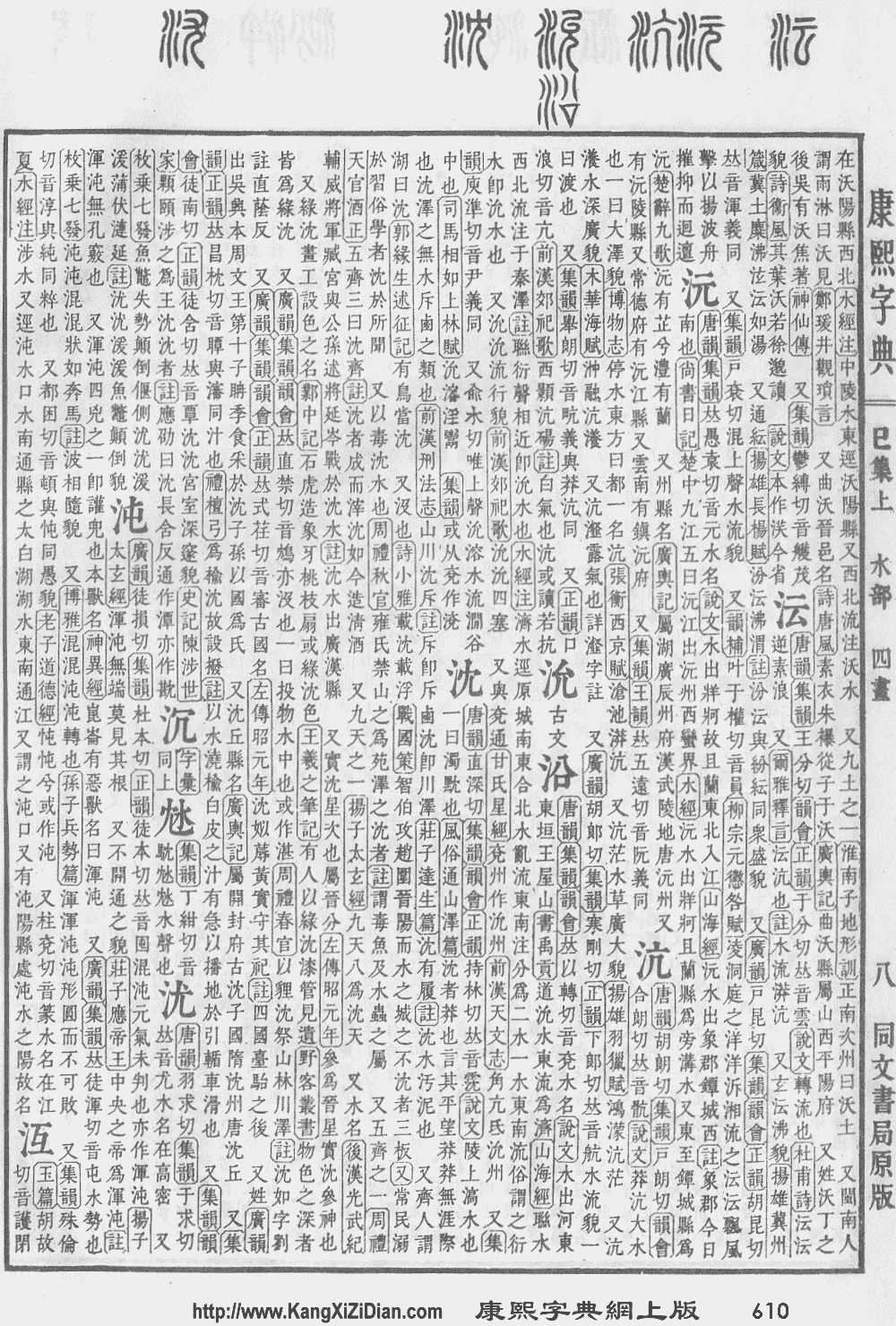
Chinese
Glyph origin
| Historical forms of the character 沈 | ||||
|---|---|---|---|---|
| Shang | Western Zhou | Warring States | Shuowen Jiezi (compiled in Han) | Liushutong (compiled in Ming) |
| Oracle bone script | Bronze inscriptions | Chu slip and silk script | Small seal script | Transcribed ancient scripts |
 |
 |
 |
 |
 |
Characters in the same phonetic series (冘) (Zhengzhang, 2003)
| Old Chinese | |
|---|---|
| 冘 | *lu, *lum |
| 抌 | *lu, *ʔl'uːmʔ, *loʔ |
| 狖 | *lus |
| 貁 | *lus |
| 耽 | *ʔl'uːm |
| 眈 | *ʔl'uːm, *ʔl'uːmʔ, *l'uːm |
| 酖 | *ʔl'uːm |
| 妉 | *ʔl'uːm |
| 黕 | *ʔl'uːmʔ |
| 衴 | *ʔl'uːmʔ |
| 瓭 | *ʔl'uːmʔ |
| 馾 | *ʔl'uːms |
| 髧 | *l'uːmʔ |
| 紞 | *ʔl'oːmʔ |
| 鈂 | *zlum, *l'um |
| 沈 | *l'um, *l'ums, *hljumʔ |
| 沉 | *l'um |
| 枕 | *l'um, *ʔljumʔ, *ʔljums |
| 莐 | *l'um |
| 霃 | *l'um |
| 鴆 | *l'ums |
| 訦 | *ɦljum, *ɦljumʔ |
| 忱 | *ɦljum |
| 邥 | *hljumʔ |
| 魫 | *hljumʔ |
In the oracle bone script, it was an ideogrammic compound (會意/会意) : 水 (“water”) + 羊 (“sheep”) — to submerge a sheep into the water (as a form of sacrifice to the river god). Other forms included 牛 (“ox”) or 玉 (“jade”) instead of 羊.
Starting from the bronze inscriptions, it became a phono-semantic compound (形聲/形声, OC *l'um, *l'ums, *hljumʔ) : semantic 水 (“water”) + phonetic 冘 (OC *lu, *lum).
This character was later borrowed to signify the surname, and the variant 沉 (OC *l'um) was adopted for the original meaning.
Etymology 1
| For pronunciation and definitions of 沈 – see 瀋 (“liquid; juice; to pour; etc.”). (This character is the simplified form of 瀋). |
Notes:
|
Pronunciation
Definitions
沈
Compounds
Pronunciation
Definitions
沈
- (historical) Shen, a state during the Zhou dynasty and located in modern-day Henan
- 三年,春,莊叔會諸侯之師伐沈,以其服於楚也,沈潰。凡民逃其上曰潰,在上曰逃。 [Classical Chinese, trad.]
- From: Commentary of Zuo, c. 4th century BCE
- Sānnián, chūn, Zhuāngshū huì zhūhóu zhī shī fá Shěn, yǐ qí fú yú chǔ yě, Shěn kuì. Fán mín táo qí shàng yuē kuì, zàishàng yuē táo. [Pinyin]
- In the third year's spring, Zhuangshu gathered the various princes' armies and attacked Shen, because it had submitted to Chu. Shen was routed. Whenever the people deserted their superiors, it's called "rout"; when superiors do so, it's called "desert".
三年,春,庄叔会诸侯之师伐沈,以其服于楚也,沈溃。凡民逃其上曰溃,在上曰逃。 [Classical Chinese, simp.]
- a surname
Pronunciation
Definitions
沈
- Only used in 沈沈.
Japanese
Korean
Etymology 1
From Middle Chinese 沈 (MC drim).
| Historical readings |
|---|
|
Pronunciation
- (SK Standard/Seoul) IPA(key): [t͡ɕʰim]
- Phonetic hangul: [침]
Compounds
Etymology 2
From Middle Chinese 沈 (MC syimX).
| Historical readings |
|---|
|
Pronunciation
- (SK Standard/Seoul) IPA(key): [ɕʰi(ː)m]
- Phonetic hangul: [심(ː)]
- Though still prescribed in Standard Korean, most speakers in both Koreas no longer distinguish vowel length.
Vietnamese
This article is issued from Wiktionary. The text is licensed under Creative Commons - Attribution - Sharealike. Additional terms may apply for the media files.