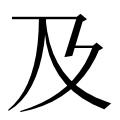
及
| ||||||||
 | ||||||||
Translingual
| Traditional | 及 |
|---|---|
| Simplified | 及 |
| Japanese | 及 |
| Korean | 及 |
| Stroke order | |||
|---|---|---|---|
 | |||
| Stroke order | |||
|---|---|---|---|
 | |||
Han character
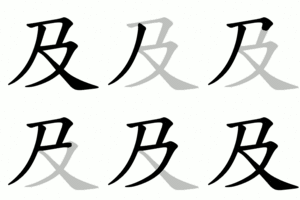
及 (Kangxi radical 29, 又+2 in traditional Chinese and Korean, 又+1 in mainland China and Japanese, 4 strokes in traditional Chinese and Korean, 3 strokes in mainland China and Japanese, cangjie input 弓竹水 (NHE), four-corner 17247, composition ⿻⿹𠄎丿乀(GHJV or U+2F836) or ⿸⿱㇇丿又(TK))
Derived characters
References
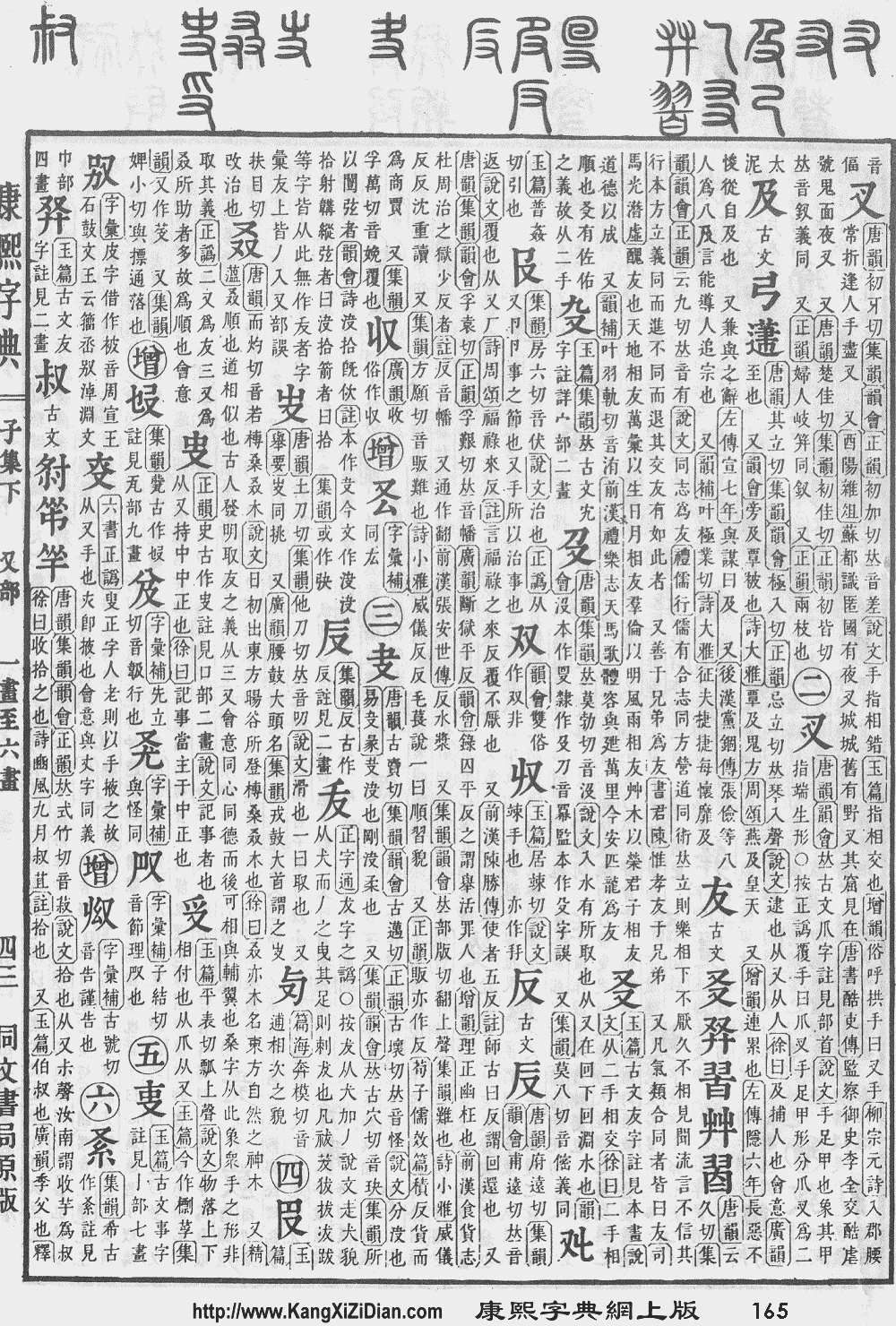
- Kangxi Dictionary: page 165, character 3
- Dai Kanwa Jiten: character 3118
- Dae Jaweon: page 374, character 17
- Hanyu Da Zidian (first edition): volume 1, page 35, character 1
- Unihan data for U+53CA
- Unihan data for U+2F836
Chinese
| trad. | 及 | |
|---|---|---|
| simp. # | 及 | |
| alternative forms | 﨤 | |
Glyph origin
| Historical forms of the character 及 | |||
|---|---|---|---|
| Shang | Western Zhou | Shuowen Jiezi (compiled in Han) | Liushutong (compiled in Ming) |
| Oracle bone script | Bronze inscriptions | Small seal script | Transcribed ancient scripts |
 |
 |
 |
 |
Ideogrammic compound (會意/会意) : 人 (“person”) + 又 (“hand”) – a hand grabbing a person.
Etymology
Possibly connected to Burmese ကပ် (kap, “to arrive at”) or Jingpho khap (“to carry, to reach”) (Starostin and Peiros, 1996) or less likely to Tibetan འགྲུབ་པ ('grub pa) ~ འགྲུབ ('grub, “to make ready”), སྒྲུབ་པ (sgrub pa) ~ བསྒྲུབ (bsgrub, “to complete, achieve”), གྲུབ་པ (grub pa, “complete”) (Schuessler, 2007).
Possibly departing tone derivations are 暨 (jì, “to attain, to reach”), 迄 (qì, “to reach to”), and 既 (jì, “already”) (Yu, 1948, Baxter, 1992). However, see those entries for more.
Pronunciation
Definitions
及
- to reach; to extend to; to reach the level of
- 觸手可及/触手可及 ― chùshǒukějí ― at one's fingertips; within reach (literally, "can be reached by the touch of hand")
- 及格 ― jígé ― to pass (i.e., to reach the grade for passing)
- to catch up; to be in time
- to be equal; to be comparable; to match
- 愚不可及 ― yúbùkějí ― foolish beyond reach; unmatched foolishness
- and; as well as
- 以及 ― yǐjí ― as well as
- 夏,五月,宋人及楚人平。 [Classical Chinese, trad. and simp.]
- From: Commentary of Gongyang, c. 206 BCE– 9 CE
- Xià, Wǔyuè, sòngrén jí chǔrén píng. [Pinyin]
- Summer, the fifth month, the generals of Song and Chu agreed to peace.
- a surname
Synonyms
Compounds
- 三元及第
- 不及 (bùjí)
- 不可企及 (bùkě qǐjí)
- 不可及 (bùkějí)
- 不足齒及/不足齿及
- 世及
- 以及 (yǐjí)
- 企及 (qǐjí)
- 來不及/来不及 (láibùjí)
- 來得及/来得及 (láidejí)
- 信及豚魚/信及豚鱼
- 兄死弟及
- 兄終弟及/兄终弟及 (xiōngzhōngdìjí)
- 八及
- 劍及履及/剑及履及
- 力所能及 (lìsuǒnéngjí)
- 危及 (wēijí)
- 又及
- 及今
- 及冠
- 及早 (jízǎo)
- 及時/及时 (jíshí)
- 及時行樂/及时行乐 (jíshíxínglè)
- 及時雨/及时雨 (jíshíyǔ)
- 及期
- 及格 (jígé)
- 及熱釜炊/及热釜炊
- 及物動詞/及物动词 (jíwù dòngcí)
- 及瓜
- 及瓜而代
- 及第 (jídì)
- 及第花
- 及笄 (jíjī)
- 及鋒/及锋
- 及鋒而試/及锋而试
- 及門/及门
- 及齡/及龄 (jílíng)
- 唯恐不及
- 噬臍何及/噬脐何及
- 噬臍無及/噬脐无及
- 噬臍莫及/噬脐莫及
- 埃及 (Āijí)
- 埃及曆/埃及历
- 央及 (yāngjí)
- 奈及利亞/奈及利亚 (Nàijílìyà)
- 始料不及 (shǐliàobùjí)
- 始料未及 (shǐliàowèijí)
- 屨及劍及/屦及剑及
- 後悔不及/后悔不及
- 後悔何及/后悔何及
- 後悔無及/后悔无及
- 後悔莫及/后悔莫及 (hòuhuǐmòjí)
- 恕己及人
- 恕己及物
- 悔之不及
- 悔之亡及
- 悔之何及
- 悔之無及/悔之无及
- 悔之莫及 (huǐzhīmòjí)
- 惠及 (huìjí)
- 愚不可及 (yúbùkějí)
- 愛屋及烏/爱屋及乌 (àiwūjíwū)
- 措不及防
- 推及
- 推己及人 (tuījǐjírén)
- 措手不及 (cuòshǒubùjí)
- 提及 (tíjí)
- 擴及/扩及
- 料及 (liàojí)
- 旁及
- 普及 (pǔjí)
- 普及教育
- 普及本
- 普及率 (pǔjílǜ)
- 望塵不及/望尘不及
- 望塵莫及/望尘莫及 (wàngchénmòjí)
- 朝不及夕
- 未及 (wèijí)
- 榮名及親/荣名及亲
- 殃及池魚/殃及池鱼 (yāngjíchíyú)
- 比及
- 沒及奈何/没及奈何
- 波及 (bōjí)
- 波及無辜/波及无辜
- 涉及 (shèjí)
- 澤及/泽及
- 澤及枯骨/泽及枯骨
- 無及/无及 (wújí)
- 無所不及/无所不及
- 狀元及第/状元及第
- 狧糠及米
- 猝不及防 (cùbùjífáng)
- 目光所及
- 萬不及一/万不及一
- 等不及 (děngbùjí)
- 累及 (lěijí)
- 聯科及第/联科及第
- 舐糠及米
- 行不及言
- 觸及/触及 (chùjí)
- 觸手可及/触手可及 (chùshǒukějí)
- 觸目所及/触目所及
- 言不及私
- 言不及義/言不及义 (yánbùjíyì)
- 詐奸不及
- 論及婚嫁/论及婚嫁
- 謀及婦人/谋及妇人
- 走及奔馬/走及奔马
- 趕不及/赶不及 (gǎnbùjí)
- 趕得及/赶得及 (gǎndejí)
- 迫不及待 (pòbùjídài)
- 追悔不及
- 追悔何及
- 追駟不及/追驷不及
- 進士及第/进士及第 (jìnshì jídì)
- 遍及 (biànjí)
- 過猶不及/过犹不及 (guòyóubùjí)
- 遙不可及/遥不可及
- 阿爾及爾/阿尔及尔 (Ā'ěrjí'ěr)
- 雞不及鳳/鸡不及凤
- 鞭不及腹
- 鞭長莫及/鞭长莫及 (biānchángmòjí)
- 顧及/顾及 (gùjí)
- 馬不及鞍/马不及鞍 (mǎ bùjí ān)
- 駟不及舌/驷不及舌
- 齒及/齿及 (chǐjí)
Descendants
References
- “及”, in 漢語多功能字庫 (Multi-function Chinese Character Database), 香港中文大學 (the Chinese University of Hong Kong), 2014–
Japanese
| Shinjitai | 及 | |
| Kyūjitai [1] |
及󠄁 及+ 󠄁?(Adobe-Japan1) |
 |
| 及󠄃 及+ 󠄃?(Hanyo-Denshi) (Moji_Joho) | ||
| The displayed kanji may be different from the image due to your environment. See here for details. | ||
Readings
References
- “及”, in 漢字ぺディア (Kanjipedia) (in Japanese), 日本漢字能力検定協会, 2015–2024