宇
| ||||||||
Translingual
Han character
宇 (Kangxi radical 40, 宀+3, 6 strokes, cangjie input 十一木 (JMD), four-corner 30401, composition ⿱宀于)
References
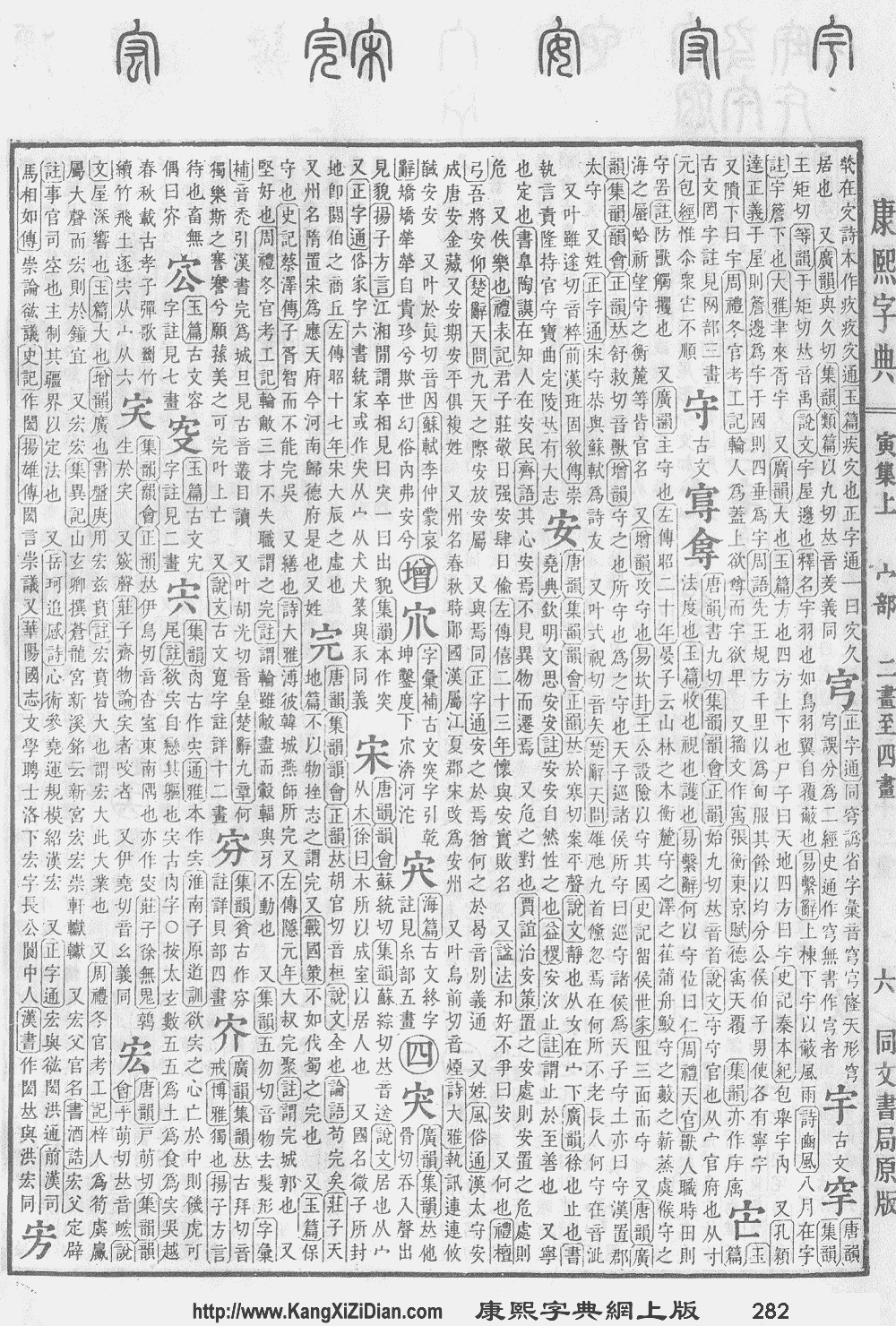
- Kangxi Dictionary: page 282, character 2
- Dai Kanwa Jiten: character 7067
- Dae Jaweon: page 551, character 22
- Hanyu Da Zidian (first edition): volume 2, page 911, character 7
- Unihan data for U+5B87
Chinese
| simp. and trad. |
宇 | |
|---|---|---|
| alternative forms | 𡧃 | |
Glyph origin
Characters in the same phonetic series (于) (Zhengzhang, 2003)
| Old Chinese | |
|---|---|
| 侉 | *qaːls |
| 夸 | *kʰʷraː |
| 姱 | *kʰʷraː |
| 胯 | *kʰʷraː, *kʰʷraːs, *kʰʷaːs |
| 跨 | *kʰʷraː, *kʰʷraːʔ, *kʰʷraːs, *kʰʷaːs |
| 誇 | *kʰʷraː |
| 垮 | *kʰʷraːʔ |
| 銙 | *kʰʷraːʔ |
| 骻 | *kʰʷraːʔ |
| 咵 | *kʰʷraːʔ |
| 釫 | *ɢʷraː, *qʷaː |
| 摦 | *ɡʷraːs |
| 鮬 | *pɢʷaː, *kʰʷaː |
| 嶀 | *qʰʷl'aː |
| 扝 | *kʰʷaː, *qʷaː |
| 刳 | *kʰʷaː |
| 郀 | *kʰʷaː |
| 挎 | *kʰʷaː |
| 袴 | *kʰʷaːs |
| 絝 | *kʰʷaːs |
| 褲 | *kʰʷaːs |
| 恗 | *qʰaː |
| 洿 | *ɡʷaːʔ, *qʷaː |
| 瓠 | *ɡʷlaː, *ɡʷlaːs |
| 鄠 | *ɢʷlaːʔ |
| 污 | *qʷaː, *qʷaːs |
| 杇 | *qʷaː |
| 圬 | *qʷaː |
| 鴮 | *qʷaː |
| 盓 | *qʷaː |
| 汙 | *qʷaːs, *ɢʷa |
| 樗 | *qʰʷl'a |
| 摴 | *qʰʷl'a |
| 荂 | *pqʰʷa, *qʰʷa |
| 雩 | *qʰʷla, *ɢʷla |
| 吁 | *qʰʷa, *ɢʷas |
| 盱 | *qʰʷa |
| 訏 | *qʰʷa |
| 扜 | *qʰʷa, *qʷa |
| 旴 | *qʰʷa |
| 冔 | *qʰʷaʔ |
| 紆 | *qʷa |
| 陓 | *qʷa |
| 迂 | *qʷa, *qʷaʔ, *ɢʷa |
| 虶 | *qʷa |
| 于 | *ɢʷa |
| 盂 | *ɢʷa |
| 竽 | *ɢʷa |
| 邘 | *ɢʷa |
| 玗 | *ɢʷa |
| 芋 | *ɢʷa, *ɢʷas |
| 杅 | *ɢʷa |
| 釪 | *ɢʷa |
| 骬 | *ɢʷa |
| 謣 | *ɢʷla |
| 宇 | *ɢʷaʔ |
Phono-semantic compound (形聲/形声, OC *ɢʷaʔ) : semantic 宀 (“house”) + phonetic 于 (OC *ɢʷa)
Etymology
- "eaves" > "abode, estate, territory"
- Unclear: either related to 羽 (OC *ɢʷaʔ, *ɢʷas, “wings”) (i.e. 'wings' of house?) (e.g. as suggested by Shiming) or related to stem *wa under 況 (OC *hwaŋh)
- "space"
- (This etymology is missing or incomplete. Please add to it, or discuss it at the Etymology scriptorium. Particularly: “From "abode" < "eaves"?”)
- universe
- (This etymology is missing or incomplete. Please add to it, or discuss it at the Etymology scriptorium. Particularly: “From "space" < "abode" < "eaves"”)
Pronunciation
Definitions
宇
- eaves
- 果臝之實、亦施于宇。 [Pre-Classical Chinese, trad.]
- From: The Classic of Poetry, c. 11th – 7th centuries BCE, translated based on James Legge's version
- Guǒluǒ zhī shí, yì shī yú yǔ. [Pinyin]
- The fruit of the heavenly gourd, would be hanging about our eaves.
果裸之实、亦施于宇。 [Pre-Classical Chinese, simp.]- 上古穴居而野處,後世聖人易之以宮室,上棟下宇,以待風雨。 [Pre-Classical Chinese, trad.]
- From: I Ching, 11th – 8th century BCE, translated based on James Legge's version
- Shànggǔ xuéjū ér yěchù, hòushì shèngrén yì zhī yǐ gōngshì, shàngdòng xiàyǔ, yǐ dài fēngyǔ. [Pinyin]
- In the highest antiquity they made their homes (in winter) in caves, and (in summer) dwelt in the open country. In subsequent ages, for these the sages substituted houses, with the ridge-beam(s) above and the eave(s) below, as a provision against wind and rain.
上古穴居而野处,后世圣人易之以宫室,上栋下宇,以待风雨。 [Pre-Classical Chinese, simp.]
- house, chamber, bower; building, structure
- 高堂邃宇,檻層軒些。 [Classical Chinese, trad.]
- From: The Verses of Chu, 4th century BCE – 2nd century CE, translated based on David Hawkes' version
- Gāotáng suìyǔ, kǎn céngxuān xiē. [Pinyin]
- High halls and deep bowers, with railings and tiered balconies
高堂邃宇,槛层轩些。 [Classical Chinese, simp.]- 我欲乘風歸去,又恐瓊樓玉宇,高處不勝寒。 [Classical Chinese, trad.]
- From: 蘇軾 Su Shi, lyrics to《水調歌頭》"Water Melody", [1076, mid-autumn].
- Wǒ yù chéng fēng guīqù, yòu kǒng qiónglóu yùyǔ, gāochù bùshèng hán. [Pinyin]
- I'd like to ride the wind and return, yet I fear the majestic towers and magnificent mansions, the high places where it's unbearably cold.
我欲乘风归去,又恐琼楼玉宇,高处不胜寒。 [Classical Chinese, simp.]
- border, frontier, boundary
- 鄰國之難,不可虞也。或多難以固其國,啟其疆土;或無難,以喪其國失其守宇。若何虞難? [Classical Chinese, trad.]
- From: Commentary of Zuo, c. 4th century BCE
- Línguó zhī nán, bùkě yú yě. Huò duō nán yǐ gù qí guó, qǐ qí jiāngtǔ; huò wú nán, yǐ sàng qí guó shī qí shǒuyǔ. Ruò hé yú nán? [Pinyin]
- And [the result of] the difficulties of neighbouring States cannot be calculated on. They may have many difficulties, which will issue [only] in strengthening them and the enlargement of their boundaries; or they may have no difficulties, and the result will be their ruin, and their losing the boundaries of which they were in charge. How is it possible to foresee the [issue of such] difficulties?
邻国之难,不可虞也。或多难以固其国,启其疆土;或无难,以丧其国失其守宇。若何虞难? [Classical Chinese, simp.]
- universe, cosmos
- 萬物同宇而異體,無宜而有用為人,數也。 [Classical Chinese, trad.]
- From: Xunzi, c. 3rd century BCE
- Wànwù tóngyǔ ér yìtǐ, wúyí ér yǒuyòng wèirén, shù yě. [Pinyin]
- The myriad things share the same cosmos and have different bodies. They have no intrinsic fittingness but are useful for humans. This is simply the arrangement of the world.
万物同宇而异体,无宜而有用为人,数也。 [Classical Chinese, simp.]
Compounds
- 仁宇
- 功濟宇內/功济宇内
- 區宇/区宇 (qūyǔ)
- 區宇一清/区宇一清
- 器宇 (qìyǔ)
- 器宇不凡
- 器宇軒昂/器宇轩昂 (qìyǔxuān'áng)
- 土宇
- 壇宇/坛宇
- 天宇 (tiānyǔ)
- 威震寰宇
- 宇下
- 宇內/宇内 (yǔnèi)
- 宇宙 (yǔzhòu)
- 宇宙塵/宇宙尘 (yǔzhòuchén)
- 宇宙射線/宇宙射线 (yǔzhòu shèxiàn)
- 宇宙年
- 宇宙火箭
- 宇宙站
- 宇宙線/宇宙线 (yǔzhòuxiàn)
- 宇宙觀/宇宙观 (yǔzhòuguān)
- 宇宙速度 (yǔzhòu sùdù)
- 宇宙鋒/宇宙锋
- 宇宙飛船/宇宙飞船 (yǔzhòu fēichuán)
- 宇文 (Yǔwén)
- 宇文化及
- 宇文泰
- 宇文覺/宇文觉
- 宇文護/宇文护
- 宇航 (yǔháng)
- 宇量
- 宸宇
- 寰宇 (huányǔ)
- 寰宇記/寰宇记
- 屋宇 (wūyǔ)
- 峻宇
- 島宇宙/岛宇宙
- 庭宇
- 廟宇/庙宇 (miàoyǔ)
- 廨宇
- 御宇 (yùyǔ)
- 德宇
- 房宇 (fángyǔ)
- 拓宇
- 握圖臨宇/握图临宇
- 故宇
- 敗宇頹垣/败宇颓垣
- 望衡對宇/望衡对宇
- 杜宇 (dùyǔ)
- 梵宇 (fànyǔ)
- 棟宇/栋宇
- 樓宇/楼宇 (lóuyǔ)
- 殿宇 (diànyǔ)
- 氣宇/气宇 (qìyǔ)
- 氣宇昂昂/气宇昂昂
- 氣宇軒昂/气宇轩昂 (qìyǔxuān'áng)
- 法宇
- 海宇 (hǎiyǔ)
- 海宇昇平/海宇升平
- 牆宇/墙宇
- 玉宇 (yùyǔ)
- 琳宮梵宇/琳宫梵宇
- 瓊樓玉宇/琼楼玉宇 (qiónglóuyùyǔ)
- 瓊臺玉宇/琼台玉宇
- 疆宇
- 眉宇 (méiyǔ)
- 真宇
- 神宇 (shényǔ)
- 祠宇
- 穹宇 (qióngyǔ)
- 紺宇/绀宇
- 紫芝眉宇
- 胸宇
- 膨脹宇宙/膨胀宇宙
- 芝宇
- 衡宇
- 觀宇/观宇
- 賓宇/宾宇
- 軒宇/轩宇
- 軒昂氣宇/轩昂气宇
- 邃宇
- 隙宇
- 韻宇/韵宇
- 飛宇/飞宇
- 黌宇/黉宇 (hóngyǔ)
References
- “宇”, in 漢語多功能字庫 (Multi-function Chinese Character Database), 香港中文大學 (the Chinese University of Hong Kong), 2014–
Korean
Etymology
From Middle Chinese 宇 (MC hjuX). Recorded as Middle Korean 우〯 (wǔ) (Yale: wǔ) in Hunmong Jahoe (訓蒙字會 / 훈몽자회), 1527.
Pronunciation
- (SK Standard/Seoul) IPA(key): [u(ː)]
- Phonetic hangul: [우(ː)]
- Though still prescribed in Standard Korean, most speakers in both Koreas no longer distinguish vowel length.
Compounds
Compounds
- 우주 (宇宙, uju, “space”)
- 우주선 (宇宙船, ujuseon, “spaceship”)
- 우주인 (宇宙人, uju'in, “alien; astronaut”)
- 대우주 (大宇宙, dae'uju, “macrocosm”)
- 소우주 (小宇宙, souju, “microcosm”)
- 우주복 (宇宙服, ujubok, “spacesuit”)
- 우주진 (宇宙塵, ujujin)
- 우주만물 (宇宙萬物, ujumanmul, “all things”)
- 우주왕복선 (宇宙往復船, ujuwangbokseon, “space shuttle”)
- 우주비행사 (宇宙飛行士, ujubihaengsa, “astronaut”)
Vietnamese
This article is issued from Wiktionary. The text is licensed under Creative Commons - Attribution - Sharealike. Additional terms may apply for the media files.