早
| ||||||||
Translingual
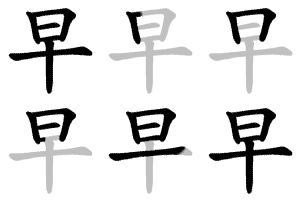
| Stroke order | |||
|---|---|---|---|
 | |||
| Stroke order | |||
|---|---|---|---|
 | |||
Han character
早 (Kangxi radical 72, 日+2, 6 strokes, cangjie input 日十 (AJ), four-corner 60400, composition ⿱日十)
References
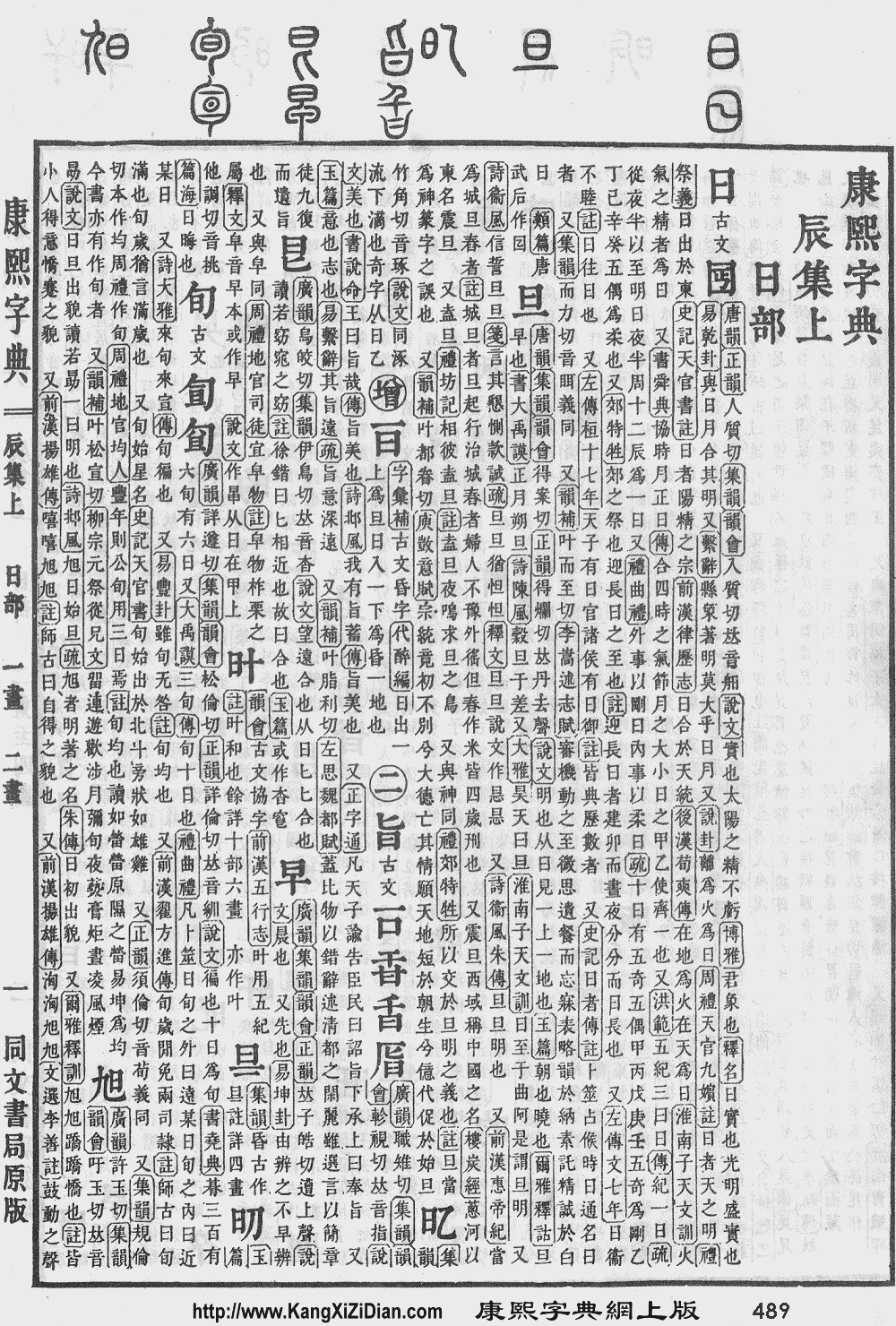
- Kangxi Dictionary: page 489, character 12
- Dai Kanwa Jiten: character 13742
- Dae Jaweon: page 850, character 9
- Hanyu Da Zidian (first edition): volume 2, page 1483, character 6
- Unihan data for U+65E9
Chinese
| simp. and trad. |
早 | |
|---|---|---|
Glyph origin
| Historical forms of the character 早 | ||||
|---|---|---|---|---|
| Warring States | Shuowen Jiezi (compiled in Han) | Liushutong (compiled in Ming) | ||
| Bronze inscriptions | Chu slip and silk script | Qin slip script | Small seal script | Transcribed ancient scripts |
 |
 |
 |
 |
 |
Early bronze inscriptions: Pictogram (象形) – acorn. Original form of 皂 (OC *zuːʔ) (once also written as 草 (cǎo)). Borrowed for "morning" sense.
Late bronze inscriptions: Phono-semantic compound (形聲/形声, OC *ʔsuːʔ) : semantic 日 (“sun”) + phonetic 棗 (OC *ʔsuːʔ), with 棗 sometimes simplified as 朿.
Small seal script: Ideogrammic compound (會意/会意) : 日 (“sun”) + 甲 (“first”) – when the sun first rises.
In some ancient texts, 蚤 (OC *ʔsuːʔ) was often used instead.
Etymology
Possible cognate found in Proto-Hmong-Mien *ntsi̯ouˣ (“early”), whence White Hmong ntxov and Iu Mien nziou (Baxter and Sagart, 2014; Schuessler, 2007), and Proto-Tai *ɟaːwꟲ (“early morning”), whence Thai เช้า (cháao) and Lü ᦋᧁᧉ (tsaw²).
Pronunciation
Definitions
早
Synonyms
| Variety | Location | Words |
|---|---|---|
| Classical Chinese | 早 | |
| Formal (Written Standard Chinese) | 早 | |
| Mandarin | Beijing | 早 |
| Taiwan | 早 | |
| Jinan | 早 | |
| Xi'an | 早 | |
| Wuhan | 早 | |
| Chengdu | 早 | |
| Yangzhou | 早 | |
| Hefei | 早 | |
| Cantonese | Guangzhou | 早 |
| Hong Kong | 早 | |
| Yangjiang | 早 | |
| Gan | Nanchang | 早 |
| Hakka | Meixian | 早 |
| Miaoli (N. Sixian) | 早 | |
| Pingtung (Neipu; S. Sixian) | 早 | |
| Hsinchu County (Zhudong; Hailu) | 早 | |
| Taichung (Dongshi; Dabu) | 早 | |
| Hsinchu County (Qionglin; Raoping) | 早 | |
| Yunlin (Lunbei; Zhao'an) | 早 | |
| Jin | Taiyuan | 早 |
| Northern Min | Jian'ou | 早 |
| Eastern Min | Fuzhou | 早 |
| Southern Min | Xiamen | 早 |
| Chaozhou | 早 | |
| Wu | Shanghai | 早 |
| Suzhou | 早 | |
| Wenzhou | 早 | |
| Xiang | Changsha | 早 |
| Shuangfeng | 早 | |
Compounds
- 一大早 (yīdàzǎo)
- 一早 (yīzǎo)
- 一早起
- 一早起了
- 一黑早
- 不早 (bùzǎo)
- 不早不晚
- 侵早
- 倒屎咁早 (dou2 si2 gam3 zou2) (Cantonese)
- 儘早/尽早
- 冗早 (liōng-chá) (Min Nan)
- 𠢕早 (gâu-chá)
- 半早
- 即早兒/即早儿
- 又早
- 及早 (jízǎo)
- 古早 (gǔzǎo)
- 可早
- 多早晚
- 大早
- 大清早 (dàqīngzǎo)
- 大清早上
- 大清早起
- 好早晚
- 屍骨早寒/尸骨早寒
- 打早 (dǎzǎo)
- 拜早年 (bàizǎonián)
- 提早 (tízǎo)
- 早上 (zǎoshang)
- 早來/早来 (zǎolái)
- 早先 (zǎoxiān)
- 早出晚歸/早出晚归 (zǎochūwǎnguī)
- 早則/早则
- 早占勿藥
- 早參/早参
- 早名必折
- 早場/早场
- 早報/早报 (zǎobào)
- 早夭
- 早婚 (zǎohūn)
- 早安 (zǎo'ān)
- 早尖
- 早就 (zǎojiù)
- 早已 (zǎoyǐ)
- 早年 (zǎonián)
- 早慧 (zǎohuì)
- 早操 (zǎocāo)
- 早日 (zǎorì)
- 早早 (zǎozǎo)
- 早春 (zǎochūn)
- 早是
- 早晌
- 早晨
- 早晚 (zǎowǎn)
- 早期 (zǎoqī)
- 早朝
- 早材
- 早死 (zǎosǐ)
- 早熟 (zǎoshú)
- 早熟兒童/早熟儿童
- 早班 (zǎobān)
- 早生貴子/早生贵子 (zǎoshēngguìzǐ)
- 早產/早产 (zǎochǎn)
- 早產兒/早产儿 (zǎochǎn'ér)
- 早稻 (zǎodào)
- 早膳
- 早茶 (zǎochá)
- 早衙
- 早衰 (zǎoshuāi)
- 早課/早课
- 早賜玉音/早赐玉音
- 早起 (zǎoqǐ)
- 早退 (zǎotuì)
- 早迷晚寤
- 早逝 (zǎoshì)
- 早遲/早迟
- 早難道/早难道
- 早霞 (zǎoxiá)
- 早霜
- 早頓/早顿 (chá-tǹg)
- 早飯/早饭 (zǎofàn)
- 早餐 (zǎocān)
- 早餐會/早餐会
- 早點/早点
- 早點兒/早点儿 (zǎo diǎnr)
- 早齋/早斋 (chá-chai) (Min Nan)
- 明早 (míngzǎo)
- 次早 (cìzǎo)
- 清早 (qīngzǎo)
- 絕早/绝早 (juézǎo)
- 老早 (lǎozǎo)
- 言之過早/言之过早 (yánzhīguòzǎo)
- 起早 (qǐzǎo)
- 起早貪黑/起早贪黑 (qǐzǎotānhēi)
- 趁早 (chènzǎo)
- 趕早/赶早 (gǎnzǎo)
- 透早 (thàu-chá)
- 這早晚/这早晚 (zhè zǎowǎn)
- 遛早兒/遛早儿
- 遲早/迟早 (chízǎo)
- 遲行早住/迟行早住
- 還早/还早
- 黑早
References
- “早”, in 漢語多功能字庫 (Multi-function Chinese Character Database), 香港中文大學 (the Chinese University of Hong Kong), 2014–
- “Entry #2446”, in 臺灣閩南語常用詞辭典 [Dictionary of Frequently-Used Taiwan Minnan] (overall work in Mandarin and Hokkien), Ministry of Education, R.O.C., 2023.
Japanese
Readings
Compounds
| Kanji in this term |
|---|
| 早 |
| はや Grade: 1 |
| kun’yomi |
References
- Matsumura, Akira, editor (2006), 大辞林 [Daijirin] (in Japanese), Third edition, Tōkyō: Sanseidō, →ISBN
Korean
Etymology
From Middle Chinese 早 (MC tsawX). Recorded as Middle Korean 조〯 (cwǒ) (Yale: cwo) in Hunmong Jahoe (訓蒙字會 / 훈몽자회), 1527.
Compounds
Vietnamese
Han character
早: Hán Việt readings: tảo (
早: Nôm readings: tảo[2][4][6], chảo[1], tảu
Compounds
References
- Nguyễn (2014).
- Nguyễn et al. (2009).
- Trần (2004).
- Bonet (1899).
- Génibrel (1898).
- Taberd & Pigneau de Béhaine (1838).