完
See also: 宗
| ||||||||
Translingual
| Stroke order | |||
|---|---|---|---|
 | |||
Han character
完 (Kangxi radical 40, 宀+4, 7 strokes, cangjie input 十一一山 (JMMU), four-corner 30211, composition ⿱宀元)
References
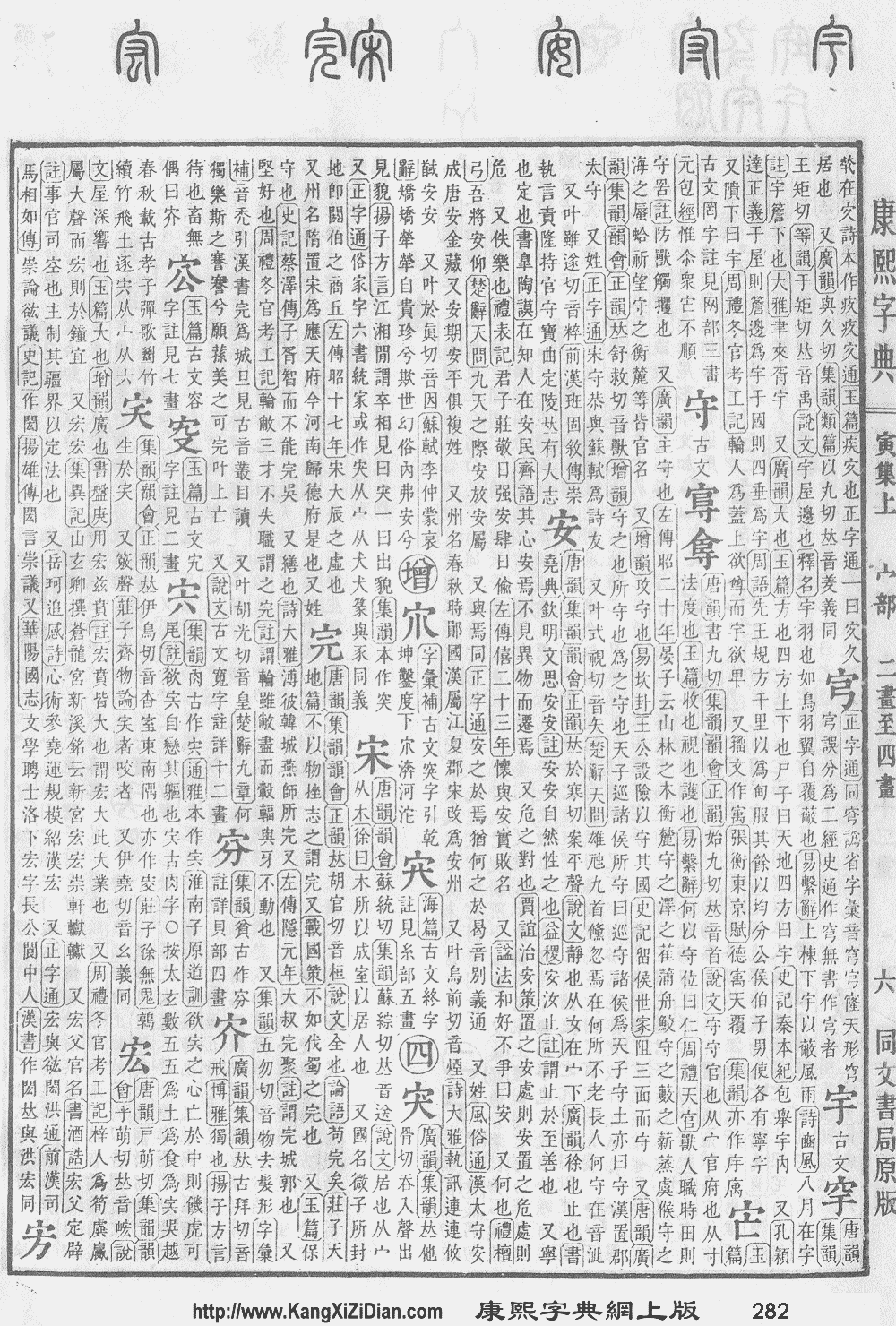
- Kangxi Dictionary: page 282, character 13
- Dai Kanwa Jiten: character 7079
- Dae Jaweon: page 555, character 1
- Hanyu Da Zidian (first edition): volume 2, page 914, character 2
- Unihan data for U+5B8C
Chinese
| simp. and trad. |
完 | |
|---|---|---|
Glyph origin
Characters in the same phonetic series (元) (Zhengzhang, 2003)
| Old Chinese | |
|---|---|
| 冠 | *kŋoːn, *kŋoːns |
| 莞 | *kŋoːn, *ɦŋoːn, *ɦŋroːnʔ |
| 脘 | *ŋkoːnʔ |
| 筦 | *ŋkoːnʔ |
| 梡 | *ŋ̊ʰoːnʔ, *ɦŋoːn, *ɦŋoːnʔ |
| 岏 | *ŋoːn |
| 刓 | *ŋoːn |
| 园 | *ŋoːn |
| 忨 | *ŋoːn, *ŋoːns |
| 蚖 | *ŋoːn, *ŋon |
| 黿 | *ŋoːn, *ŋon |
| 抏 | *ŋoːn |
| 玩 | *ŋoːns |
| 貦 | *ŋoːns |
| 翫 | *ŋoːns |
| 妧 | *ŋoːns |
| 完 | *ɦŋoːn |
| 捖 | *ɦŋoːn |
| 垸 | *ɦŋoːn, *ɦŋoːns |
| 綄 | *ɦŋoːn, *ɦŋoːnʔ |
| 院 | *ɦŋoːn, *ɦŋons |
| 皖 | *ɦŋoːnʔ, *ɦŋroːnʔ |
| 晥 | *ɦŋoːnʔ |
| 浣 | *ɦŋoːnʔ |
| 頑 | *ŋroːn, *ŋroːn |
| 睆 | *ɦŋroːnʔ |
| 鯇 | *ɦŋroːnʔ |
| 元 | *ŋon |
| 沅 | *ŋon |
| 芫 | *ŋon |
| 杬 | *ŋon |
| 邧 | *ŋon, *ŋonʔ |
| 阮 | *ŋon, *ŋonʔ |
| 俒 | *ɦŋuːn, *ɦŋuːns |
Phono-semantic compound (形聲/形声, OC *ɦŋoːn) : semantic 宀 (“roof”) + phonetic 元 (OC *ŋon).
Pronunciation
Definitions
完
- whole; complete; intact
- 完好 ― wánhǎo ― intact
- 城入趙而璧留秦;城不入,臣請完璧歸趙。 [Classical Chinese, trad.]
- From: The Records of the Grand Historian, by Sima Qian, c. 91 BCE
- Chéng rù Zhào ér bì liú Qín; chéng bù rù, chén qǐng wán bì guī Zhào. [Pinyin]
- If the cities are granted to Zhao, the jade will remain in Qin; if the cities are not granted, allow your servant to return to Zhao with the jade intact.
城入赵而璧留秦;城不入,臣请完璧归赵。 [Classical Chinese, simp.]
- to end; to finish
- Used after a verb to indicate perfective aspect (action completion).
- to run out; to use up
- to complete; to finish
- (obsolete) firm; stable
- perfect; faultless; flawless
- 完人 ― wánrén ― perfect person
- to fail; to enter a dangerous or hopeless state; to be doomed; done for
- to pay; to pay back
- (obsolete) abundant; sufficient; plentiful
- (literary) to preserve
- (literary) to build; to repair; to renovate
- 溥彼韓城,燕師所完。 [Pre-Classical Chinese, trad.]
- From: The Classic of Poetry, c. 11th – 7th centuries BCE, translated based on James Legge's version
- Pǔ bǐ Hán chéng, Yān shī suǒ wán. [Pinyin]
- Large is the wall of [the city of] Han,
Built by the multitudes of Yan.
溥彼韩城,燕师所完。 [Pre-Classical Chinese, simp.]
- (historical) an ancient light punishment
- a surname
Synonyms
- (whole):
- 了當/了当 (liǎodàng)
- 俱備/俱备 (jùbèi) (literary)
- 全 (quán)
- 全備/全备 (quánbèi)
- 全部 (quánbù) (attributive)
- 加尼 (Zhangzhou Hokkien)
- 十足 (shízú)
- 囫圇/囫囵 (húlún)
- 囫圇個/囫囵个 (húlúngè) (colloquial)
- 妥 (tuǒ)
- 完備/完备 (wánbèi)
- 完全 (wánquán)
- 完具 (wánjù) (literary)
- 完整 (wánzhěng)
- 實足/实足 (shízú)
- 掃/扫 (literary, or in compounds)
- 整 (zhěng)
- 整個/整个 (zhěnggè) (attributive)
- 整齊/整齐 (zhěngqí)
- 渾然/浑然 (húnrán)
- 滿/满 (mǎn)
- 褿備/褿备 (Taiwanese Hokkien)
- 褿全 (Hokkien)
- 齊備/齐备 (qíbèi)
- 齊全/齐全 (qíquán)
Compounds
- 不完全是
- 不完全葉/不完全叶
- 乘凶完配
- 劉完素/刘完素
- 完了
- 完事 (wánshì)
- 完人 (wánrén)
- 完備/完备 (wánbèi)
- 完全 (wánquán)
- 完全中立
- 完全小學/完全小学
- 完全就業/完全就业 (wánquán jiùyè)
- 完全平方
- 完全打擊/完全打击
- 完全數/完全数 (wánquánshù)
- 完全比賽/完全比赛
- 完全燃燒/完全燃烧
- 完全立方
- 完全肥料
- 完全花
- 完全葉/完全叶
- 完全變態/完全变态
- 完具 (wánjù)
- 完卵
- 完善 (wánshàn)
- 完好 (wánhǎo)
- 完好如初 (wánhǎorúchū)
- 完好無缺/完好无缺 (wánhǎowúquē)
- 完婚 (wánhūn)
- 完完全全 (wánwánquánquán)
- 完封 (wánfēng)
- 完工 (wángōng)
- 完成 (wánchéng)
- 完房
- 完整 (wánzhěng)
- 完滿/完满 (wánmǎn)
- 完璧 (wánbì)
- 完璧歸趙/完璧归赵 (wánbìguīzhào)
- 完畢/完毕 (wánbì)
- 完稅/完税 (wánshuì)
- 完稅貨價/完税货价
- 完稿 (wángǎo)
- 完竣
- 完糧/完粮
- 完結/完结 (wánjié)
- 完結篇/完结篇
- 完美 (wánměi)
- 完美主義/完美主义 (wánměi zhǔyì)
- 完美無缺/完美无缺 (wánměiwúquē)
- 完聚
- 完膚/完肤 (wánfū)
- 完蛋 (wándàn)
- 完足 (wánzú)
- 完達山脈/完达山脉
- 完顏/完颜 (Wányán)
- 完飯/完饭
- 未完 (wèiwán)
- 沒了沒完/没了没完
- 沒完/没完 (méiwán)
- 沒完沒了/没完没了 (méiwánméiliǎo)
- 玩兒完/玩儿完 (wánrwán)
- 玩完 (wánwán)
- 用完 (yòngwán)
- 短褐不完
- 神完氣足/神完气足
- 肌無完膚/肌无完肤
- 衣不完采
- 補完/补完 (bǔwán)
- 覆巢之下無完卵/覆巢之下无完卵 (fùcháozhīxiàwúwánluǎn)
- 身無完膚/身无完肤
- 體無完膚/体无完肤 (tǐwúwánfū)
- 鹿裘不完
Descendants
- → Vietnamese: vẹn
References
- “完”, in 漢語多功能字庫 (Multi-function Chinese Character Database), 香港中文大學 (the Chinese University of Hong Kong), 2014–
Japanese
Compounds
References
- Matsumura, Akira, editor (2006), 大辞林 [Daijirin] (in Japanese), Third edition, Tōkyō: Sanseidō, →ISBN
Korean
Etymology
From Middle Chinese 完 (MC hwan).
Compounds
Compounds
- 완전 (完全, wanjeon, “complete; whole”)
- 완성 (完成, wanseong, “completion”)
- 완벽 (完璧, wanbyeok, “perfection”)
- 완료 (完了, wallyo, “completion”)
- 완결 (完結, wan'gyeol, “conclusion”)
- 완패 (完敗, wanpae, “defeat”)
- 미완성 (未完成, miwanseong, “incompletion”)
Vietnamese
Compounds
- hoàn hảo (“successfully done, perfect”) (完好)
- hoàn thiện (“to complete, to perfect”) (完善)
- hoàn thành (“to accomplish, to finish, to complete”) (完成)
- hoàn toàn (“complete, completely”) (完全)
This article is issued from Wiktionary. The text is licensed under Creative Commons - Attribution - Sharealike. Additional terms may apply for the media files.