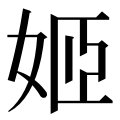
姬
See also: 姫
| ||||||||
 | ||||||||
Translingual
| Traditional | 姬 |
|---|---|
| Simplified | 姬 |
| Japanese | 姫 |
| Korean | 姬 |
Alternative forms
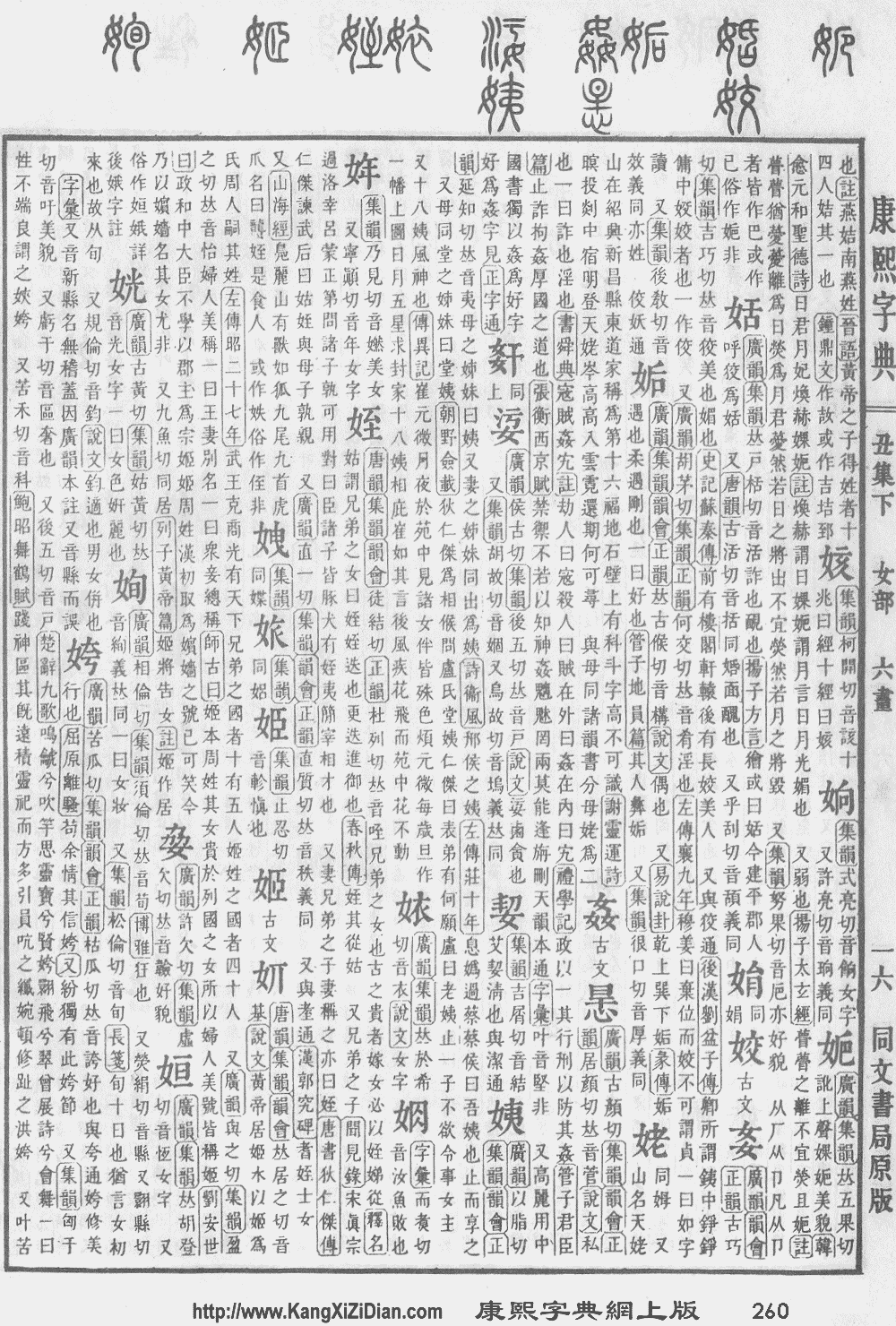
The character commonly used in Japanese is 姫 (U+59EB). Note that the Korean form is written with 𦣝 as the right component, which is the historical form found in the Kangxi Dictionary.
Han character
姬 (Kangxi radical 38, 女+7, 10 strokes, cangjie input 女尸中中 (VSLL), four-corner 41417, composition ⿰女𦣞(GHT) or ⿰女𦣝(K))
Derived characters
- 𩠯
References
- Kangxi Dictionary: page 260, character 23
- Dai Kanwa Jiten: character 6230
- Dae Jaweon: page 526, character 24
- Hanyu Da Zidian (first edition): volume 2, page 1049, character 15
- Unihan data for U+59EC
- Unihan data for U+2F862
Chinese
| trad. | 姬 | |
|---|---|---|
| simp. # | 姬 | |
| alternative forms | 姫 㚶 | |
Glyph origin
| Historical forms of the character 姬 | |||
|---|---|---|---|
| Shang | Western Zhou | Spring and Autumn | Warring States |
| Oracle bone script | Bronze inscriptions | Bronze inscriptions | Bronze inscriptions |
 |
 |
 |
 |
Characters in the same phonetic series (頤) (Zhengzhang, 2003)
Phono-semantic compound (形聲/形声, OC *klɯ, *lɯ) : semantic 女 (“woman; matrilateral family line; family name”) + phonetic 𦣞 ().
Etymology 1
This etymology is incomplete. You can help Wiktionary by elaborating on the origins of this term.
- Zhou dynastic surname
- Its eponym was traditionally held to the river 姬 (Jī), which has been identified with the river 汾 (Fén) in Shanxi. However, Pulleyblank (2000) points out that "there seems to be no record of a Ji River outside the myth" of the Yellow Emperor.
- Instead, he suggests an etymological connection between "the two intermarrying moieties, a ruling clan and its collateral, wife-supplying counterpart": 姬 (OC *(C)ɰə̀ɰ) and 姜 (*(C)ɰàŋ). He also points to other word-pairs, including 似 (MC ziX, “to resemble”) < *-əɰʔ and 像 (MC zjangX, “to imitate, image”) < *-aŋʔ, which display the phonetic correspondences: *-ɰ vs. *-ŋ as well *-ə- vs. *-a- (ibid.)
- lady (ancient laudatory title for women)
- According to Yan Shigu (apud Kangxi Dictionary):
- 姬本周姓,其女貴於列國之女,所以婦人美號皆稱姬。 [Classical Chinese, trad.]
- From: Kangxi zidian
- Jī běn Zhōu xìng, qí nǚ guì yú lièguó zhī nǚ, suǒyǐ fùrén měihào jiē chēng jī. [Pinyin]
- Ji ("姬") was originally the surname of the Zhou; their princesses were more honorable than princesses of other states; therefore women with laudatory appellations are all called Ji ("姬").
姬本周姓,其女贵于列国之女,所以妇人美号皆称姬。 [Classical Chinese, simp.]
Pronunciation
Definitions
姬
- a surname, used by the ruling family of the House of Zhou
- 王姬 ― Wáng Jī ― (historical) Royal (Princess) Ji (formal appellation for various women born out of the royal house of Zhou)
- 曷不肅雝、王姬之車。 [Pre-Classical Chinese, trad.]
- From: The Classic of Poetry, c. 11th – 7th centuries BCE, translated based on James Legge's version
- Hé bù sù yōng, Wáng Jī zhī chē. [Pinyin]
- Are they not expressive of reverence and harmony, the carriages of the king's daughter (lit. "the Royal Princess Ji")?
曷不肃雍、王姬之车。 [Pre-Classical Chinese, simp.]
- 諸姬/诸姬 ― zhūjī ― (historical) the various Ji (collective appellation for various nobles and states' rulers patrilineally related to the royal house of Zhou)
- 孌彼諸姬、聊與之謀。 [Pre-Classical Chinese, trad.]
- From: The Classic of Poetry, c. 11th – 7th centuries BCE, translated based on James Legge's version
- Luán bǐ zhūjī, liáo yǔ zhī móu. [Pinyin]
- Admirable are those, my cousins (lit. "the various Ji nobles"); I will take counsel with them.
娈彼诸姬、聊与之谋。 [Pre-Classical Chinese, simp.]
- (literary) lady (ancient laudatory title for women)
- 風吹柳花滿店香,吳姬壓酒喚客嘗。 [Classical Chinese, trad.]
- From: 李白 Li Bai〈金陵酒肆留別〉"Farewell at a Tavern in Jinling"
- Fēng chuī liǔhuā mǎn diàn xiāng, Wú jī yājiǔ huàn kè cháng. [Pinyin]
- The wind blows on the willow-catkins, filling the inn with fragrance; the Wu lady calls out to customers to try newly pressed wine.
风吹柳花满店香,吴姬压酒唤客尝。 [Classical Chinese, simp.]
- (mythology) name of a river
- 黃帝居姬水,以為姓。 [Classical Chinese, trad.]
- From: Shuowen Jiezi, circa 2nd century CE
- Huángdì jū Jīshuǐ, yǐwéi xìng. [Pinyin]
- The Yellow Thearch dwelt by the Ji river, (whose name) he took as (his) surname.
黄帝居姬水,以为姓。 [Classical Chinese, simp.]
- (literary) beauty
- 沛公居山東時,貪於財貨,好美姬。今入關,財物無所取,婦女無所幸。 [Classical Chinese, trad.]
- From: The Records of the Grand Historian, by Sima Qian, c. 91 BCE
- Pèigōng jū Shāndōng shí, tān yú cáihuò, hào měijī. Jīn rù guān, cáiwù wú suǒqǔ, fùnǚ wú suǒxìng. [Pinyin]
- When Lord of Pei was in Shandong, he coveted riches and desired beauties. Yet now that he has entered Guan[zhong], he has not confiscated wealth, nor has he lusted after women."
沛公居山东时,贪于财货,好美姬。今入关,财物无所取,妇女无所幸。 [Classical Chinese, simp.]
- (literary) concubine
- 莊襄王為秦質子於趙,見呂不韋姬,悅而取之,生始皇。 [Classical Chinese, trad.]
- From: The Records of the Grand Historian, by Sima Qian, c. 91 BCE
- Zhuāngxiāng wáng wèi Qín zhìzǐ yú Zhào, jiàn lǚ bùwéi jī, yuè ér qǔ zhī, shēng Shǐhuáng. [Pinyin]
- When King Zhuangxiang was a Qin hostage in Zhao, he saw Lü Buwei's concubine, he fell in love with her and married her; she gave birth to the First Emperor.
庄襄王为秦质子于赵,见吕不韦姬,悦而取之,生始皇。 [Classical Chinese, simp.]
- (neologism, slang) Synonym of 基 (jī, “gay”), with a feminine connotation; lesbian
- 搞姬 ― gǎojī ― to engage in lesbian activities
Synonyms
Dialectal synonyms of 妾 (“concubine”) [map]
Compounds
- 丹姬
- 二姬
- 仙姬
- 伯姬
- 伯姬引
- 侍姬
- 名姬
- 吳姬/吴姬
- 大姬
- 天姬
- 妖姬
- 妙姬
- 姣姬
- 姬人
- 姬伯
- 姬侍
- 姬僕/姬仆
- 姬公
- 姬劉/姬刘
- 姬化
- 姬呂/姬吕
- 姬周
- 姬國/姬国
- 姬姒
- 姬妾 (jīqiè)
- 姬姜
- 姬媵
- 姬孔
- 姬文
- 姬易
- 姬松茸 (jīsōngróng)
- 姬漢/姬汉
- 姬鼠
- 嬖姬
- 孋姬/㛤姬
- 孔姬
- 宗姬
- 宮姬/宫姬
- 家姬
- 寵姬/宠姬
- 小姬
- 帝姬 (dìjī)
- 幸姬
- 庶姬
- 從姬/从姬
- 愛姬/爱姬 (àijī)
- 文姬入塞
- 族姬
- 昌姬
- 曼姬
- 朱姬大仙
- 村姬
- 楚姬
- 楚岫瑤姬/楚岫瑶姬
- 楊柳姬/杨柳姬
- 樊姬
- 橈姬/桡姬
- 歌姬 (gējī)
- 毛姬
- 泣別虞姬/泣别虞姬
- 漢姬/汉姬
- 燕姬
- 王姬
- 班姬
- 班姬扇
- 班姬詠扇/班姬咏扇
- 班姬辭輦/班姬辞辇
- 瑤姬/瑶姬
- 瓊姬/琼姬
- 盧姬/卢姬
- 祅姬
- 秦姬曲
- 程姬之疾
- 竹姬
- 而姬壺/而姬壶
- 胡姬
- 荊姬/荆姬
- 虞姬
- 蠶姬/蚕姬
- 諸姬/诸姬
- 讒姬/谗姬
- 豔姬/艳姬
- 貞姬/贞姬
- 貴姬/贵姬
- 遺姬/遗姬
- 隆姬
- 霸王別姬/霸王别姬
- 驪姬/骊姬
- 麗姬/丽姬
- 鼓姬
- 齊姬/齐姬
Etymology 2
(This etymology is missing or incomplete. Please add to it, or discuss it at the Etymology scriptorium.)
Pronunciation
Definitions
姬
- This term needs a translation to English. Please help out and add a translation, then remove the text
{{rfdef}}.
Japanese
Readings
Vietnamese
This article is issued from Wiktionary. The text is licensed under Creative Commons - Attribution - Sharealike. Additional terms may apply for the media files.