矢
| ||||||||
| ||||||||
Translingual
| Stroke order | |||
|---|---|---|---|
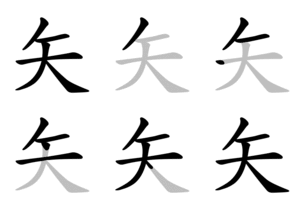 | |||
Han character
矢 (Kangxi radical 111, 矢+0, 5 strokes, cangjie input 人大 (OK), four-corner 80430, composition ⿱𠂉大 or ⿰㇒天)
- Kangxi radical #111, ⽮.
Derived characters
References
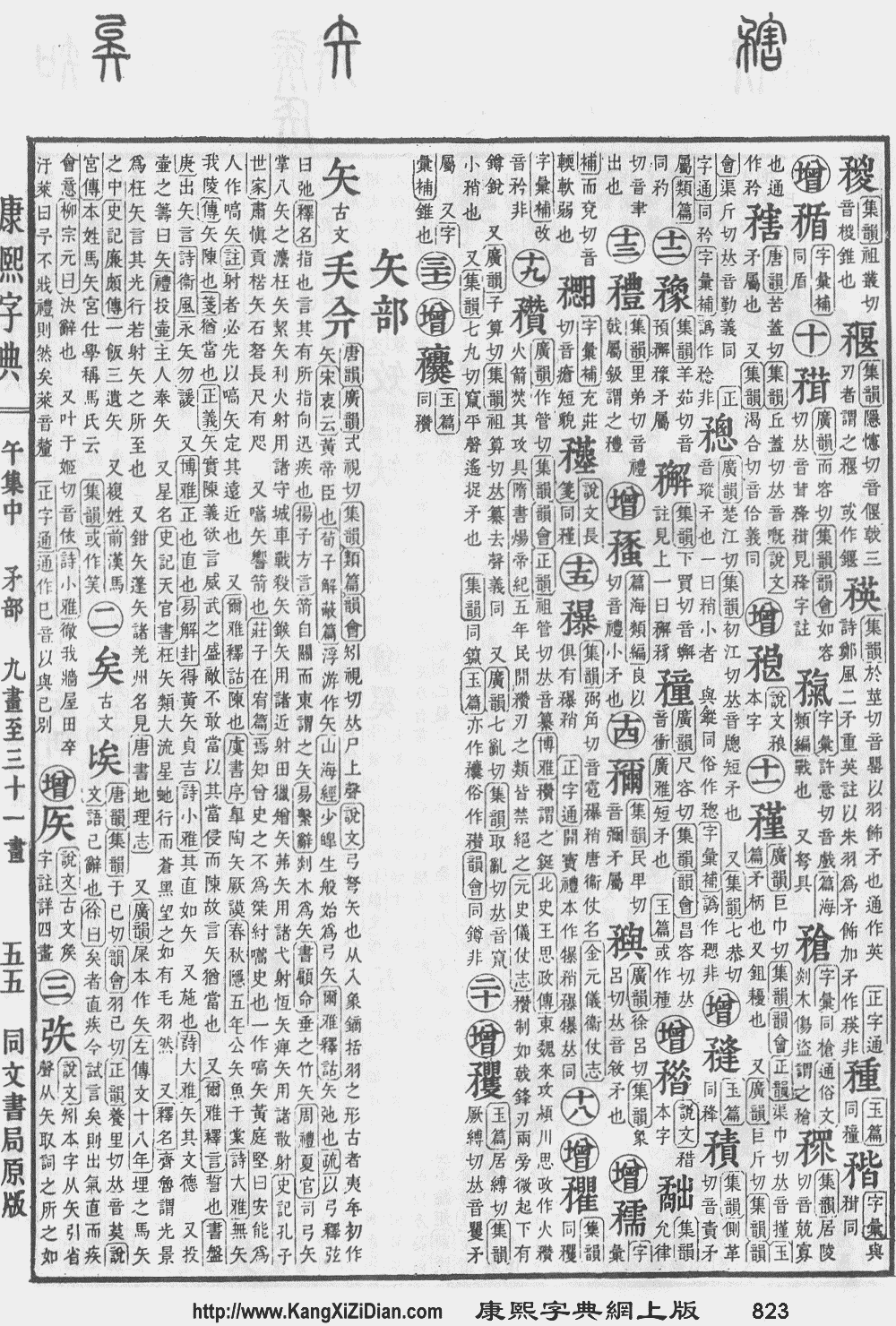
- Kangxi Dictionary: page 823, character 34
- Dai Kanwa Jiten: character 23929
- Dae Jaweon: page 1235, character 22
- Hanyu Da Zidian (first edition): volume 4, page 2580, character 1
- Unihan data for U+77E2
Chinese
| simp. and trad. |
矢 | |
|---|---|---|
Glyph origin
| Historical forms of the character 矢 | |||
|---|---|---|---|
| Shang | Western Zhou | Shuowen Jiezi (compiled in Han) | Liushutong (compiled in Ming) |
| Oracle bone script | Bronze inscriptions | Small seal script | Transcribed ancient scripts |
 |
 |
 |
 |
Pictogram (象形) – an arrow. More recognizable in older forms.
Etymology 1
- arrow
- From Proto-Sino-Tibetan *d/s-ləj (“bow (weapon); slingshot”); cognate with Burmese လေး (le:, “bow; crossbow”), Mizo li (“spring (as of gun, watch, etc.)”), Japhug tɯdi (“bow”), zdi (“arrow”), Tangut 𘎗 (*lhjɨ̣¹, “bow”), 𗮆 (*ljị¹, “arrow”) (STEDT; Schuessler, 2007; Hill, 2013; Jacques, 2014; Zhang, Jacques and Lai, 2019).
- to swear, to vow
- (This etymology is missing or incomplete. Please add to it, or discuss it at the Etymology scriptorium. Particularly: “From sense "arrow"?”)
Pronunciation
Definitions
矢
- (Classical, archery, weaponry) arrow
- 周道如砥,其直如矢。 [Pre-Classical Chinese, trad. and simp.]
- From: The Classic of Poetry, c. 11th – 7th centuries BCE, translated based on James Legge's version
- Zhōu dào rú dǐ, qí zhí rú shǐ. [Pinyin]
- The way to Zhou was like a whetstone,
And straight as an arrow.
- to vow; to swear
- 夫子矢之曰:「予所否者,天厭之,天厭之!」 [Classical Chinese, trad.]
- From: The Analects of Confucius, c. 475 – 221 BCE
- Fūzǐ shǐ zhī yuē: “Yú suǒ pǐ zhě, tiān yǎn zhī, tiān yǎn zhī!” [Pinyin]
- [T]he Master swore, saying, "Wherein I have done improperly, may Heaven reject me! may Heaven reject me!"
夫子矢之曰:「予所否者,天厌之,天厌之!」 [Classical Chinese, simp.]
Synonyms
- (arrow):
Pronunciation
Definitions
矢
- Alternative form of 屎 (“excrement; poop”)
- 夫愛馬者,以筐盛矢,以蜄盛溺。 [Classical Chinese, trad.]
- From: Zhuangzi, circa 3rd – 2nd centuries BCE, translated based on James Legge's version
- Fú ài mǎ zhě, yǐ kuāng chéng shǐ, yǐ shèn chéng nì. [Pinyin]
- Those again who are fond of horses preserve their dung in baskets, and their urine in jars (made from large clamshell).
夫爱马者,以筐盛矢,以蜄盛溺。 [Classical Chinese, simp.]- 廉將軍雖老,尚善飯;然與臣坐,頃之三遺矢矣。 [Classical Chinese, trad.]
- From: The Records of the Grand Historian, by Sima Qian, c. 91 BCE
- Lián jiāngjūn suī lǎo, shàng shàn fàn; rán yǔ chén zuò, qǐngzhī sān yíshǐ yǐ. [Pinyin]
- General Lian, despite advanced age, has very good appetite. However, when conferring with me he had to excuse himself for toilet three times in a short while.
廉将军虽老,尚善饭;然与臣坐,顷之三遗矢矣。 [Classical Chinese, simp.]
Compounds
- 一矢之地
- 兵盡矢窮/兵尽矢穷
- 嚆矢 (hāoshǐ)
- 弓折矢盡/弓折矢尽
- 弓矢 (gōngshǐ)
- 張弓挾矢/张弓挟矢
- 拉矢
- 攢矢/攒矢
- 有的放矢 (yǒudìfàngshǐ)
- 桃弧棘矢
- 桑弧蓬矢
- 栝矢亞/栝矢亚
- 楛矢
- 永矢弗諼/永矢弗谖
- 流矢
- 無的放矢/无的放矢 (wúdìfàngshǐ)
- 狗矢
- 發矢/发矢
- 眾矢之的/众矢之的 (zhòngshǐzhīdì)
- 矢下如雨
- 矢不虛發/矢不虚发
- 矢人 (shǐrén)
- 矢勤矢勇
- 矢口 (shǐkǒu)
- 矢口否認/矢口否认 (shǐkǒufǒurèn)
- 矢在弦上
- 矢志 (shǐzhì)
- 矢棋
- 矢無虛發/矢无虚发
- 矢盡兵窮/矢尽兵穷
- 矢石 (shǐshí)
- 矢石之間/矢石之间
- 矢石之難/矢石之难
- 矢石如雨 (shǐshí rúyǔ)
- 矢言 (shǐyán)
- 矢車菊/矢车菊 (shǐchējú)
- 矢量 (shǐliàng)
- 身當矢石/身当矢石
- 躬蹈矢石
- 鍛矢/锻矢
- 集矢
- 飛矢/飞矢
References
- “矢”, in 漢語多功能字庫 (Multi-function Chinese Character Database), 香港中文大學 (the Chinese University of Hong Kong), 2014–
Japanese
Readings
Usage notes
Used in the Nihon Shoki (720 CE) as 借音 (shakuon) kana for ⟨si⟩.
Etymology 1
From Old Japanese. Found in the Kojiki of 712 CE, and in the Man'yōshū completed some time after 759 CE.[1]

Noun
矢 • (ya)
- (archery, weaponry) an arrow
- 光陰矢の如し。
- Kōin ya no gotoshi.
- Shine and shadow, just like an arrow. → Time flies like an arrow.
- , text here
- 大夫之弓上振起射都流矢乎後将見人者語継金 [Man'yōgana]
- ますらをの弓末振り起し射つる矢を後見む人は語り継ぐがね [Modern spelling]
- masurao no yuzue furiokoshi itsuru ya o nochi mimu hito wa kataritsugu gane
- (please add an English translation of this example)
- 光陰矢の如し。
- a wedge used to break hard objects such as wood or stone
- a 家紋 (kamon, “family crest”) with various designs of arrows
Derived terms
Etymology 2
| Kanji in this term |
|---|
| 矢 |
| さ Grade: 2 |
| kun’yomi |
From Old Japanese. Found in the Man'yōshū, completed some time after 759 CE.[3]
Possibly cognate with Old Japanese-derived 幸 (sachi, “a hunting implement”) and Korean 살 (sal, “arrow”).
This reading does not appear to be used in modern Japanese.
Pronunciation
- IPA(key): [sa̠]
Noun
矢 • (sa)
- (obsolete) an arrow
- , text here
- 阿良之乎乃伊乎佐太波佐美牟可比多知可奈流麻之都美伊埿弖登阿我久流 [Man'yōgana]
- 荒し男のいをさ手挟み向ひ立ちかなるましづみ出でてと我が来る [Modern spelling]
- arasi-wo no iwo-sa tapasami mukapi-tati kanaruma sidumi idete to a ga kuru
- (please add an English translation of this example)
- , text here
Khitan
Noun
矢 (transliteration needed) (khi)
- This term needs a translation to English. Please help out and add a translation, then remove the text
{{rfdef}}.
Related terms
- 矢关 (“khitai”)
Korean
Etymology
(This etymology is missing or incomplete. Please add to it, or discuss it at the Etymology scriptorium. Particularly: “Middle Korean readings, if any”)
Pronunciation
- (SK Standard/Seoul) IPA(key): [ɕʰi]
- Phonetic hangul: [시]
Vietnamese
Noun
矢
References
- Nom Foundation
- Thiều Chửu : Hán Việt Tự Điển Hà Nội 1942
- Trần Văn Chánh: Từ Điển Hán Việt NXB Trẻ, Ho Chi Minh Ville, 1999
- Vũ Văn Kính: Đại Tự Điển Chữ Nôm, NXB Văn Nghệ, Ho Chi Minh Ville, 1999