掉
| ||||||||
Translingual
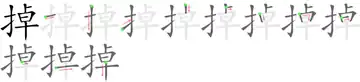
| Stroke order | |||
|---|---|---|---|
 | |||
Han character
掉 (Kangxi radical 64, 手+8, 11 strokes, cangjie input 手卜日十 (QYAJ), four-corner 51046, composition ⿰扌卓)
Derived characters
- 𦄹, 𧐼, 𬕩
References
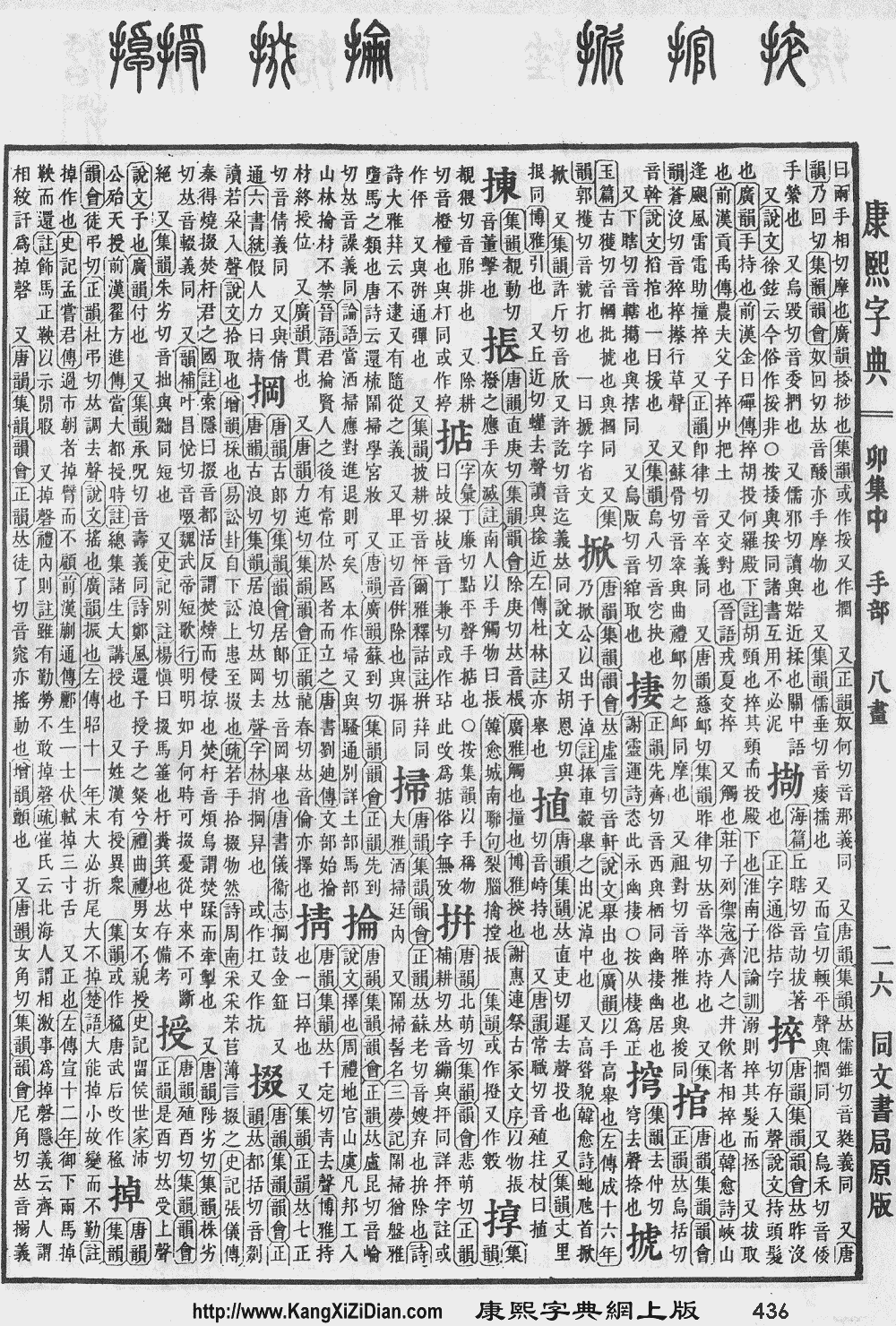
- Kangxi Dictionary: page 436, character 20
- Dai Kanwa Jiten: character 12243
- Dae Jaweon: page 786, character 7
- Hanyu Da Zidian (first edition): volume 3, page 1896, character 1
- Unihan data for U+6389
Chinese
| simp. and trad. |
掉 | |
|---|---|---|
| alternative forms | 𢴿 | |
Glyph origin
Characters in the same phonetic series (卓) (Zhengzhang, 2003)
Phono-semantic compound (形聲/形声, OC *deːwʔ, *deːwɢs, *rneːwɢ) : semantic 扌 (“hand”) + phonetic 卓 (OC *rteːwɢ).
Pronunciation
Definitions
掉
- to drop; to fall
- to lose; to part
- to shake; to wag; to swing
- 尾大不掉 ― wěidàbùdiào ― "too fat a tail to wag"; to be hampered by one's own powerful subordinates
- to turn; to move
- (dialectal, intransitive) to be missing; to be lost
- (Cantonese, Teochew) to throw; to toss
- (Cantonese, Teochew) to toss out; to dispose of; to discard
- Used along with a verb to indicate completion, usually together with 了 (le); or to indicate imperative mood.
- (Mainland China Hokkien) to shake; to shiver
Synonyms
Dialectal synonyms of 扔 (“to throw”) [map]
| Variety | Location | Words |
|---|---|---|
| Classical Chinese | 投 | |
| Formal (Written Standard Chinese) | 扔, 丟, 拋, 擲1, 摔 | |
| Mandarin | Beijing | 扔, 溜, 拽, 砍 |
| Taiwan | 扔, 丟 | |
| Jinan | 扔, 拽 | |
| Xi'an | 撂, 丟 | |
| Wuhan | 丟, 掟 | |
| Chengdu | 甩, 丟, 掟 | |
| Guilin | 丟 | |
| Yangzhou | 摔 | |
| Hefei | 甩 | |
| Malaysia | 丟 | |
| Singapore | 丟 | |
| Cantonese | Guangzhou | 掟, 抌, 掉 |
| Hong Kong | 掟, 抌, 掉 | |
| Gan | Nanchang | 拋, 釘 |
| Hakka | Meixian | 㧒, 撜, 擲4 |
| Miaoli (N. Sixian) | 擲4 | |
| Pingtung (Neipu; S. Sixian) | 擳 | |
| Hsinchu County (Zhudong; Hailu) | 擲4 | |
| Taichung (Dongshi; Dabu) | 擲4 | |
| Hsinchu County (Qionglin; Raoping) | 擲4 | |
| Yunlin (Lunbei; Zhao'an) | 擊 | |
| Jin | Taiyuan | 砍, 給, 蠻 |
| Northern Min | Jian'ou | 射 |
| Eastern Min | Fuzhou | 挌, 抾, 轆, 獻 |
| Southern Min | Xiamen | 挕, 揕, 擲2, 練, 捔, 㧒 |
| Quanzhou | 挕, 揕, 擲2, 㧒 | |
| Jinjiang | 挕, 揕, 擲2 | |
| Zhangzhou | 挕, 揕, 捔, 㧒 | |
| Tainan | 挕, 揕, 掔 | |
| Penang (Hokkien) | 揕 | |
| Singapore (Hokkien) | 挕, 揕, 擲2, 捔 | |
| Manila (Hokkien) | 挕, 揕, 擲2 | |
| Chaozhou | 捔, 撾, 挒, 標 | |
| Jieyang | 捔, 撾, 挒, 標, 打, 擲3 | |
| Wu | Shanghai | 摜, 厾 |
| Suzhou | 厾, 真 | |
| Wenzhou | 𪜃, 甩, 拌 | |
| Xiang | Changsha | 射, 釘 |
| Shuangfeng | 亞, 打 | |
Dialectal synonyms of 扔 (“to discard; to throw away”) [map]
| Variety | Location | Words |
|---|---|---|
| Formal (Written Standard Chinese) | 扔, 丟棄 | |
| Mandarin | Beijing | 扔, 撇 |
| Taiwan | 扔, 丟 | |
| Jinan | 拽, 扔 | |
| Xi'an | 撇 | |
| Wuhan | 丟, 甩 | |
| Chengdu | 甩, 丟 | |
| Yangzhou | 撂 | |
| Hefei | 撂, 甩, 板 | |
| Singapore | 丟 | |
| Cantonese | Guangzhou | 擗, 掉, 𢫕, 抌 |
| Hong Kong | 擗, 掉, 抌 | |
| Yangjiang | 擗 | |
| Gan | Nanchang | 丟, 釘 |
| Hakka | Meixian | 丟, 㧒 |
| Jin | Taiyuan | 砍, 撂, 蠻 |
| Northern Min | Jian'ou | 丟 |
| Eastern Min | Fuzhou | 溜, 轆, 獻, 抾, 挌 |
| Southern Min | Xiamen | 挕, 摑, 㧒 |
| Quanzhou | 挕, 摑, 㧒 | |
| Zhangzhou | 挕, 㧒 | |
| Chaozhou | 捔, 撼, 擿 | |
| Shantou | 捔, 擿 | |
| Jieyang | 捔, 撼, 擿 | |
| Wu | Shanghai | 摜, 厾 |
| Suzhou | 厾, 摜, 甩 | |
| Wenzhou | 𪜃, 甩, 拌 | |
| Xiang | Changsha | 撂, 丟 |
| Shuangfeng | 亞 | |
Compounds
- 丟不掉/丢不掉
- 丟掉/丢掉 (diūdiào)
- 做掉 (zuòdiào)
- 劃掉/划掉
- 單掉兒/单掉儿
- 失掉 (shīdiào)
- 尾大不掉 (wěidàbùdiào)
- 尾大難掉/尾大难掉
- 幹掉/干掉 (gàndiào)
- 廢掉/废掉
- 忘掉 (wàngdiào)
- 戒掉
- 扔掉 (rēngdiào)
- 扣掉
- 拋掉/抛掉
- 拔掉
- 拆掉
- 掉下 (diàoxià)
- 掉三寸舌
- 掉以輕心/掉以轻心 (diàoyǐqīngxīn)
- 掉價兒/掉价儿
- 掉刀
- 掉包
- 掉嘴口
- 掉嘴弄舌
- 掉回頭/掉回头
- 掉弄
- 掉換/掉换 (diàohuàn)
- 掉文
- 掉書袋/掉书袋 (diàoshūdài)
- 掉皮
- 掉眼
- 掉胎
- 掉背臉/掉背脸
- 掉膘
- 掉臂
- 掉臂不顧/掉臂不顾
- 掉舌
- 掉舌鼓脣/掉舌鼓唇
- 掉色
- 掉落 (diàoluò)
- 掉貨/掉货
- 掉轉/掉转 (diàozhuǎn)
- 掉轉頭/掉转头
- 掉過來/掉过来
- 掉過兒/掉过儿
- 掉過頭/掉过头
- 掉鎗花/掉枪花
- 掉開/掉开
- 掉隊/掉队 (diàoduì)
- 掉鞅
- 掉頭/掉头 (diàotóu)
- 掉頭不顧/掉头不顾
- 掉頭而去/掉头而去
- 掉頭鼠竄/掉头鼠窜
- 掉魂
- 改掉 (gǎidiào)
- 末大不掉
- 死掉 (sǐdiào)
- 毀掉/毁掉 (huǐdiào)
- 溜掉
- 漏掉 (lòudiào)
- 甩掉 (shuǎidiào)
- 當掉/当掉
- 破掉
- 笑掉大牙 (xiàodiàodàyá)
- 老掉牙 (lǎodiàoyá)
- 脫掉/脱掉 (tuōdiào)
- 花掉
- 跑不掉
- 蹦掉
- 躲不掉
- 連根拔掉/连根拔掉
- 關掉/关掉 (guāndiào)
- 除掉 (chúdiào)
Synonyms
- (to throw):
Dialectal synonyms of 扔 (“to throw”) [map]
| Variety | Location | Words |
|---|---|---|
| Classical Chinese | 投 | |
| Formal (Written Standard Chinese) | 扔, 丟, 拋, 擲1, 摔 | |
| Mandarin | Beijing | 扔, 溜, 拽, 砍 |
| Taiwan | 扔, 丟 | |
| Jinan | 扔, 拽 | |
| Xi'an | 撂, 丟 | |
| Wuhan | 丟, 掟 | |
| Chengdu | 甩, 丟, 掟 | |
| Guilin | 丟 | |
| Yangzhou | 摔 | |
| Hefei | 甩 | |
| Malaysia | 丟 | |
| Singapore | 丟 | |
| Cantonese | Guangzhou | 掟, 抌, 掉 |
| Hong Kong | 掟, 抌, 掉 | |
| Gan | Nanchang | 拋, 釘 |
| Hakka | Meixian | 㧒, 撜, 擲4 |
| Miaoli (N. Sixian) | 擲4 | |
| Pingtung (Neipu; S. Sixian) | 擳 | |
| Hsinchu County (Zhudong; Hailu) | 擲4 | |
| Taichung (Dongshi; Dabu) | 擲4 | |
| Hsinchu County (Qionglin; Raoping) | 擲4 | |
| Yunlin (Lunbei; Zhao'an) | 擊 | |
| Jin | Taiyuan | 砍, 給, 蠻 |
| Northern Min | Jian'ou | 射 |
| Eastern Min | Fuzhou | 挌, 抾, 轆, 獻 |
| Southern Min | Xiamen | 挕, 揕, 擲2, 練, 捔, 㧒 |
| Quanzhou | 挕, 揕, 擲2, 㧒 | |
| Jinjiang | 挕, 揕, 擲2 | |
| Zhangzhou | 挕, 揕, 捔, 㧒 | |
| Tainan | 挕, 揕, 掔 | |
| Penang (Hokkien) | 揕 | |
| Singapore (Hokkien) | 挕, 揕, 擲2, 捔 | |
| Manila (Hokkien) | 挕, 揕, 擲2 | |
| Chaozhou | 捔, 撾, 挒, 標 | |
| Jieyang | 捔, 撾, 挒, 標, 打, 擲3 | |
| Wu | Shanghai | 摜, 厾 |
| Suzhou | 厾, 真 | |
| Wenzhou | 𪜃, 甩, 拌 | |
| Xiang | Changsha | 射, 釘 |
| Shuangfeng | 亞, 打 | |
- (to lose): 甩 (shuǎi)
- (to shake):
- 交懍恂/交懔恂 (Hokkien)
- 呞呞顫/呞呞颤 (Xiamen Hokkien, Zhangzhou Hokkien, Taiwanese Hokkien)
- 哆嗦 (duōsuo)
- 圪觫 (geh5 sueh4) (Jin)
- 慄慄掣/栗栗掣 (Hokkien)
- 戰/战 (zhàn)
- 戰慄/战栗 (zhànlì) (literary)
- 戰抖/战抖 (zhàndǒu)
- 打抖 (da3 deu3) (Gan)
- 抖 (dǒu)
- 抖動/抖动 (dǒudòng)
- 抖抖絲/抖抖丝 (Longyan Min)
- 掣 (Hokkien, Teochew)
- 搦搦掣 (Hokkien)
- 發抖/发抖 (fādǒu)
- 蟯蟯掣/蛲蛲掣 (Hokkien)
- 起掉 (Xiamen Hokkien, Zhangzhou Hokkien)
- 顫/颤
- 顫動/颤动 (chàndòng)
- 顫抖/颤抖 (chàndǒu)
References
- “掉”, in 漢語多功能字庫 (Multi-function Chinese Character Database), 香港中文大學 (the Chinese University of Hong Kong), 2014–
Japanese
Kanji
掉
- This term needs a translation to English. Please help out and add a translation, then remove the text
{{rfdef}}.
Readings
- Go-on: じょう (jō)←でう (deu, historical)
- Kan-on: ちょう (chō)←てう (teu, historical)
- Kan’yō-on: とう (tō)←たう (tau, historical)
- Kun: ふるう (furuu, 掉う)←ふるふ (furufu, 掉ふ, historical)
Korean
Hanja
掉 (eum 도 (do))
- This term needs a translation to English. Please help out and add a translation, then remove the text
{{rfdef}}.
Vietnamese
This article is issued from Wiktionary. The text is licensed under Creative Commons - Attribution - Sharealike. Additional terms may apply for the media files.