方
| ||||||||
| ||||||||
Translingual
| Traditional | 方 |
|---|---|
| Simplified | 方 |
| Japanese | 方 |
| Korean | 方 |
| Stroke order | |||
|---|---|---|---|
 | |||
| Stroke order (alternative) | |||
|---|---|---|---|
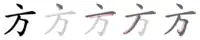 | |||
| Stroke order | |||
|---|---|---|---|
 | |||
| Stroke order (alternative) | |||
|---|---|---|---|
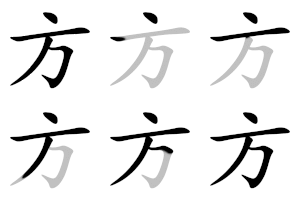 | |||
Han character
方 (Kangxi radical 70, 方+0, 4 strokes, cangjie input 卜竹尸 (YHS), four-corner 00227, composition ⿱丶万)
- Kangxi radical #70, ⽅.
Derived characters
References
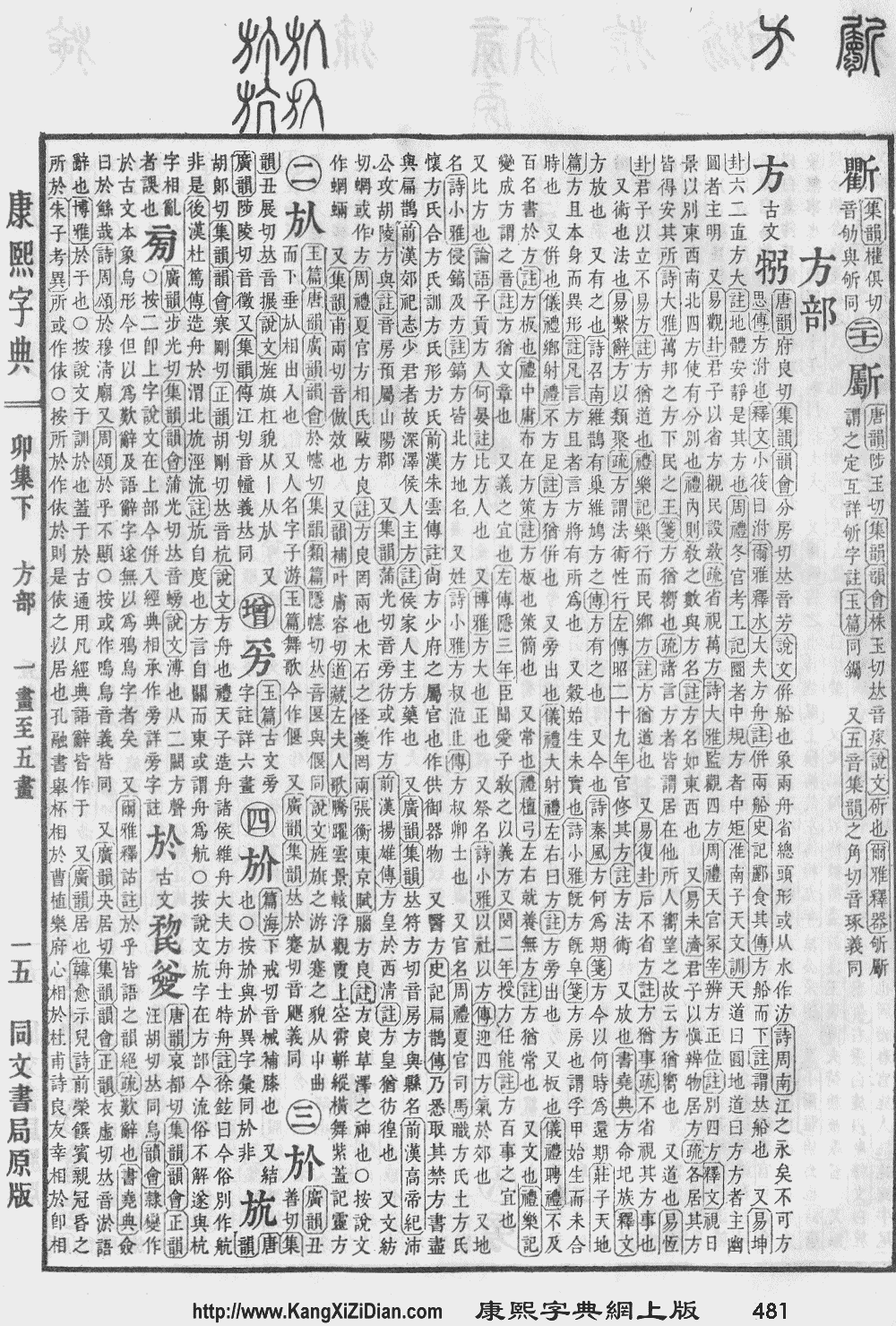
- Kangxi Dictionary: page 481, character 3
- Dai Kanwa Jiten: character 13620
- Dae Jaweon: page 842, character 5
- Hanyu Da Zidian (first edition): volume 3, page 2172, character 1
- Unihan data for U+65B9

Chinese
| simp. and trad. |
方 | |
|---|---|---|
Glyph origin
| Historical forms of the character 方 | ||||
|---|---|---|---|---|
| Shang | Western Zhou | Warring States | Shuowen Jiezi (compiled in Han) | Liushutong (compiled in Ming) |
| Oracle bone script | Bronze inscriptions | Chu slip and silk script | Small seal script | Transcribed ancient scripts |
 |
 |
 |
 |
 |
| Old Chinese | |
|---|---|
| 縍 | *paːŋ |
| 榜 | *paːŋʔ, *praːŋs, *braːŋ |
| 蒡 | *paːŋʔ, *braːŋ |
| 牓 | *paːŋʔ |
| 螃 | *paːŋʔ, *paːŋs, *baːŋ |
| 搒 | *paːŋs, *braːŋ |
| 舫 | *paːŋs, *paŋs |
| 謗 | *paːŋs |
| 雱 | *pʰaːŋ |
| 磅 | *pʰaːŋ, *pʰraːŋ |
| 霶 | *pʰaːŋ |
| 滂 | *pʰaːŋ |
| 鎊 | *pʰaːŋ |
| 髈 | *pʰaːŋʔ, *baːŋ |
| 彷 | *baːŋ, *pʰaŋʔ |
| 趽 | *baːŋ, *paŋ, *paŋs |
| 房 | *baːŋ, *baŋ |
| 篣 | *baːŋ, *braːŋ |
| 騯 | *baːŋ, *praːŋ, *braːŋ |
| 傍 | *baːŋ, *baːŋs |
| 膀 | *baːŋ |
| 旁 | *baːŋ |
| 徬 | *baːŋs |
| 閍 | *praːŋ |
| 祊 | *praːŋ |
| 嗙 | *praːŋ |
| 方 | *paŋ, *baŋ |
| 汸 | *paŋ |
| 坊 | *paŋ, *baŋ |
| 邡 | *paŋ, *pʰaŋs |
| 枋 | *paŋ |
| 鈁 | *paŋ |
| 蚄 | *paŋ |
| 肪 | *paŋ, *baŋ |
| 鴋 | *paŋ, *baŋ |
| 牥 | *paŋ |
| 昉 | *paŋʔ |
| 瓬 | *paŋʔ |
| 放 | *paŋʔ, *paŋs |
| 倣 | *paŋʔ |
| 芳 | *pʰaŋ |
| 淓 | *pʰaŋ |
| 妨 | *pʰaŋ, *pʰaŋs |
| 紡 | *pʰaŋʔ |
| 仿 | *pʰaŋʔ |
| 髣 | *pʰaŋʔ |
| 鶭 | *pʰaŋʔ |
| 訪 | *pʰaŋs |
| 防 | *baŋ, *baŋs |
| 魴 | *baŋ |
Ideogrammic compound (會意/会意) : 一 + 刀 (“sword”) – blade; tip of a blade. Original form of 芒 (OC *maːŋ, *maŋ, “awn (of cereal); tip (of blade)”); later borrowed to mean “side”. Other theories regarding the origin of this character also exist.
It is unrelated to 㫃 (“fluttering flag”), from which characters like 旗 (OC *ɡɯ, “flag”) and 旅 (OC *ɡ·raʔ, “troops”) are derived.
Etymology 1
- "side; square; region"
- Probably related to 旁 (OC *baːŋ), 傍 (OC *baːŋ, *baːŋs) (Schuessler, 2007).
- "parallel boats"
- Cognate with 舫 (OC *paːŋs, *paŋs, “boat”), 艕 (“boat”). According to STEDT, from Proto-Sino-Tibetan *poŋ (“raft; float”); compare Burmese ဖောင် (hpaung, “raft”), Jingpho hpong (“kac”). According to Schuessler (2007), this etymon is an area word; compare Thai พ่วง (pûuang, “raft; pontoon”), Proto-Austronesian *qabaŋ (“boat”), Old Mon kɓaŋ (“ship; boat”).
- "just now"; "now"
- Cognate with 甫 (OC *paʔ, “just now”). Compare Jingpho hpang (“to begin”), Proto-Kuki-Chin *pran (“to begin”) (STEDT).
- "method; law"
- Etymology not certain. May be the same word as 方 (OC *paŋ, “side; square; region”). Cognate with 仿 (OC *pʰaŋʔ, “to imitate”). Perhaps cognate with Tibetan བྱང་བ (byang ba, “skill; experience”), Tibetan སྦྱངས (sbyangs, “trained; exercised studied”) (Schuessler, 2007). Alternatively, it may belong to Khmer ព្រាង (priəng, “to draft; to sketch”) < Khmer រាង (riəng, “shape; form; figure”). If so, it belongs to an Austroasiatic allofam which includes 狀 (OC *zraŋs, “form; appearance”). "Law; norm; standard" is a common extension of "form; shape".
Pronunciation 1
Definitions
方
- (obsolete) parallel; side by side
- (obsolete) parallel boats; raft made of bamboo
- 江之永矣,不可方思。 [Pre-Classical Chinese, trad. and simp.]
- From: The Classic of Poetry, c. 11th – 7th centuries BCE, translated based on James Legge's version
- Jiāng zhī yǒng yǐ, bùkě fāng sī. [Pinyin]
- The length of the Jiang
Cannot be navigated with a raft.
- (obsolete) to match; to be equal to
- (obsolete) to compare; to set side by side
- (obsolete) to differentiate; to discriminate
- (obsolete) to occupy; to take up
- (mathematics) square; rectangle; cube
- side; aspect; party
- place; region; locality
- orientation; direction
- (obsolete) law; rule; reason
- method; way
- (obsolete) sort; category; kind
- (obsolete) moral principle and knowledge; learning
- (obsolete) earth; solid earth; ground
- (traditional Chinese medicine) prescription
- (mathematics) power
- (mathematics) Short for 平方米 (píngfāngmǐ, “Classifier for square metre.”).
- (mathematics) Short for 立方米 (lìfāngmǐ, “Classifier for cubic metre.”).
- Classifier for square objects.
- (literary, preceding a measurement of length to indicate area) area surrounding (something); surroundings; vicinity
- upright; honest; irreproachable
- just; just when; at the time when; just now; now
- 國家方危,諸侯方貳,將以襲敵人,不亦難乎? [Classical Chinese, trad.]
- From: Commentary of Zuo, c. 4th century BCE
- Guójiā fāng wēi, zhūhóu fāng èr, jiāng yǐ xí dírén, bùyì nán hū? [Pinyin]
- The State is now in a perilous condition, and the other States are now disaffected towards it; shall we not find it a difficult enterprise to invade an enemy in such circumstances?
国家方危,诸侯方贰,将以袭敌人,不亦难乎? [Classical Chinese, simp.]- 趙方西憂秦,南憂楚,其力不能禁我。 [Classical Chinese, trad.]
- From: The Records of the Grand Historian, by Sima Qian, c. 91 BCE
- Zhào fāng xī yōu Qín, nán yōu Chǔ, qí lì bùnéng jìn wǒ. [Pinyin]
- Zhao is now worrying about Qin in the west and Chu in the south; it cannot restrain us with its strength.
赵方西忧秦,南忧楚,其力不能禁我。 [Classical Chinese, simp.]
- just; only
- 書到用時方恨少/书到用时方恨少 ― shū dào yòng shí fāng hèn shào ― to regret not acquiring enough knowledge only when it comes time to apply it
- 對於文化問題,我是門外漢,想研究一下,也方在開始。 [MSC, trad.]
- From: 1940, 毛澤東 (Mao Zedong), 《新民主主義論》 (On New Democracy), 《毛澤東選集》. English translation based on the Foreign Languages Press edition
- Duìyú wénhuà wèntí, wǒ shì ménwàihàn, xiǎng yánjiū yīxià, yě fāng zài kāishǐ. [Pinyin]
- I am a layman in matters of culture; I would like to study them, but have only just begun to do so.
对于文化问题,我是门外汉,想研究一下,也方在开始。 [MSC, simp.]
- Synonym: 才 (cái)
- at (a specific time); when
- 為人子,方少時,親師友,習禮儀。 [Literary Chinese, trad.]
- From: Three Character Classic, circa 13th century CE
- Wéi rénzǐ, fāng shàoshí, qīn shīyǒu, xí lǐyí. [Pinyin]
- He who is the son of a man, when he is young, should attach himself to his teachers and friends, and practise ceremonial usages.
为人子,方少时,亲师友,习礼仪。 [Literary Chinese, simp.]
- will; going to
- 今治水軍八十萬眾,方與將軍會獵於吳。 [Literary Chinese, trad.]
- From: Pei Songzhi, Annotations to Records of the Three Kingdoms, circa 5th century CE
- Jīn zhì shuǐjūn bāshí wàn zhòng, fāng yǔ jiāngjūn huìliè yú Wú. [Pinyin]
- (please add an English translation of this usage example)
今治水军八十万众,方与将军会猎于吴。 [Literary Chinese, simp.]
- (lexicography) Short for 方言 (fāngyán, “dialect”).
- a surname
- 方孝孺 ― Fāng Xiàorú ― Fang Xiaoru (Confucian scholar-bureaucrat of the Ming Dynasty)
Compounds
- 一方 (yīfāng)
- 七方 (Qīfāng)
- 下方 (xiàfāng)
- 上方 (shàngfāng)
- 三方通話/三方通话
- 不劣方頭/不劣方头
- 不方
- 丹方 (dānfāng)
- 乘方 (chéngfāng)
- 九方
- 九方皋
- 五方 (wǔfāng)
- 以古方今
- 仙方 (xiānfāng)
- 他方 (tāfāng)
- 付方
- 何方 (héfāng)
- 來日方長/来日方长 (láirìfāngcháng)
- 侯方域
- 借方 (jièfāng)
- 偶方
- 偏方 (piānfāng)
- 儀態萬方/仪态万方
- 僻處一方/僻处一方
- 兜喜神方
- 八方 (bāfāng)
- 公方 (gōngfāng)
- 刓方為圓/刓方为圆
- 前方 (qiánfāng)
- 削方為圓/削方为圆
- 勞方/劳方 (láofāng)
- 北方 (běifāng)
- 十方 (shífāng)
- 千方百計/千方百计 (qiānfāngbǎijì)
- 千方萬計/千方万计
- 千金要方
- 半官方 (bànguānfāng)
- 南方 (nánfāng)
- 右方
- 古方 (gǔfāng)
- 吃十方
- 各方 (gèfāng)
- 同方
- 各霸一方
- 周方
- 單方/单方 (dānfāng)
- 四方 (sìfāng)
- 四面八方 (sìmiànbāfāng)
- 圓鑿方枘/圆凿方枘
- 圓頭方足/圆头方足
- 圓顱方趾/圆颅方趾
- 圓首方足/圆首方足
- 圜鑿方枘/圜凿方枘
- 土方 (tǔfāng)
- 地方 (dìfang)
- 坍方
- 填方
- 塌方 (tāfāng)
- 外圓內方/外圆内方
- 外方 (wàifāng)
- 多方 (duōfāng)
- 大方 (dàfāng)
- 天各一方 (tiāngèyīfāng)
- 天方 (Tiānfāng)
- 如夢方醒/如梦方醒 (rúmèngfāngxǐng)
- 如日方中 (rúrìfāngzhōng)
- 如日方升 (rúrìfāngshēng)
- 如醉方醒
- 妙方 (miàofāng)
- 孔方 (kǒngfāng)
- 孔方兄 (kǒngfāngxiōng)
- 定之方中
- 官方 (guānfāng)
- 寶方/宝方
- 對方/对方 (duìfāng)
- 尚方
- 局方
- 左方
- 己方 (jǐfāng)
- 平方 (píngfāng)
- 後方/后方 (hòufāng)
- 想方設法/想方设法 (xiǎngfāngshèfǎ)
- 成方兒/成方儿
- 戒方 (jièfāng)
- 我方 (wǒfāng)
- 戴圓履方/戴圆履方
- 挖方
- 措置乖方
- 據義履方/据义履方
- 收方
- 敵方/敌方 (dífāng)
- 斗方
- 斲方為圓/斲方为圆
- 方丈 (fāngzhàng)
- 方且
- 方人
- 方今 (fāngjīn)
- 方位 (fāngwèi)
- 方伯
- 方何礙/方何碍
- 方便 (fāngbiàn)
- 方俗
- 方信道
- 方兒/方儿
- 方內/方内
- 方冊/方册 (fāngcè)
- 方几
- 方劑/方剂 (fāngjì)
- 方勝/方胜
- 方向 (fāngxiàng)
- 方名
- 方命
- 方單/方单
- 方國/方国 (fāngguó)
- 方圓/方圆 (fāngyuán)
- 方土
- 方城
- 方堙
- 方塊/方块 (fāngkuài)
- 方士 (fāngshì)
- 方壺/方壶
- 方夏
- 方外
- 方天戟 (fāngtiānjǐ)
- 方天畫戟/方天画戟 (fāngtiān huàjǐ)
- 方子 (fāngzi)
- 方字
- 方孝孺
- 方家 (fāngjiā)
- 方寸 (fāngcùn)
- 方將/方将 (fāngjiāng)
- 方山
- 方岳
- 方嶽/方岳
- 方州
- 方巾 (fāngjīn)
- 方幅
- 方底圓蓋/方底圆盖
- 方式 (fāngshì)
- 方弼
- 方彝
- 方形 (fāngxíng)
- 方心
- 方志 (fāngzhì)
- 方情
- 方才 (fāngcái)
- 方技 (fāngjì)
- 方技略
- 方斯蔑如
- 方明
- 方書/方书
- 方會/方会
- 方枘圜鑿/方枘圜凿
- 方根 (fānggēn)
- 方格
- 方框
- 方桌 (fāngzhuō)
- 方案 (fāng'àn)
- 方框圖/方框图
- 方格紙/方格纸
- 方桃譬李
- 方棋 (fāngqí)
- 方正 (fāngzhèng)
- 方步 (fāngbù)
- 方比
- 方法 (fāngfǎ)
- 方濟谷派/方济谷派
- 方灘/方滩 (Fāngtān)
- 方照
- 方牧
- 方物
- 方略 (fānglüè)
- 方相
- 方知
- 方磚/方砖
- 方礙/方碍
- 方程 (fāngchéng)
- 方策 (fāngcè)
- 方筆/方笔
- 方糖 (fāngtáng)
- 方纔/方才 (fāngcái)
- 方罫
- 方聞/方闻
- 方興日盛/方兴日盛
- 方興未艾/方兴未艾 (fāngxīngwèi'ài)
- 方舞
- 方舟 (fāngzhōu)
- 方苞
- 方蓬
- 方藥/方药 (fāngyào)
- 方行
- 方術/方术 (fāngshù)
- 方解石 (fāngjiěshí)
- 方言 (fāngyán)
- 方趾圓顱/方趾圆颅
- 方軌/方轨
- 方軒/方轩
- 方輦/方辇
- 方輿/方舆 (fāngyú)
- 方近
- 方連/方连
- 方里
- 方針/方针 (fāngzhēn)
- 方鉛礦/方铅矿
- 方鍼/方针
- 方鎮/方镇 (fāngzhèn)
- 方鑿圓枘/方凿圆枘
- 方關/方关
- 方陣/方阵 (fāngzhèn)
- 方隅
- 方面 (fāngmiàn)
- 方音 (fāngyīn)
- 方響/方响 (fāngxiǎng)
- 方領矩步/方领矩步
- 方頭/方头
- 方頤大口/方颐大口
- 方頭括號/方头括号 (fāngtóu kuòhào)
- 方駕/方驾
- 方高坪 (Fānggāopíng)
- 方鼎
- 春方 (chūnfāng)
- 時方/时方
- 智圓行方/智圆行方
- 有方 (yǒufāng)
- 朔方 (shuòfāng)
- 未艾方興/未艾方兴
- 東北方/东北方
- 東南方/东南方
- 枘圓鑿方/枘圆凿方
- 東方/东方 (dōngfāng)
- 校方 (xiàofāng)
- 檢方/检方
- 欺以其方
- 正方 (zhèngfāng)
- 殊方
- 毀方投圓/毁方投圆
- 毀方瓦合/毁方瓦合
- 比方 (bǐfang)
- 比方說/比方说 (bǐfangshuō)
- 氣血方剛/气血方刚
- 滓方
- 炎方 (yánfāng)
- 無方/无方
- 照方兒抓/照方儿抓
- 男方 (nánfāng)
- 界方
- 異方/异方
- 畢方/毕方
- 療方/疗方
- 百方 (bǎifāng)
- 百計千方/百计千方
- 盂方水方
- 直內方外/直内方外
- 省方觀俗/省方观俗
- 省方觀民/省方观民
- 知方 (zhīfāng)
- 矩步方行
- 石方 (shífāng)
- 祕方/秘方 (mìfāng)
- 禁方
- 萬方/万方 (wànfāng)
- 秋方
- 立方 (lìfāng)
- 端方
- 絕域殊方/绝域殊方
- 絕域異方/绝域异方
- 經方/经方 (jīngfāng)
- 義方/义方
- 聖惠方/圣惠方
- 職方/职方
- 肘後方/肘后方
- 至死方休
- 良方 (liángfāng)
- 草頭方兒/草头方儿
- 藥方/药方 (yàofāng)
- 處方/处方 (chǔfāng)
- 血氣方剛/血气方刚 (xuèqì fānggāng)
- 血氣方壯/血气方壮
- 血氣方盛/血气方盛
- 行不踰方/行不逾方
- 複方/复方 (fùfāng)
- 西方 (xīfāng)
- 見方/见方
- 規圓矩方/规圆矩方
- 變化無方/变化无方
- 貸方/贷方 (dàifāng)
- 買方/买方 (mǎifāng)
- 貴方/贵方 (guìfāng)
- 貽誚多方/贻诮多方
- 資方/资方 (zīfāng)
- 賣方/卖方 (màifāng)
- 走方
- 遐方
- 遊方/游方 (yóufāng)
- 遠方/远方 (yuǎnfāng)
- 邊方/边方
- 鄉方/乡方
- 配方 (pèifāng)
- 醫方/医方 (yīfāng)
- 鑿圓枘方/凿圆枘方
- 長方/长方 (chángfāng)
- 開方/开方 (kāifāng)
- 陟方
- 隨方就圓/随方就圆
- 雙方/双方 (shuāngfāng)
- 零方案
- 面方口闊/面方口阔
- 面闊口方/面阔口方
- 驗方/验方 (yànfāng)
- 鬼方 (Guǐfāng)
- 魔方 (mófāng)
Descendants
Others:
Pronunciation 2
Definitions
方
Etymology 2
Rendering of a dialectal pronunciation of 慌 (huāng).
Pronunciation
Definitions
方 (Mainland China, neologism, slang)
- The template Template:zh-pronunciation spelling of does not use the parameter(s):
gloss=to [[panic]]
Please see Module:checkparams for help with this warning.Pronunciation spelling of 慌 (huāng). - The template Template:zh-pronunciation spelling of does not use the parameter(s):
gloss=[[panicky]]
Please see Module:checkparams for help with this warning.Pronunciation spelling of 慌 (huāng).- 好方! ― Hǎo fāng! ― So panicky!
Etymology 3
| For pronunciation and definitions of 方 – see 仿 (“to imitate; to resemble; to be similar; etc.”). (This character is a variant form of 仿). |
Pronunciation
Pronunciation
Pronunciation
References
- “方”, in 漢語多功能字庫 (Multi-function Chinese Character Database), 香港中文大學 (the Chinese University of Hong Kong), 2014–
Japanese
Readings
Compounds
Etymology 2
| Kanji in this term |
|---|
| 方 |
| かた Grade: 2 |
| kun’yomi |
Noun
方 • (kata)
Suffix
方 • (-kata)
Etymology 3
pe > ɸe > we > e.
Etymology 4
| Kanji in this term |
|---|
| 方 |
| さま Grade: 2 |
| irregular |
From Old Japanese. Originally a compound of さ (sa, “that”, pronominal indicating a person, place, thing, or direction in the middle distance) + ま (ma, “likeness, way, similarity”, suffix indicating a quality).[3]
Alternative forms
Noun
方 • (sama)
References
- Matsumura, Akira, editor (2006), 大辞林 [Daijirin] (in Japanese), Third edition, Tōkyō: Sanseidō, →ISBN
- NHK Broadcasting Culture Research Institute, editor (1998), NHK日本語発音アクセント辞典 [NHK Japanese Pronunciation Accent Dictionary] (in Japanese), Tōkyō: NHK Publishing, →ISBN
- Shōgaku Tosho (1988) 国語大辞典(新装版) [Unabridged Dictionary of Japanese (Revised Edition)] (in Japanese), Tōkyō: Shogakukan, →ISBN
Korean
Etymology
(This etymology is missing or incomplete. Please add to it, or discuss it at the Etymology scriptorium. Particularly: “Middle Korean readings, if any”)
Pronunciation
- (SK Standard/Seoul) IPA(key): [pa̠ŋ]
- Phonetic hangul: [방]
Compounds
- 방향 (方向, banghyang)
- 방법 (方法, bangbeop)
- 방식 (方式, bangsik)
- 사방 (四方, sabang)
- 금방 (今方, geumbang)
- 서방 (西方, seobang)
- 전방 (前方, jeonbang)
- 방위 (方位, bang'wi)
- 방면 (方面, bangmyeon)
- 상대방 (相對方, sangdaebang)
- 처방 (處方, cheobang)
- 방침 (方針, bangchim)
- 방안 (方案, bang'an)
- 변방 (邊方, byeonbang)
- 방도 (方道, bangdo)
- 후방 (後方, hubang)
- 방편 (方便, bangpyeon)
- 동방 (東方, dongbang)
- 방책 (方策, bangchaek)
- 근방 (近方, geunbang)
- 북방 (北方, bukbang)
- 동남방 (東南方, dongnambang)
- 사방 (巳方, sabang)
- 지방 (地方, jibang)
- 한방약 (韓方藥, hanbang'yak)
- 방편 (方便, bangpyeon)
- 임시방편 (臨時方便, imsibangpyeon)
- 남방 (南方, nambang)
- 방정식 (方程式, bangjeongsik)
- 간방 (艮方, ganbang)
- 서방극락 (西方極樂, seobanggeungnak)
- 쌍방 (雙方, ssangbang)
Vietnamese
Han character
方: Hán Việt readings: phương (
方: Nôm readings: phương[1][2][3], vuông[1][3][4], phăng[1]
References
- Nguyễn (2014).
- Nguyễn et al. (2009).
- Trần (2004).
- Hồ (1976).